Category: Web Marketing

New ways to create and measure sites so they improve their ability to bring your best customers closer and attact other individuals just like them

  • Is datamining Twitter conversations worth it?

    What started with a piece by David Berkowitz on MediaPost (registration required), on Ten Ways To Decide If Your Business Should Tweet, has turned into an interesting conversation about using Twitter to support a brand, and especially about measuring those efforts. This conversation has been primarily through this lengthy post from earlier today by Marshall Sponder.

    Marshall makes some excellent points (he’s not @WebMetricsGuru for nothing!), including this one: “Social Media isn’t really designed, at this time, to analyze Acquisition or Retention but Web Analytics, is — and I maintain this is one of the strongest arguments to merge the two, in a formal way, rather than in an informal way.”

    Datamining and CRM

    How do you begin merging these data in a “formal” way? Tools are emerging to allow for the mining of conversations, and linking them where possible to a CRM database. Here’s Marshall’s take on this process:

    David Berkowitz talks about Target Audiences, but you’d first have to figure out what your Target Audience is for your Brand or for a particular product or promotion of your Brand – then do CRM datamining using house database lists, or the Social Media CRM outreach to collect names and classify them according to Target Audience Segmentation — best done with data analytics.   Let’s say, that for the purposes of this post, my article on Entrepreneur.com on Learn to Measure Your Web Presence using Unbound Technology or Rapleaf, is the way to go.

    If you’re a mom-and-pop shop, you’d do nothing as elaborate, more just Twitter research, much as I’ve shown above, but if you’re Zappos, or Dell, well … that’s another story — the story I tell in Learn to Measure Your Web Presence and others, like it.

    Of course, a big brand can make a lot of money whereas the mom and pop shop, probably won’t — so a big brand can afford to spend a lot of money on data mining — and it’s well worth doing because of the potential money and value that can come from it.

    Scarcity of Resources

    The biggest constraint in doing this sort of work isn’t technology. It’s time. Even properly guided, the process takes many people-hours, and that is a resource in short supply for most businesses today. I see a major challenge in the linkage between prospects / customers and Twitter profiles. (Ack!, I can hear you yell. Yet another datapoint to capture in our CRM databases: The client’s Twitter handle!)

    But it is becoming clear that this is an area where a business should focus some of its energies — assuming the business passes David Berkowitz’s Ten Ways test.

    Years ago, Don E. Schultz co-wrote Measuring Brand Communication ROI. In this marketing chestnut, he and his co-authors built a surprisingly relevant model for tracking spending and estimated returns for each brand communication (How old is this book? The included Excel file was loaded on a 5.25″ magnetic diskette). A huge category — and ROI black hole — was customer service.

    Twitter is a communication channel more than a marketing tactic, and this channel has more to do with customer satisfaction and brand education than driving sales. It’s another touchpoint and nothing more.

    But like email and other important touchpoints, it should be measured. Conversations like the one taking place today will help determine how this measurement takes place and to what end.
  • OMMA presents the vanguard of online metrics and measurement

    I’ve recently disparaged the Kabuki dance of trade conferences. But even I admit they have their place. In fact, today I find myself especially sorry I won’t be able to make next week’s OMMA Metrics and Measurement Conference in New York’s Yale Club. In one day those attending it will hear from some of the industry’s leaders, and I frankly cannot find a single presentation where I’d find an excuse to duck out. That’s quite a feat.

    One Day Event, Tuesday, Jun 09, 2009
    9:00 AM

    Welcome & Opening Remarks

     MC  
    Jodi McDermott,
    Director, Data Strategy,

    Clearspring Technologies

    9:15 AM

    Keynote- The State of the Union for the Metrics Industry

    We are well past the first 100 days of 2009 and a lot has changed, yet nothing has changed.  New technologies and social media have invaded the online channels that we’ve become accustomed to. Yet the foundatiolid.   Jeffrey Eisenberg, CEO of FutureNow, will walk us through a report card of the online measurement industry and address what’s next and what we need to do better as marketers, practitioners and vendors in order to support the shift of ad dollars from offline to online.
     Keynote  
    Jeffrey Eisenberg,
    Co-founder & CEO,

    FutureNow, Inc.

    9:45 AM

    Audience Measurement

    How is the role of the audience measurement firm evolving? We’ve got panel, direct measurement and hybrid approaches to address today’s industry challenges. Who’s on top? Which approaches should advertisers and markw the approaches differ and the impact differences make on the numbers we are trying to study. We will also touch on the new IAB industry guidelines and what they mean to the standardization of reporting on audience metrics.
     Moderator  
    Joe Laszlo,
    Director of Research,

    Interactive Advertising Bureau

     Panelists  
    Josh Chasin,
    Chief Research Officer,

    comScore

    Adam Gerber,
    Chief Marketing Officer,

    Quantcast

    Yaakov Kimelfeld,
    SVP, Director, Digital Research & Analytics,

    MediaVest

    Mainak Mazumdar,
    SVP, Global Measurement Science, Emerging Media,

    The Nielsen Company

    10:30 AM

    Coffee Break

    10:45 AM

    The Analytics Food Chain

    How do you use audience measurement, campaign analysis tools and web analytics to plan and measure the efficacy of your marketing campaigns? With standards set by various organizations and new technologies providindecisions from. This panel will focus on understanding the differences and synergies of panel and census data from the various parts of the analytics food chain – what to use and when.
     Moderator  
    Jodi McDermott,
    Director, Data Strategy,

    Clearspring Technologies

     Panelists  
    Andy Fisher,
    VP, Analytics,

    Razorfish

    Dennis Mortensen,
    Director of Data Insights,

    Yahoo!

    Judah Phillips,
    Senior Director, Global Site Analytics,

    Monster Worldwide

    Greg Smith,
    Chief Operating Officer,

    Neo@Ogilvy

    Bill Tancer,
    General Manager of Global Research,

    Hitwise

    11:30 AM

    Measuring Video and Virality

    The video market is exploding with numerous vendors, business models and technology. What are the metrics and how do they fit into measuring user engagement and advertising models within video? This panel will exploity, and tying the stream back to site activity and customer conversion.
     Moderator  
    Tania Yuki,
    Director, Product Management,

    comScore

     Panelists  
    Scott Ferber,
    Chairman & Chief Executive Officer,

    TidalTV

    Jayant Kadambi,
    President and Co-Founder,

    YuMe

    Matt Langie,
    Senior Director, Product Marketing,

    Omniture Inc.

    Keith Richman,
    CEO,

    Break Media

    Brian Shin,
    CEO,

    Visible Measures

    12:15 PM

    Luncheon

    1:30 PM

    Keynote: Measuring Madison Avenue

    Campaigns have moved well beyond the impression and click in today’s distributed and fragmented world of online advertising.  Interactive campaigns that include the ability for users to share, respond and mashug dollars. Curt Hecht, President of the VivaKi Nerve Center, will  take attendees through the measurement challenges that are facing agencies as they introduce new methods and new media for reaching their client’s target audience.
     Keynote  
    Curt Hecht,
    President,

    VivaKi Nerve Center

    2:00 PM

    Campaign Attribution

    If the click is dead, how do I know how to attribute success to my campaign? Should it be on the first impression view, the click or the viewthrough? As debate continues in the industry over how to gauge campaign sends are emerging and if there is a solution to the question that has been plaguing the industry for years.
     Moderator  
    Joe Mandese,
    Editor in Chief,

    MediaPost

     Panelists  
    Michael Brunick,
    VP Media Technology,

    Cadreon

    Ari Buchalter,
    Chief Operating Officer,

    MediaMath

    Adam Goldberg,
    Co-Founder and Chief Innovation Officer,

    ClearSaleing

    Katrin Ribant,
    Director of Product Development,

    Artemis, Havas Digital

    Esco Strong,
    Senior Group Manager, Atlas Institute,

    Microsoft

    2:45 PM

    When The Numbers Speak For Themselves

    Do you know when to pull the plug on a campaign that is performing poorly? Or how to take action on the data once you have the results? Taking the metrics and turning them into actions is often a forgotten or weaknd optimization in meeting the goals of your marketing initiatives.
     Moderator  
    Joshua Koran,
    VP, Targeting and Optimization,

    ValueClick

     Panelists  
    Srishti Gupta,
    Senior Partner, Insights & Analytics Director,

    MediaCom Interaction

    Ben Seslija,
    Senior Director, Acquisition and Analytics,

    Clickable

    Mark Wachen,
    Managing Director,

    Autonomy Optimost

    3:30 PM

    Coffee Break

    3:45 PM

    Integrating Online and Offline Data

    Tying the shelf or online purchase to the campaign data that you collect is a great concept, but not easy to implement in reality. This panel will expose you to companies who have e stronger relationship with their customers and control costs.
     Moderator  
    Doug McFarland,
    Co-CEO,

    Dimestore Media

     Panelists  
    Joe Apprendi,
    CEO,

    Collective Media

    Jarvis Bowers,
    VP, Research and Analytics,

    ESPN

    Roman Bukary,
    VP, Marketing & Business Development,

    Truviso Corporation

    Ryan Christensen,
    VP, Media Operations,

    Brand.net

    Jason Harper,
    Group Director, Marketing Intelligence,

    Organic, Inc.

    4:30 PM

    The “Ins and Outs” of Measuring Social Media

    Are your customers on Twitter, Facebook and MySpace? You are naïve if you say “no”. People of all demographics are engaging with each other and brands online like never before. Marketers trying to reach this audien this panel we will cover topics such as application installs, engagement, widgets, blogs, corporate Twittering and more.
     Moderator  
    Nick O’Neill,
    Founder,

    Social Times Inc.

     Panelists  
    Maurice Boissiere,
    Vice President, Client Solutions,

    Clearspring Technologies

    Sarah Hofstetter,
    Vice President, Emerging Media & Client Strategy,

    360i

    Ed McLoughlin,
    Managing Director,

    MindShare

    Jerry Needel,
    Senior Vice President, BuzzMetrics Product Leadership,

    Nielsen Online

    Jason Richman,
    Director, Digital Product Strategy,

    NBC Universal

    Are you attending? If so, please contact me and let me know your thoughts on this first-ever event. But don’t go on too much about how terrific it was. That will just break my heart.

  • It’s time again for Online Community Month

    It’s June 1. That marks the beginning of my second annual Online Community Month. Last year’s handful of June posts discussed how technology has affected our society 10 years after the publication of the chilling book, Bowling Alone.

    Also, I and a few experts on the subject, talked about historical trends and recent measurements in what has been termed social capital.

    Results we a mixed bag, as this last post of the series reveals.

    Over the course of this month, I’ll be focusing more on how technology is helping communities come together from two perspectives:

    • How is micro-blogging connecting unlikely groups of individuals for the common good?
    • How is technology making remote work more “social,” and doing more to forge the type of friendships and camaraderie we usual associate with physicial workplaces (of the fortunate!)

    More discussions of marketing technology ROI

    Along the way will be a few suprises. Just as important for my regular readers, you can still expect news and trends directly related to digital marketing will also continue to be explored in Jue — all filtered through the wide-ranging experiences and passions of a Midwestern marketing wonk.

    I hope you’ll enjoy it.

  • Estimating the true value of a web visitor

    Marketers are still grappling with finding the real value of digital marketing efforts. At the end of a promotional campaign, marketers find even the most “trackable” of web visits difficult to value. If we didn’t know this already, a survey of chief marketing officers, conducted by Atlanta’s Heidrick & Struggles, clarified the problem.

    Kevin Hillstrom, author of Multichannel Forensics, suggests a reasonable way to approach web campaign valuation. It works well for e-commerce site visits, and even sheds light on valuing other types of visitors.

    Placing value on non-buying visitors

    Start the valuation process with the obvious: Visitors who immediately convert to a sale. But then keep going. Apply common sense numbers to those visitors who do not immediately buy. And why not? Visitors may come back two, three or more times before making a purchase. Like a fish that nibbles before biting, these “lost” visits aren’t so lost after all. They should be fairly depreciated, not totally ignored.

    Here’s what Kevin says about ignoring all but the “one-visit” purchasers:

    We try our hardest to allocate orders to the advertising vehicle that caused the order, seldom considering a series of events.

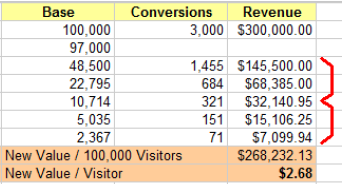
    Take paid search as an example. Assume that a paid search campaign results in a 3% conversion rate and a $100 AOV [Average Order Value]. We run a profit and loss statement on the 0.03 * 100 = $3.00 demand generated by the campaign, factoring in the cost of the campaign.

    What about the 97% of visitors who did not purchase?

    Hillstrom asks, “What if you had this data?”:

    • Of those who are left [i.e., 97% of the base], 50% will visit the website again within one week, with 3% converting, spending $100 each.
    • Of those who are left, 50% will not visit again. Those who are left will visit again within three weeks, with 3% converting, spending $100 each.
    • Of those who are left, 50% will not visit again. Those who are left will visit again within one month, with 3% converting, spending $100 each.
    • Of those who are left, 50% will not visit again. Those who are left will visit again within four months, with 3% converting, spending $100 each.
    • Of those who are left, 50% will not visit again. Those who are left will visit again within six months, with 3% converting, spending $100 each.

    He goes on to explain:

    There is value in each case, value that most of us choose not to measure.
    When I iterate through the five cases above, I calculate an additional $2.75 of future visitor value. [I get $2.68 in my number-crunching, as the number in the lower right of the graphic shows. Here’s my math in a Google Spreadsheet.]

    Value of a Site Visitor Assuming $100 AOVIn other words, we measure the $3.00 generated by short-term conversion. We don’t always measure the $2.75 of future conversions.

    Now there may be additional expenses associated with the $2.75 number — that customer might require additional paid search expense or might use a shopping comparison site, whatever. So we need to run a true profit and loss statement on the additional $2.75 generated by future visits.

    If each first-time visitor (one that doesn’t convert immediately) is worth $0.30 profit over the next twelve months, you think differently about attracting visitors, don’t you?

    I agree. The BrandWeek article I linked to in the first paragraph said that the CMOs surveyed, “Expressed an awareness of digital’s potential, along with a recognition that they weren’t close to tapping it.”

    Building sales models that take into account the messy realities of online behavior is one way we can start.

  • Watching Twitter sell things like pizza and beer

    Most online marketers recognize Twitter’s power to connect people. This virtual network is great for many B2B marketing types. In some ways Twitter — and microblogging in general — is the new Power To Get In. But what about driving consumer business? And here I’m not talking about ephemeral branding. I’m talking about getting people to your business with money in hand.

    Last night I got a few answers.

    Among other marketing innovators, I had the pleasure of meeting Joe Woelfle, owner of Blatz Liquor. He was co-hosting a Tweetup in collaboration with JSOnline.com. He contends microblogging has produced tangible results.

    Last month Journal Sentinel business writer Tannette Elie (@Telie) cited Woelfle as saying that Facebook is responsible for 10% of his sales. This, he explained, was primarily through the soft-sell of publicizing wine- and beer-tasting events.

    One tenth of a “bricks-and-mortar” retailer’s business attributed to Facebook? It seemed a lofty claim, but when I asked Joe earlier today if he would revise that estimate, he said only to throw his newest tactic — Twitter — into that mix.

    The wall-to-wall turnout at the event last night certainly suggested that Twitter was powerful at something. But what? Skeptics would say you could use plenty of other methods to spread the word about a free event at a beer, wine and liquor store — one that included plenty of liberally-poured product samples!

    Time will tell how effective @BlatzLiquor‘s Twitter efforts are at growing real sales and loyalty. But in the meantime, someone else at the Tweetup has a Twitter-fueled business already road-tested by other entrepreneurs.

    Korean BBQ Tacos and Pizza By The Slice

    Scott Baitinger is co-owner of Streetza Pizza (@StreetzaPizza). I was excited about connecting with him for two reasons:

    1. His business just had its official launch this Memorial Day weekend and I was eager to find out how it went
    2. Scott’s business is a glimpse at a promising future for retail — for everyone from food vendors to dry cleaners to banks

    Streetza’s business model uses Twitter to tell hungry customers where its truck will be parked next. It even polls followers on questions such as future locations and product offerings. I wrote about this business model — this promising taste of the Web 3.0 world — last week. It was in a SOHOBizTube article. In that piece, I cited the wildly successful Zogi BBQ, a Los Angeles purveyor of “Korean tacos” that informs its tens of thousands of Twitter followers (@KogiBBQ) where it will be next.

    As odd as it sounds, these customer-centric Tweets are truly a taste of things to come.

    That’s because the next meaningful digital innovations won’t provide consumers with cooler web sites and more content. They will be mobile applications that provide exactly the content we crave, talking to us when we are physically in a place to scratch the itch.

    The future of the web is about place. And like Kogi, Streetza Pizza, in sleepy little Milwaukee, will be leading us there one slice at a time.