Category: Data Visualization

  • Pecha Kucha Milwaukee stages another successful event

    Roughly 200 people attended Tuesday night’s Pecha Kucha Night, at Milwaukee’s Hi Hat Garage. I was one of them, and had the honor of being one of the presenters.

    If you don’t know what a pecha kucha is, you should find out. Here’s a post about the evening (pre-event) on the blog of the Milwaukee organizer, 800-CEO-Read. It includes links to help explain what it is and why you should care.

    This YouTube video of my presentation has just been posted:

    Special thanks to Jon, Kate and everyone at 800ceoread for making this event, and the follow-up videos, such a terrific success.

    You can see others from that night by reviewing this list on YouTube.

    The evening was an absolute blast. I’m definitely going back. If you’re in the Milwaukee area, I hope to see you there.

  • Wish you had a map to the social media landscape? Here you go

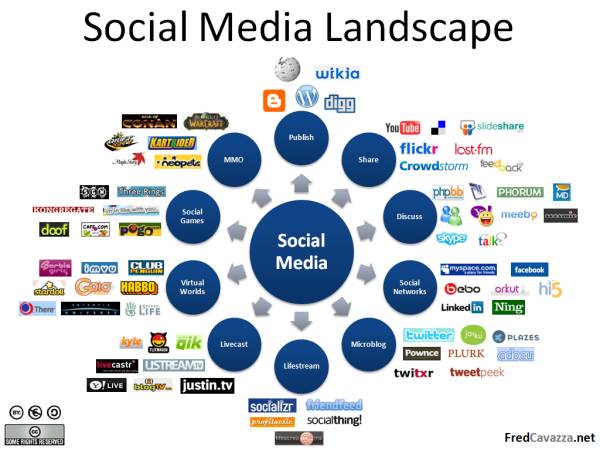
    This post, describing what the social media ecosystem looks like today, offers some excellent insights. Kudos to Fred Cavassa … brought to my attention by way of Jennifer Van Grove‘s “favorited Flickr” images, by way of her FriendFeed. Got that? If you’re unsure, Fred’s map may help:

    Social Media Landscape

    In Fred’s post, he defines these social media categories as follows:

    • Publication tools with blogs ( Typepad, Blogger, etc.), wikis ( Wikipedia, Wikia, Wetpaint, etc.) and citizen journalism portals ( Digg, Newsvine, etc.)
    • Sharing tools for videos ( YouTube, etc.), pictures ( FlickR, etc.), links ( del.icio.us, Ma.gnolia, etc.), music ( Last.fm, iLike, etc.), slideshows ( Slideshare), products reviews ( Crowdstorm, Stylehive, etc.) or products feedbacks ( Feedback 2.0, GetSatisfaction, etc.)
    • Discussions tools like forums ( PHPbb, vBulletin, Phorum, etc.), video forums ( Seesmic), instant messaging ( Yahoo! Messenger, Windows Live Messenger, Meebo, etc.) and VoIP ( Skype, Google Talk, etc.)
    • Social networks ( Facebook, MySpace, Bebo, Hi5, Orkut, etc.), niche social networks ( LinkedIn, Boompa, etc.) and tools for creating social networks ( Ning)
    • Micropublication tools ( Twitter, Pownce, Jaiku, Plurk, Adocu, etc.) and alike ( twitxr, tweetpeek)
      Social aggregation tools like lifestream ( FriendFeed, Socializr, Socialthing!, lifestrea.ms, Profilactic, etc.)
    • Platforms for livecast hosting ( Justin.tv, BlogTV, Yahoo! Live, UStream, etc.) and there mobile equivalent ( Qik, Flixwagon, Kyte, LiveCastr, etc.)
    • Virtual worlds ( Second Life, Entropia Universe, There, etc.), 3D chats ( Habbo, IMVU, etc.) and teens dedicated virtual universes ( Stardoll, Club Penguin, etc.)
    • Social gaming platforms ( ImInLikeWithYou, Doof, etc.), casual gaming portals ( Pogo, Cafe, Kongregate, etc.) and social networks enabeled games ( Three Rings, SGN)
    • MMO ( Neopets, Gaia Online, Kart Rider, Drift City, Maple Story) and MMORPG ( World of Warcraft, Age of Conan, etc.)

    It’s a huge social media world. If you haven’t already, start exploring!


    NOTE: The last days of my summer vacation are near an end. My friends will be able to view photos and accounts on my Facebook profile once I get home!

  • Google and Radiohead: Two great tastes that taste great together

    Google, it appears, has gotten into the music video business. They recently worked with Radiohead to create a video in support of the, HO USE OF_C ARDS. Watch the video, featuring the scanned face of Thom York:

    What is so impressive is no cameras or lights were used. They instead collected information about the shapes and relative distances of objects (mostly York’s face) using laser scanning technology. The video was then created entirely through visualizations of this data.

    Now explore that vast amounts of data that this laser face-scanning scanning technology yields. It’s amazing.

    HOU SE OF_C ARDS video - data exploration

  • New use of Wii controller helps you swim through data

    The ability of the Wii controller to sense our relative position and movement through space has created a gaming sensation. Here’s an example of using this same controller to interact with a 3D model, showing uncanny perspective.

    The implications for how this interface could allow us to explore data are exhilarating. But what data? I have two examples:

    Visual Thesaurus Anyone who has used the Visual Thesaurus knows what I mean when I talk about “swimming through data” (the video demo is embedded below). This interface translates all of the interconnectivity of a thesaurus into linked “nodes” that advance, recede and move out of our way as we dig deeper into the connections. One could conceivably move from node-to-node for hours, never reading the same word or phrase twice. And in such an experience, one would walk away understanding not only the meanings of words but how they are interrelated. This is invaluable.

    Walk2Web The developers of this application show an appealing way to see how web sites are interconnected through their hyperlinks. In other words, a swim that had you diving off here, at this post, would lead you to both the Visual Thesaurus site and Walk2Web site. The journey would continue to the many sites from which these sites link. The interface shows summary information about each site along the trip, providing context and meaning to the interconnections. Again, you walk away understanding more about this “data set,” and learning a ton!

    When Visual Thesaurus arrived on the scene many years ago, the concept was thrilling. The interface, with its enticing movement through two dimensions, was impressive. But how much better to involve the whole body — and a third dimension! — in the exploration of this network of interrelated concepts.

    Do you have a favorite example of applications you could see more appealingly “swim-able” using this Wii controller and 3D visualization technology?

  • Summize helps marketers peer into the attitudes of a million+ Twitter fans

    How is this for stating the obvious? Data mining is helping marketers better understand and cater to consumer behavior. Examples abound — even here, in Digital Solid. But this fact is worth repeating considering this latest example.

    As reported and discussed in this GigaOm post, Twitter is likely to purchase Summize, which is a popular third-party application that searches and reports on keywords embedded in these 140-character packets of text. Om Malik of GigaOm conjectures that the reason for the purchase is less about search, which can be interesting, but about understanding consumer behavior, which can be useful to marketers.

    This is an understatement.

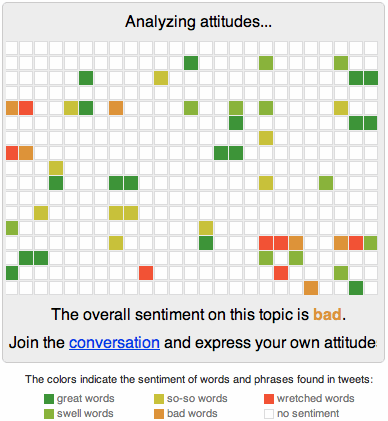
    The biggest question surrounding Twitter has been, How can this seeming toy ever break through and become a profitable business? This week’s news suggests a research product that, in its beta phase, is already quite good. Go to its Sentiment Analyzer and type in a phrase. Malik typed in keywords related to the acquisition of Summize by Twitter. Here was his result:

    Analyzing what Twitter fans think of the Summize purchase

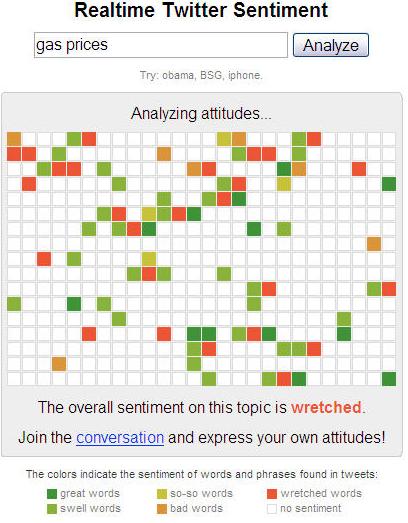
    Sentiment is “Bad.” Obviously the majority of people Tweeting about the buy-out aren’t Summize’s soon-to-be-wealthier founders! If you want to see really bad, however, type in “Gas Prices,” as I did here:

    Twitter Sentiment surrounding \'gas prices\'

    It’s a fun toy. But the real time market research implications are huge.