Category: Data Marketing

Using the power of computing to draw a straighter line between a business and its customers, to the benefit of each

  • B-to-B Viral Marketing Case: Powerboat sales as a window to our current economic squall

    Let’s say you’re a company that mines data in a quiet niche — one not known for analytic vigor. You’ve been doing it for years and do it wonderfully. For clients who appreciate your chops, you’re a godsend. But these clients are exceptional in the traditional retail business sector you serve.

    How, how do you spread the word about your super-segmented lists and dead-on business intelligence services? Intuition says you find something to “go viral” around. But that requires some degree of topical relevance, if not outright sensationalism. How do you enliven something as dry as, say, boat purchase behavior (pun intended), to give it the life necessary to grab headlines?

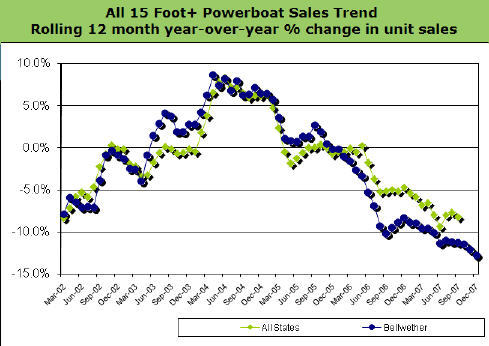
    The answer is what Info-Link does. They periodically publish one of the more pedestrian metrics they track: Quarterly sales in bellwether states. Below is their latest Bellwether Report, available on their site and distributed via a simple but effective opt-in email:

    Info-Link Bellwether Report

    You can explore various sales statistics by quarter (use the pull-down). Yes, the news is depressing. But it’s undeniably informative. And share-able. What information can your business repackage in such a way that people will want to share it?

  • Follow-through is crucial to higher search conversion rates

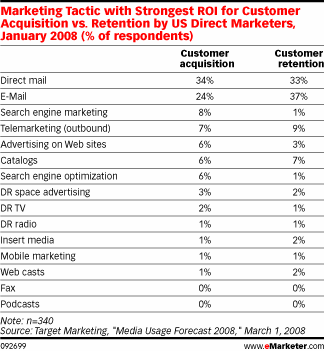
    Yesterday I sent a results report to a client for a pay-per-click (PPC) search  lead generation campaign that my team managed. It showed a performance that was five times higher, in terms of cost-per-lead, than a traditional direct mail campaign. That’s pretty cool. But as I sent the report, I was reminded of this recent report from eMarketer:

    eMarketer summary of favored direct response media

    It shows how a majority of marketers favor direct mail for lead generation versus search marketing. Scott Brinker was rightly puzzled by this, in a recent post. I agree with Scott that a chief reason for this strong preference for direct mail over search engine marketing (34% versus 8%), when it comes to customer acquisition, is the difficulty many marketers face in getting search prospects to convert.

    Indeed, if the lead acquisition campaign my team was leading was instead a customer acquisition campaign, the results would likely have been closer to a dead heat with direct mail in terms of ROI.

    But what does that mean? Just that we’re not trying hard enough. As marketers, I feel we cannot allow so many opportunities for conversion to click away from landing pages. There are many tested techniques for improving conversions (new offers, testimonials, guarantees, Web 2.0 landing page design). There are also spectacular new tools to do multivariate testing of these techniques.

    Let’s take direct mail for what it should be. It is (usually) the customer acquisition benchmark. Now let’s shift more resources online, but apply them where it really counts: To create campaigns that actually surpass the mail in delivering a strong ROI.

  • PRISM, a bricks and mortar store analytics effort, takes its cue from e-stores

    It seems improbable that there was ever a time when skilled marketers didn’t use at least some traffic data to make improvements to their sites. The availability of this data, no matter how flawed, has been a chief impetus for the growth of web marketing as a discipline. The comparison was always with the dearth of similar data from bricks and mortar stores. Here are a few specifics:

    Stage of Purchase Web Metric Store Metric
    Initiation Unique Visits Foot Traffic Counts
    Consideration Page Views None Available
    Completion Transactional Data Transactional Data

    This list is over-simplified, but it makes a point. In the Consideration Stage — between the time when the door store swings open and the time the purchase is rung up — there is little to help the bricks and mortar marketer understand the motivation of the customer.

    By comparison, a web marketer has a full toolkit of metrics. There are page views to show visits to specific product pages and web site sections, exit pages to show when a consumer decides to leave without buying, and shopping cart abandonment metrics to show exactly when a consumer decided to stop his or her purchase.

    This stark difference is changing fast.

    PRISM (short for “Pioneering Research for an In-Store Metric”), is a Nielsen Media / In-store Marketing Institute co-production. Working with a consortium of retailers and consumer-goods manufacturers, the duo completed a test recently using sensors placed at key points in over 160 stores around the country. These sensors monitored the entrances and exits, as well as some store aisles, composing data sets and even heat maps of customer-traffic patterns.

    In a way that is uncannily similar to web analytics, the PRISM system combined these traffic data with transactional information. The end game is to achieve greater insight into consumer behavior.
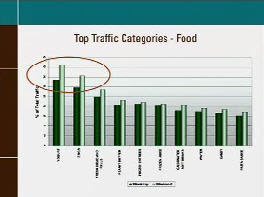
    A chart from the videoAs you can imagine, the potential for improving the in-store experience is huge. Just as web marketers have walked away with significant improvements to their sites through web analytics, these marketers are nearly giddy with new-found knowledge. At least, that’s the impression I’ve received by press accounts of PRISM. This piece in In-Store Marketing Institute’s site is characteristic of that excitement, particularly in this accompanying Flash and Quicktime video. (Warning: The video is all talking heads. Sadly, demonstrations of the system at work are being held closely under wraps.)

    Here is a typical insight, disclosed in the video by David Calhoun, CEO of the Nielsen Company:

    “In some food stores, the heaviest traffic flow is not through the carbonated beverage and snack aisles — which might be the conventional wisdom based on sales rates — but through the yogurt and eggs section of the store.”

    The chart above shows this (but not very well — it was captured from the video and only Calhoun’s narrative can identify the categories), with the two circled categories being the Yogurt and the Eggs sections.

    Since the advent of web analytics, physical world marketers have looked at us web marketers with envy. It appears their time to play next to us, in the sandbox of database marketing, is just around the corner.
  • Gamers in the ivory towers

    A recent survey of 7,100 executives revealed a secret C-level indulgence: video games. PopCap Games conducted the survey, and here is a summary of their findings:

    This representative sample suggests that as many as 80 million white collar workers play casual games. Of those white collar workers surveyed, nearly a quarter (24%) said they play “at work” — with fully 35% of CEOs, CFOs and other senior executives saying they play at work.

    Tameka Kee of MediaPost points out the most promising implication for business-to-business (B2B) marketers: “These ad-supported games reach their targets on an unexpected, but increasingly popular medium.” In other words, they reach the men and women who screen their calls, have someone else sort through their mail and block unknown emails.

    At last we know what they’re doing behind those closed doors.

  • Growth of out of home ads reflects our fragmented media consumption

    Physicists tell us the universe is ever-expanding, a concept that can make the mind reel. Advertisers trying to reach their target audience know this feeling well, as media alternatives continually fragment and multiply. One solution: Forget about media as we would ordinarily think about them and look to the places your market congregates as the medium itself.

    I’m only a recent convert to the power of out of home advertising, but that only seems to make me more of a zealot. Here are three examples worth filing away in your new media mental database:

    • Billboards that greet you by name — Tested last year and rolled out in the April of 2007, the Mini Cooper Motorby program is ingenious. Have owners register online, and receive a free key fob. When that key fob gets within 500 feet of a billboard, it triggers a personalized message. The billboard is 5 feet tall and 33 feet wide. My only questions: What are the results? And how are they translated to a true ROI?
    • Virtual billboards, Second Life-style — If an ad is on the side of a building, but that building is on Second Life, is that an interactive ad or out of home? A little of both, because it is far more interactive (try clicking through the side of a real building without getting injured or arrested), but has the same ambient quality of the real world. The biggest down-side: Ads are everywhere in Second Life.
    • Literally touch your consumers as they drink their coffee — Coffee cup sleeves have come of age. According to BriteVision, an industry leader in their production and distribution (they have their own ad network of coffee shops), the average consumer spends 49 minutes with their “Ad-Sleeve,” what an average recall of the ad at two-thirds (65%). The biggest up-side: Since many cafes offer WiFi, providing a URL can help measure effectiveness and reach an upscale segment of consumers. You can also include a phone number or short code for a mobile marketing play.

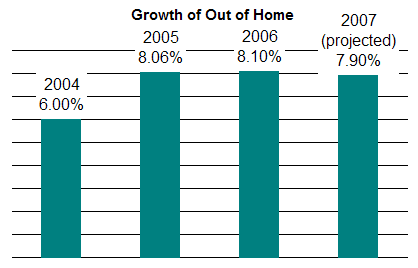
    The reach and creative potential with out of home are a couple of reasons it is growing when other media types are stagnant or shrinking. According to the OAAA, revenue for out-of-home advertising so far this year has increased by 7.9% (within a rounding error of the growth seen last year, and the year before). This projection for 2007 is based on spending in the first six months of the year. The graphic below shows prior growth.

    Growth of out of home this year is projected again at roughly 8 percent

    All of this is great news for brands that want to make a difference. There are many ways to truly involve consumers — some quite high tech, some that are extremely “out there,” and some that are frankly both. It all makes for an interesting ride with plenty to see and do.