Category: Data Marketing

Using the power of computing to draw a straighter line between a business and its customers, to the benefit of each

  • Expanded Facebook Lexicon helps marketers understand user zeitgeist

    In the early days of radio journalism, reporters would conduct “man on the street interviews,” to get the opinion of “John Q Public.” The news-gathering ritual has extended into television reporting today. The technique makes for interesting coverage of a topic, but opinions recorded are hardly the unvarnished truth. When presented a microphone, all but the most incautious of us edit out statements to fit what he’d like the world to think of us.

    If it were possible, a more accurate accounting of public zeitgeist might be to eavesdrop on a roomful of friends, discussing and arguing about the topic at hand. Listen in on enough rooms and you might be able to get a better feel for public sentiment.

    That’s the concept behind Facebook’s Lexicon. This (currently) free feature allows marketers and others to slice and dice Facebook members’ comments on their friends’ Walls. Currently this new Lexicon version is limited to a list of roughly 20 terms. There are plans to open this up shortly.

    An earlier Lexicon version showed relative volume of terms over time, but not actual numbers. This made any sort of statistical inferences impossible. The newer release shows the actual numbers, as well as these enhancements:

    • Demographics by gender and age
    • Geographic breakdowns down to state level. You can even compare breakdowns between two terms on the same map.
    • Sentiment over time, although Facebook hasn’t stated how it determines this.
    • Associations: Terms frequently mentioned alongside a given term.

    Below is an example of terms associated with mentions of “Palin,” over the last two weeks. Significantly, it was within this period that Saturday Night Live (SNL) presented a much-talked-about skit, where Tina Fey played Sarah Palin at a press conference, standing beside Amy Poehler as a disgruntaled Hillary Clinton. The topic was sexism in the presidential race.

    In the Associations graphic, the bottom dimension is gender, with the terms farthest to the right being used by more men than women. The graphic (which can be expanded by clicking on the image) shows that more women than men commented on Facebook walls during that time period with statements containing SNL, Tina Fey and skit (when also using the word Palin).
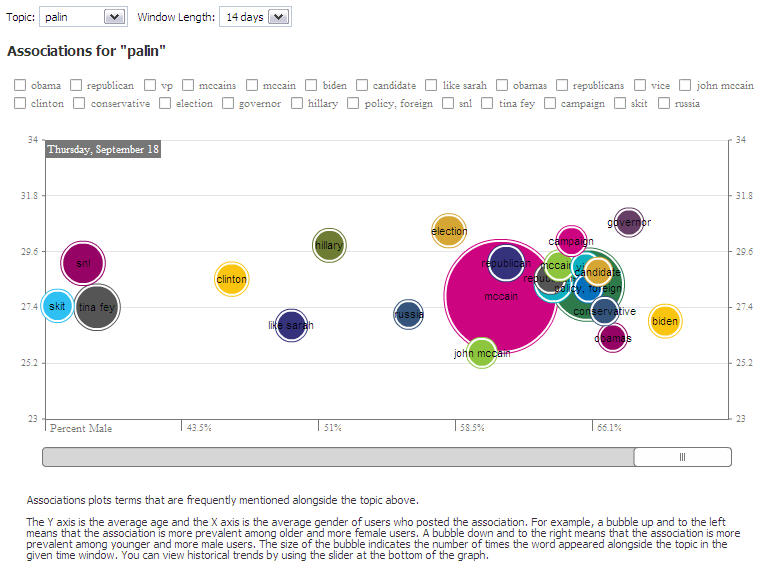
    The caption at the bottom of the graphic helps you understand what you’re looking at:

    The Y axis is the average age and the X axis is the average gender of users who posted the association. For example, a bubble up and to the left means that the association is more prevalent among older and more female users. A bubble down and to the right means that the association is more prevalent among younger and more male users. The size of the bubble indicates the number of times the word appeared alongside the topic in the given time window.

    Explore Lexicon for yourself. And if you’re curious what all of the comments were about, check out the skit:
  • Facebook direct response ads prove how little has changed

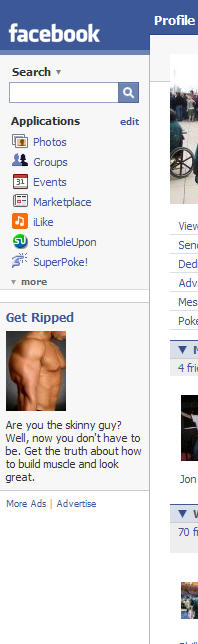
    It’s a common theme among direct marketers: There is little that actually changes as new media spring up and ads adapt to them. Take Facebook. As David Berkowitz discussed in his post today (and also in his MediaPost piece), an ad series that targets people based on their gender and age is making the rounds. And getting a lot of scrutiny. I had seen another version of it last week, and had mentioned it to him via Twitter. (Thanks for the mention, David.)

    Significantly, this ad series wasn’t showing when I just visited a few moment ago, nor could I find in on the More Ads page of Facebook. Coincidence?

    Here is the ad in context -- circa April, 2008Way back on April 9 this ad series first captured my attention, although at the time it wasn’t testing headlines customized to age and gender, as this newest batch does. At the time I made a number of screen captures, and took some notes, but didn’t blog about it then.
    Now this latest twist (featuring headlines such as, “29 Yr Male Overweight?“) is a great chance to share my research into the advertisement — especially for those readers who first caught David’s post and wondered how the subsequent user experience plays out.

    The answer is it’s very old school, with some shrewd modern touches.

    Like the best print ads of the direct response print ad “Golden Age” (somewhere between the 1960’s and the 1980’s, I’d venture to guess), it is a carefully tuned conversion engine, as well as a massive blight on the advertising landscape.

    The ad itself had the headline “Get Ripped.” The photo is smaller than the new versions, but the copy is written with the same economy and obvious care. When you click though to it, you see a page that is incredibly busy, with three different fonts and primary colors, and a ton going on. (Click to open it full size in a new window).

    An AJAX layer offers a clever YouTube video player (I don’t recall checking to see if it was truly pulling from YouTube, or was residing on the advertiser’s server — but I’m guessing the advertisers were not counting on YouTube’s cooperation, and this was indeed locally streamed).

    Folks who wouldn’t know better would assume this ad is a loser. “Who could possibly respond to something this schlocky?,” they might ask. My answer would be that, like the pattern on the carpeting of a Las Vegas casino floor, everything about it is there for a reason. And it’s all there because it’s effective, as proven over time, with much testing.

    But Wait!

    The best part for me is shown below. When I tried to close the window, I got a fake system message saying, “Hey Wait!” It goes on to say a live agent would like to give me a “last-minute saving,” Okay then. Points for persistence.

    A clever way to stop people from leaving

    What do you think of this surprisingly old-fashioned approach? Do you think it will work — with, or even without — the age / gender personalized headlines?

  • Summize helps marketers peer into the attitudes of a million+ Twitter fans

    How is this for stating the obvious? Data mining is helping marketers better understand and cater to consumer behavior. Examples abound — even here, in Digital Solid. But this fact is worth repeating considering this latest example.

    As reported and discussed in this GigaOm post, Twitter is likely to purchase Summize, which is a popular third-party application that searches and reports on keywords embedded in these 140-character packets of text. Om Malik of GigaOm conjectures that the reason for the purchase is less about search, which can be interesting, but about understanding consumer behavior, which can be useful to marketers.

    This is an understatement.

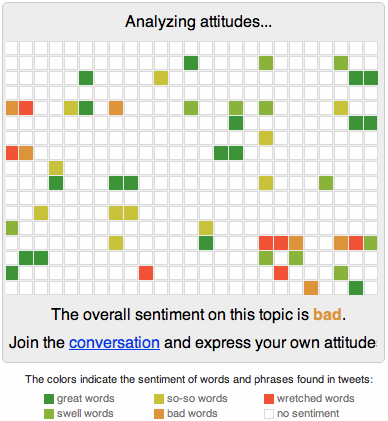
    The biggest question surrounding Twitter has been, How can this seeming toy ever break through and become a profitable business? This week’s news suggests a research product that, in its beta phase, is already quite good. Go to its Sentiment Analyzer and type in a phrase. Malik typed in keywords related to the acquisition of Summize by Twitter. Here was his result:

    Analyzing what Twitter fans think of the Summize purchase

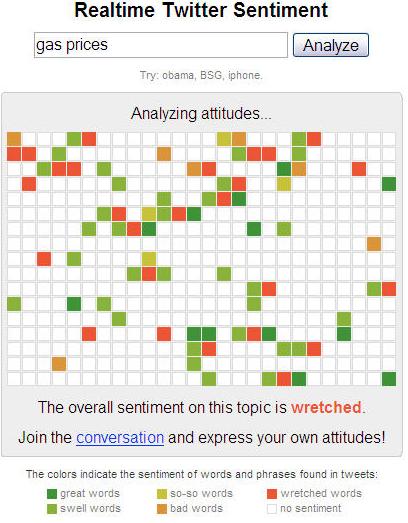
    Sentiment is “Bad.” Obviously the majority of people Tweeting about the buy-out aren’t Summize’s soon-to-be-wealthier founders! If you want to see really bad, however, type in “Gas Prices,” as I did here:

    Twitter Sentiment surrounding \'gas prices\'

    It’s a fun toy. But the real time market research implications are huge.

  • Does giving away your book, ala DRM-free music, make business sense?

    When avant-garde rock band Radiohead posted their latest album online, they invited fans to pay whatever price they thought was appropriate — or even pay nothing at all. More recently, bluesy Brit Joss Stone went on record as saying she thought “piracy” of her music was just dandy. She implies that the freely shared music is growing box office sales of her live shows. These and other examples from the recording industry suggest a business model where your chief intellectual product can be given away — or shared at a huge discount — to the overall benefit of your bottom line. One could even go so far as suggest that digital rights management (DRM) protection does more economic harm than good.

    Okay, but does this model hold water if you’re a niche business writer, speaker and consultant?

    Kevin HillstromMy blogging friend Kevin Hillstrom reports that it seems to, if viewed holistically. And especially since his book is called Multichannel Secrets, you’d better believe Kevin views things holistically!

    Joss Stone more or less admitted in her interview that, taken as a single tactic (my word, not hers), giving away music helps create buzz. It doesn’t help pay the bills. But this buzz is supporting her live shows. She is, in essence, a multi-channel business, and one channel is benefiting from the loss-leader status of the other.

    Similarly, Kevin — who is the president of MineThatData — mentions in his blog that his pre-release book giveaway was not a profitable move. He reports at one point that he gave away twice as many books as he sold. But he emphasizes that as a “‘micro-channel’ strategy to running my business,” the giveaway concept makes good economic sense.

    If you’re a self-publisher, you’ve probably already considered the strategy of giving out free advance copies. But Kevin can still help you, with his well-framed case for emulating Radiohead. Rock on, Kevin!

  • Quantifying community standards one Google search at a time

    A Florida lawyer has found a novel use for search engine data in presenting a court case. Defending his client from obscenity charges, Lawrence Walters seeks to show that the “community standards” in Pensacola aren’t as lofty as some might expect. The New York Times lays out his defense tactic in “What’s Obscene? Google could have an answer“:

    In the trial of a pornographic Web site operator, the defense plans to show that residents of Pensacola are more likely to use Google to search for terms like “orgy” than for “apple pie” or “watermelon.” The publicly accessible data is vague in that it does not specify how many people are searching for the terms, just their relative popularity over time. [Walters] is arguing that the evidence is sufficient to demonstrate that interest in the sexual subjects exceeds that of more mainstream topics — and that by extension, the sexual material distributed by his client is not outside the norm.

    I’m reminded of an old Tom T. Hall song about another southern community. In “Harper Valley PTA,” a single mother is accused by her school group of being unfit to raise her middle school daughter. She “wears tight skirts,” and has a drink or two in public — with men, no less! The song has our protagonist defending herself:

    Well, Mr. Harper couldn’t be here ’cause he stayed too long at Kelly’s Bar again
    And if you smell Shirley Thompson’s breath, you’ll find she’s had a little nip of gin
    Then you have the nerve to tell me you think that as a mother I’m not fit
    Well, this is just a little Peyton Place and you’re all Harper Valley hypocrites

    Of course the song ends with her accusers chastened and her “fitness” as a mother confirmed. Relatively speaking, of course, taking into account the prevailing Harper Valley community standards.

    It will be interesting to see if a more high-tech version of this shaming defense wins the case. I have no affection for the industry that’s being defended, but if a jury of non-technologists can find the data presented reasonable and compelling, it will be a sign of just how quickly “John Q. Public” is coming around to viewing behavioral data as a yardstick of social attitudes.