Category: Data Marketing

Using the power of computing to draw a straighter line between a business and its customers, to the benefit of each

  • Why the debate about in-house SEM vs outsourced work clouds an important issue

    This morning, MediaPost featured “The Great (And Completely Ridiculous) ‘In-house vs. Outsourced SEM’ Debate,” by Dave Pasternack (registration to MediaPost is required). The piece begins with Pasternack asserting that in his 10 years in the business, “I’ve never, not once, seen a search campaign created by an in-house team outperform one crafted by a competent SEM [search engine marketing] agency.”

    I trust that what he says is his experience, although at least one other in the comments reports differing results. Also in the comments, David Berkowitz found some of Dave’s arguments to be as “spurious” as the premise itself (Hark! Do I hear you composing your own post on the subject, David?).

    I’m letting that discussion continue without adding to the din.

    But my opinion is that the debate itself — in-house versus outsourced SEM — clouds the true secret to optimum ROI: Working together, in-house and agency pros are more likely to get a campaign that really hits one out of the park.

    No one understands the subject domain as well as those who live and breathe it. And successful SEM requires content that uses this knowledge. Customer-focused internal SEM pros can add a level of richness to an SEM campaign that no outside agency can match.

    SEM Is More Similar Than Different Across Industries

    So what’s the problem with most “pure-play” internal SEM work? It’s a question of experience. When someone is handling multiple campaigns for many different types of clients, the similarities and synergies become apparent. Knowledge has a way of “cross-pollinating” between campaigns and clients. That’s a huge advantage. Also, this level of activity forces a heightened level of process that is just too difficult to match in an internal campaign.

    As with most black-and-white debates, this one distracts from the benefits of a middle ground.

    In every industry, and in every business category, there are those brands that lead the way in SEM. For the majority of these market leaders, I would be shocked if there wasn’t a smart blend of internal and outsourced efforts and expertise at work.

    Both sides of the desk have something superior to bring to an SEM campaign. I suggest we SEM agencies work harder to remember this, and to promote this important truth.
  • Multi-touch screen tables interact with casino patrons

    Since Jeff Han first presented multi-touch screen technology, there has been a great deal of speculation on which industry would be first to make use of it. The industry first to reap profits from another breakthrough technology — personal video players — was not surprising “adult entertainment.” But manipulating images on a cool glass monitor is hardly conducive to this, er, prurient interest. Allow another vice, or maybe two, to step in and fill the void.

    Of course! Drinking. And eventually, gambling.

    Thank you Mike Luedke, of Dinefly fame, for tipping me off to this extraordinary application of Microsoft Surface technology. As this report explains:

    The six rectangular tables with built-in 30-inch flat screens using Microsoft Surface technology were installed in a lounge at the Rio All-Suite Hotel & Casino in Las Vegas, with custom applications built for Harrah’s.

    A spokeswoman for Microsoft said the units sold for a base price of $10,000.

    A program called Mixologists lets patrons play bartender by creating and ordering concoctions of whatever cocktails and mixers they click on. The system is able to remember users’ drink orders and, one day, may be able to offer customers the same drink at other Harrah’s locations, such as when they play a slot machine.

    Another program lets users watch YouTube videos, either by searching or choosing from a list of popular videos. Harrah’s officials said they reached a licensing deal with YouTube on Wednesday.

    The table also includes a program called Flirt, which lets customers sitting at any such table in the lounge see and chat with each other, take and e-mail pictures and even trade cell phone numbers.

    Okay, so maybe there is a tie-in to prurient interests. Or at least hooking up. Regardless, this is a brilliant application from Harrah’s, a group that has already shown its mastery in customer relationship marketing.

    I’ll be curious, when my parents next travel to Vegas, to see if these tables will suck them in. They are long-standing members of Harrah’s Club. I hope they do. I would love to see how data from interactions with these bar tables are used to further improve their experiences at the casinos and beyond.

    Speaking of my parents, Have a great Father’s Day weekend, dad!

  • Infoweek and TechWeb launch strikingly familiar b-to-b portal

    This week InformationWeek and its affiliated TechWeb introduced CreateYourNextCustomer.com, a b-to-b portal for their reportedly “13.3 million business technology buyers.”

    Here\'s the scope of what they coverI’ve signed up and looked over their downloads and other resources, and I have to say there appears to be some valuable material. The focus of the portal is to help marketing technology pros plan their campaigns and online media buys. This would happen, in part, by gaining access to their media partners’ planning tools.

    Where have I seen that before?

    Which brings up a little episode of deja vous. They tout a media planning widget, to “zoom in on the business technology marketing solutions you need.” This was of course designed independently of one of the projects that my team produced last year, but I have to say it’s uncanny the similarities!

    Here’s a blurb in Yahoo Financial News on the site and its solution wizard (oh, wait — that’s what our creation is called!).

    What are your thoughts on this portal? Will it serve a need? Or is it too blatant a sell-through device for their partners?

  • The decline of legible handwriting

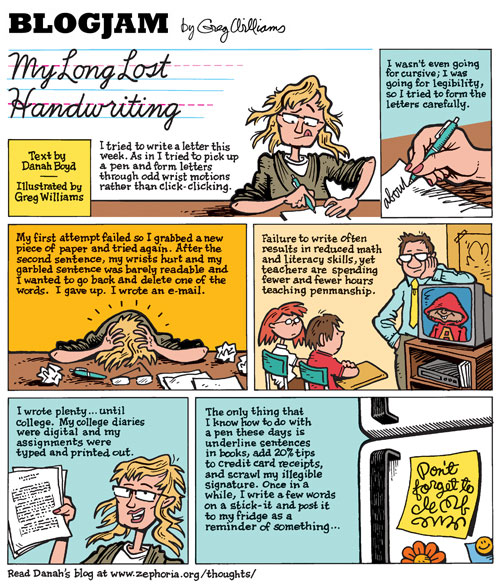
    Although it might not be a harbinger of lost social capital, it is undeniably sad that typing away all day has made most of us strangers to our once-good handwriting. One of my favorite scholars on the subject of technology and society, danah boyd, blogged about this last year. And now her lament has been put into wonderful comic form, in the Tampa Tribune’s Blogjam:

    danah boyd\'s ode to good handwriting, and lament to its passing

  • Financial services marketers lean heavily on direct response and email tactics

    A new report by the Direct Marketing Association reveals that marketers in the financial services sector are relying heavily on direct marketing and email, and showing an impressive ROI for these tactics. Here are two particularly impressive findings from this research of U.S. banks and credit institutions:

    • They invested $13.4 billion in direct marketing advertising, which produced $178.8 billion in sales, or $13.34 returned for every dollar spent
    • Growth in email marketing within financial services companies is expected to be the greatest of all media types used in the next four years, for a compound annual growth of 22.5%

    The report also showed a very small reduction in print advertising over the next four years.

    What can account for this? Aside from the arguably better overall effectiveness of these media, they are also tactics more suitable to centralized control. As financial institutions continue to consolidate, these tactics become even more appealing.