Tag: seo

  • AI boosts ecommerce conversions by compressing evolution

    AI boosts ecommerce conversions by compressing evolution

    Every sale on your ecommerce site travels through four phases: Attention, Interest, Desire and Action (AIDA). Before AI, optimizing each meant months of randomized controlled tests, slow feedback loops, and lots of guesswork. AI compresses that personalization cycle dramatically. Marketers using it have a distinct competitive advantage

    To explain how, I’m pulling from two creatures found in nature. They evolved over millennia to do exactly what your ecommerce experience needs. One of them might be the strangest and most instructive thing you’ve never heard of.

    I described those two creatures recently on another blog site, Dyslexic Data. The title: Using data to visualize evolutionary forces. There I explained how the pair have evolved to catch and eat the optimal number of bugs, in a feat of natural selection that evolutionary biologists have visualized.

    Although you should not expect either showing up in an upcoming Pixar feature, in my mind’s eye I do see them, above, fitting in nicely outside The Haunted Mansion. (I describe the significance of this Disneyland attraction in another post, also on Dyslexic Data). 

    First, the spider: A creature so reviled it even has a phobia named after it. I asked AI to make it look friendly. Still, all those legs! It’s hard to avoid the creep factor.

    The other isn’t shown, because, 1.) It is genuinely hideous, and 2.) It spends its phase of life hiding in loose sand, at the bottom of funnel-shaped depressions like the three shown in the foreground. 

    This shy, larval stage of the lacewing, is called the ant lion.

    Growing qualified visits by optimizing attention and interest

    AI is rewriting the economics of all four phases of AIDA. The first two, before modern LLMs, were addressed by the human optimization of paid and organic search, as well as digital display ads. Algorithms helped, but decisions based on feedback loops were slow and data was thin.

    You can think of this process, pre-AI, as similar to the silk spun by the very first ancestors of modern spiders. They weren’t very efficient. 

    The computer simulator described in my evolution blog post makes a case that natural selection and food scarcity inevitably drive generations of spiders to spin webs optimized for the lowest calorie expenditure yielding the greatest caloric intake. If you ran that NetSpinner simulation a thousand times, over multiple generations, each pass would iteratively, gradually evolve to what you see above: the classic Charlotte’s Web bug-catcher. 

    Every single time. Now that’s optimization!

    Similarly, modern machine learning works to optimize your campaigns for better attraction of attention and generation of interest. Here are just three of the mechanisms:

    1. It does a better job of stitching identities in your customer data platform (CDP)
    2. It refines your organic and paid campaigns by providing more actionable data
    3. It continually interprets that data to launch and test multiple ad variants

    Those actions include look-alike modeling, to find more prospects similar to your best customers, and suppression models, to ensure you aren’t “wasting silk” — in this case, your ad dollars — on people who are already customers.

    In these ways and the others below, AI compresses evolution by quickly learning the best placement of its own “sticky silk strands” to capture the attention and interest of ideal prospects.

    From search rankings to AI recommendations: the new attention engine

    Organic search marketing, also known as search engine optimization (SEO), is still important. 

    AI helps there too. 

    It can optimize your product description pages to rank higher in search engines for the phrases your customers use to find the products.

    Rapidly emerging as a counterpart to SEO is agentic engine optimization (AEO … sometimes called GEO for “generative engine optimization”). AEO / GEO acknowledges that attention and interest take place in ways we marketers find difficult to quantify, in recommendations made by ChatGPT and other chatbots.

    Agents such as Optimizely’s Opal can build the data schemas within your product description pages that are invisible to human visitors but instructive to bots.

    Those schemas serve as training datasets for the LLMs. They help persuade chatbots to recommend your products over competitors when consulted by your prospects.

    Measuring Success

    Success metrics in a world of AEO / GEO can be tricky. 

    In the old world, interest was measured by the raw number of people who arrived at your site. Since the emergence of Google Gemini, ChatGPT and their ilk, marketers are noticing significantly fewer visitors. That’s because consideration for many is happening on search engine answer sections and the recommendations served up by the chatbots. 

    Here are two metrics that still work:

    1. An increased return on ad spent (ROAS)
    2. A reduced number of clicks leading to conversion, since people are generally arriving more knowledgeable about your offerings, with fewer questions

    Boosting desire and action through optimized conversion funnels

    I’ve known about ant lions since I was a morbid little boy. As a digital marketer, I recognized they’ve evolved to produce a literal, perfect conversion funnel.

    The ant lion hangs out at the bottom. When it senses an ant has stumbled onto the rim, it flings its shovel-shaped head to toss grains of sand up and over.

    The unwitting ant works against the avalanche as it begins a downward slide. The ant lion counters with more targeted shoveling. In stages, similar to the steps of conversion funnels that are your site’s shopping experiences, any slip-up would mean escape, and a ruined dinner.

    The Action at the end of the Desire phase is, of course, a sale. Improving your conversion funnels to optimize sales, before AI, was slow and imperfect. 

    True, funnel-optimizing A/B and multivariate testing succeeded in the pre-AI world, by using complex math to measure improvements. But today, AI makes these calculations and decisions in an instant, based on more variables than you could ever hold in your mind (the segment of that prospect, the visit source, day and time, and purchase history, to name just a few attributes).

    AI ensures that every method to reduce conversion funnel attrition is put to practice in real time. The result? A greater share of your prospects pass from Desire to Action.

    Measuring Success

    What metrics would tell you if your conversion funnels are performing like a well-dug ant lion trap? Here are two:

    1. Conversion rate, as measured from sales divided by entries into the relevant product description page.
    2. Shopping basket size, since AI can also supercharge your “You may also like” recommendations

    Better webs, smarter funnels

    AI doesn’t change what a sale is. It compresses the time it takes to get there … to serve up the right message and experience for the right person at every stage of the process. 

    Chances are some of your competitors are already using AI to spin better webs and dig more efficient funnels. The question isn’t whether to adopt AI. It’s which phase of your AIDA cycle you optimize first. 

    Start there.
  • Make your press releases behave more like blog posts

    Reading my headline, you may be thinking, “Why would I even want the press releases on my corporate site to be more blog-like? Aren’t blogs kind of, well, flaky?” The answer has to do with three dimensions of a sound digital communication strategy:

    1. Improved engagement
    2. Improved compliance
    3. Improved search engine presence

    Improved Engagement

    Here’s what I mean by improved engagement. It has to do with engaging (involving, informing) web visitors. If your site provides more information about a newsworthy product or service, the chances are better that a web visitor will want one. There’s an old salesmanship saying: “Telling is selling.”

    Of course, engagement isn’t the same thing as boring someone to death. That’s why the web is such a great way to deliver content. When content is served up properly, there are ample spaces for long copy to breathe. This copy can be broken up between several pages, headings or hidden div layers. When a visitor wants more information, he or she simply has to click, or to scan headlines and sub-headings.

    Some think you can’t pack much selling information into a stodgy old press release. They’re quite mistaken. Press releases that are loaded into a web site can describe features and benefits. Because of the journalistic style of them, these descriptions are usually short — or at least written in an easy-to-digest inverted pyramid style.

    To keep these online press releases relatively short, yet packed with selling power, writers should link often to more detailed information elsewhere within the site. Just as I have with my link to a definition of the inverted pyramid style of journalism (earlier in this paragraph), a single link can speak volumes for those curious enough to click.

    Improved Compliance

    Just as you can (and should!) link off of the press release to other source information, you should consider linking to a given press release from blog posts on that topic. This allows you to speak more loosely in your blog posts without running afoul of the legal team in your company who want to ensure the company won’t lose credibility or get sued.

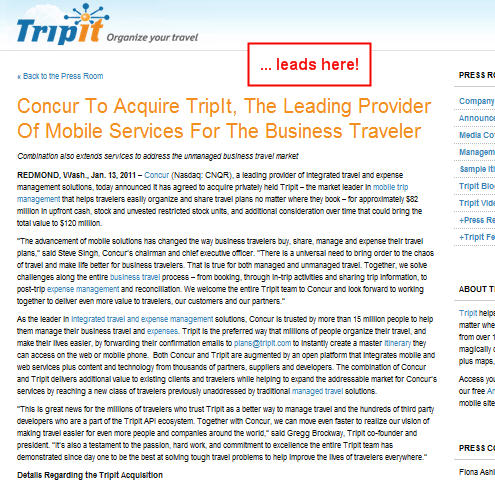
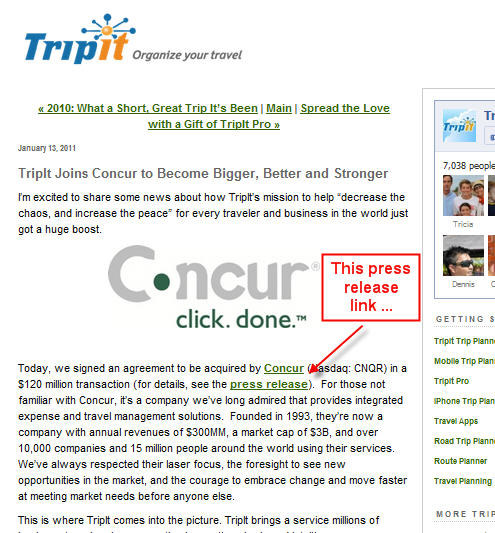
    Below is an example, from the press release section and blog section of the Tripit.com site:


    Look at the headline for the blog post: “Tripit Joins Concur to Become Bigger, Better and Stronger.” It’s a lot easier, from a compliance perspective, to say this in a blog post. Journalists and the financial industry — the two groups most likely to be interested in this story — would both regard a press release using this language with some skepticism.

    However, by linking to the press release talking about the same event, this level of hyperbole is understandable … even expected. Blogs are about opinion. Press releases are about cold facts.

    So how is the press release in this example behaving more like a blog post? You really can’t tell unless you look at the source code, but this press release was posted using the WordPress blogging system. Which leads to better search engine performance …

    Improved Search Engine Presence

    Here are four ways that serving up your press releases the way Tripit.com has is smart from a search engine marketing perspective:

    1. More press releases = more search engine optimization

    This technique gets your public relations or marketing teams out of the mindset that press releases should be rationed out carefully. Just as blog posts go up often, so should your press releases. Mind you, this does not mean more spending with services such as PRWeb or PRNewswire. That’s what got your PR team into the mindset in the first place!

    Instead, continue to use those far-reaching press release distribution services for the big announcements. When you do, replicate the press releases on your site. Then post others that aren’t earth-shattering news, but can support other product or service launches or upgrades.

    Most corporate site web visitors don’t seek out press releases. But if you link to specific releases from blog posts, the content will reinforce what’s in that post. The intra-site links will also slightly boost the rankings of both pages in the eyes of many search engines.

    2. Double the odds of getting into top search engine results pages

    With the one-two punch of a blog post and a press release, you double your chances of ranking high. That assumes that none of the content between the two items is shared. Search engines frown on identical copy one pages that it is indexing. True, you can excerpt the press release in your blog, but don’t get carried away.

    3. Provide search engines with a second RSS feed

    One of the reasons that search engines love to rank blog posts high in results pages is they timely and are easily accessible through RSS feeds. When a blog post goes live, a search engine that has access to its RSS feed has the inside scoop, so to speak. The same can be said for your press releases when you use a blogging platform such as WordPress to publish them.

    4. Benefit from search-engine-friendly page URLs, categories and much more

    Here is the full URL of the press release example shown about:
    http://www.tripit.com/press/2011/01/concur-to-acquire-tripit-the-leading-provider-of-mobile-services-for-the-business-traveler/

    This is exactly the sort of URL that search engine spiders can sink their teeth into!

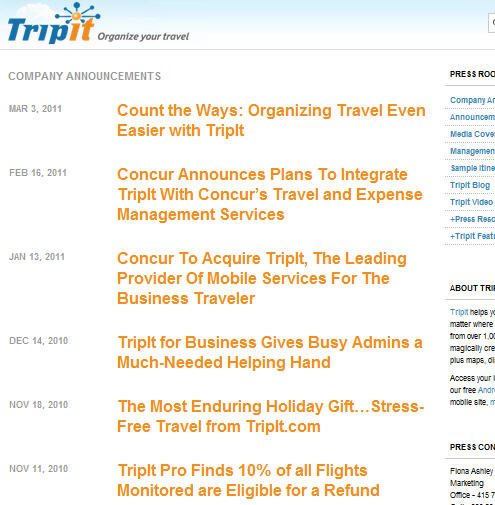
    Finally, a press release can be given a “category,” such as Tripit’s “Company Announcements” (the full length is truncated and you can see the left edge in the upper right corner, below. This allows that category page to be indexed by search engines as well. Here’s an example from the Tripit.com Press Release section:

    I could add one more reason to use this technique: It’s extremely easy to install and test. Try it with your corporate site. If you already have, let me know what you think of it.

    Have you noticed, by the way, that I haven’t mentioned press releases in PDF format once? It’s only because I trust you, dear reader, to not even dream of using this unwise tactic with your company. But if you have no choice, please share this posts with the powers that be and beg them to reconsider their folly.

    The marketing power of a press release is a terrible thing to waste!

  • Use your smallness to out-maneuver competitors in search engines

    King George II never knew what hit him. Your business can enjoy the same sneak attack advantage on search engines.

    Many say our Founding Fathers won independence simply due to effective military strategy. They exploited their smallness — seemingly appearing out of nowhere and just as easily melting back into their surroundings. In this way the greatly out-gunned militia of George Washington prevailed over King George II and his army. This same approach helped the Viet Cong, keeping the Vietnam War in a stalemate until the U.S. withdrew. If you’re a small business, or a small competitor in a tough business segment, you can tear a page from these playbooks to win dominance on search engines.

    But first, you need to understand which battles are worth winning. With modern search engines, the most important area to focus your efforts is backlinks. I’ve blogged before about their importance, offering seven types of backlinks to pursue.

    Here are three ways to use smallness to your advantage in finding and exploiting search engine opportunities:

    1. Remind yourself that being great isn’t enough. You may build the best mousetrap ever. That doesn’t count. You have to also be strategic. In his book The Sirens Titan, Kurt Vonnegut, Jr. writes, “There is no reason why good cannot triumph as often as evil. The triumph of anything is a matter of organization. If there are such things as angels, I hope that they are organized along the lines of the Mafia.” Organize your search engine strategy “along the lines of the Mafia.”
    2. In keeping with Rule #1, look for vulnerabilities. Find the unique qualities of your product or service that cannot be reproduced by your competitors. Specifically, find how these unique characteristics can induce popular sites to link to you and no one else in your industry. As an example: Your company generates electricity, and does so in a way that is unmatched, in that it leaves a significantly smaller carbon footprint. That opens the door for backlinks from “green” directories and blog sites that your competitors cannot follow you onto. Each of these placements can be a huge win for your site.
    3. Be ready to turn on a dime. It’s something that smaller, more guerrilla-style fighters can do that their slower enemies cannot. Don’t look at your larger peers and mimic the pace with which they adapt to new market conditions. Instead, push your limits, and discover just how fast you can react. Then watch them struggle to keep up.

    If you apply these three rules you’ll be well on your way to search engine victory. Often, your competitors won’t even know what hit them until it’s too late!

  • Search conversion lift seen from social media

    On Friday I gave a presentation in Chicago, at Loyola University, on social media and compliance. We covered many topics dear to the hearts of those who participate in social media and would prefer not to go to jail due to SEC or HIIPA violations. Left to other presenters was the topic of social media’s importance in today’s marketplace.

    It’s just as well that I left the topic out. Since most of the attendees were bloggers themselves (yes, more than half of them — I counted hands!), covering the importance of social media would have been preaching to the converted. But recent research, by GroupM and comScore, helps remind us all that some of the strongest reasons to engage in social media aren’t readily apparent.

    The study showed that people using search engines who also use social media are “more engaged consumers” and “more likely to be looking for places to buy and brands to consider.”

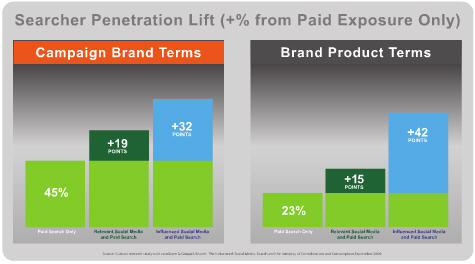
    The research found that consumers using social media are “1.7 times more likely to search with the intention of making a list of brands or products to consider purchasing compared to the average internet user.”
    Here are more findings from the study:

    • Consumers exposed to influenced social and paid search exhibit 223% heavier search behavior than consumers exposed to paid alone
    • Fifty percent of social media-exposed searchers search daily for product terms, compared to 33% of non-exposed searchers

    And finally, this is the finding that I thought was most revealing: “In organic search, consumers searching on brand product terms who have been exposed to a brand’s social marketing campaign are 24 times more likely to click on organic links leading to the advertiser’s site than the average user seeing a brand’s paid search ad alone.”

    How much do you spend on paid search ads? This finding suggests to me that whatever you invest in pay-per-click advertising, you can reduce that cost or improve its reach by combining it with a well-planned social media engagement.

    Great post-presentation feedback

    After the presentation I met a ton of the audience members through Twitter. This is a group who really understands how social media can extend the value of a presentation! One participant, David Kamerer, had a great suggestion for a way to improve my compliance presentation. He suggested I add some content on the CANN-SPAM email marketing law. Thanks, @DavidKamerer, and the other folks attending the talk. I had a blast!

  • More answers and links for vet practice managers

    Let’s say you’re a practice manager for a veterinary clinic or animal hospital, and you realize you need to change your current marketing budget. Like last year and the year before, your marketing spend heaps way too much money on print and other tactics that are missing many of today’s consumers.

    So what do want to learn most desperately when a skinny, still-slightly-contageous (cough, cough) marketing geek climbs behind the podium at your conference (organized by the AAHA)? Well, I’ll tell you.

    What follows are links to resources that should come in handy if you live in the world of a practice manager, and will come in particularly handy if you attended my presentations. These are a Greatest Hits of sorts, based on the questions posed at the end of each of four presentations, and in emails I’ve received as recently as last night, requesting specific answers to question.

    First, here are the topics we covered, linked to their mind maps — which served as outline during the presentations:

    Most Popular Questions Posed

    I took a while to post this because I wanted it to be comprehensive, and until even last night, I was getting requests for specific information. The profession of veterinary medicine is clearly waking up to the ways a strong online presence can help grow a practce and keep it vital!

    Q: If you say a site that is “content managed” is ideal, what is the best person in my organization to manage that web content?

    A: The simple answer is it’s the person closest to the authoritative content. Content management systems have opened businesses up to a greater intimacy with their customers by making web sites more useful. If you know that a business’s site will provide you with realiable, time-sensitive information, you’ll return to the site more often. And ostensibly, you’ll be more ready to refer the site — and the business — to others. What sort of information can an animal hospital site provide? You do not have to talk about animal diseases or treatments. Other general sites do that. Talk about how your services may be accessed (hours? phone numbers?), the way your services are provided and what I can expect if I go to you. Know your audience, and provide every scrap of information that could be useful.

    This will require someone close enough to the answers, but obviously not a veterinarian whose hours would better serve the business by being devoted to billable work. Is there an assistant or clerical person who feels good about writing short snippets of information? Expose this person to all the facts needed and then let that person go!

    Q: Regarding search engine marketing: What if I have a new site that is competing against large, established practices for the same keyworks. These older sites are “owning” the keywords. My site barely shows up in search engine results pages for them. Help!

    A: You’ve done the first step. You realize there is a problem. One should consider a site’s real home page to be a search engine results page! The first step is to do a compehensive inventory of all keyword phrases you want to go after. The odds are, your competitor won’t be present for all phrases for all major search engines. You can start by creating content that is optimized for those unclaimed phrases. As for the others, realize that search engines favor age over “youth” when they look at web sites, so your new site will be viewed skeptically by Google, et al. So the second step is to find more backlinks than your competing sites have. Truly high-quaity backlinks can confer credibility fast. Here’s a post to help you establish backlinks.

    Q: Can you help me read up on social network marketing?

    A: It’s the hottest top around in online marketing, and that was clear from the volume of questions I received immediately after my presentations, and subsequently, via email. Luckily there is a ton of material out there. Start with my post on why Facebook is a good set of “training wheels” for those unsure about how to begin. This post specifically addresses why Facebook is superior in its ability to instruct a user than Twitter. For an overall map of the social network space, I posted one nine months ago that gives you a taste of its size and complexity. The most valuable aspect of the map is the categories. You don’t have to follow many. Just think of the types of social sites that might have users talk about you.

    Yelp was discussed a great deal in my AAHA talk. Here is a link to that outstanding On The Media podcast, where Bob Garfield (of AdAge fame) explores what you can do when someone dishes dirt about your business on Yelp and elsewhere (the short answer: Precious little! But it helps to know when dirt has been dished). This link to OnTheMedia.org includes an embedded sound player, a way to download the MP3, and even a link to the transcript, if you’d prefer to read instead of listen. It’s a great show overall — I cannot recommend it more highly for understanding how media of all types are influencing us … and are themselves influenced, by politics, business and society.

    Q: I like the idea of a new media refrigerator magnet to promote my practice. Tell me more about Digital Pet Parade.

    A: That’s the Facebook widget that can also be viewed in higher-end smart phones, and can even be embedded in the blogs of your biggest fans (by one fairly recent count there are over 70 million blogs out there — certainly some of those are written by people your practice delighted). Read my post and then contact me if you’d like to be part of the beta test for this exciting marketing tool.

    Did I miss any?

    Let me know in the comments section below what other questions you’d like answered!