Opinions are all my own

  • Should your brand spawn an online community?

    Some brands are clearly benefiting from their own online communities. Nike’s community is quite active, with over 57,000 members. The largest Blackberry community has nearly twice that number. Marc Andreessen is betting that more niche brands — as well as sports teams, community groups and hobbyists — will want to reap the same benefits.

    I’m thinking he’s onto something, due to the new ways that consumers are interacting with brands, as well as the power of search engines to fuel these connections. It wouldn’t be the first time Andreessen has a winning hunch.

    You may recall that in mid-’90, the sweetheart of the internet was Netscape. Marc Andreessen was co-developer of this free web browser. During Netscape’s zenith, he was on the cover of every magazine from Business 2.0 to Time. That’s before Microsoft moved into the browser business, and its Internet Explorer did to Netscape what its Word did to WordPerfect and Excel to SuperCalc. Microsoft has rained on a lot of parades. Andreessen got drenched. But also quite rich.

    As reports these past few weeks have declared, he has invested his money in Ning, a way to “launch a social network with a few mouse clicks.”

    Ning would take much of the pain out of testing an online community surrounding your brand. But is it a wise decision? Let’s put aside for a moment the legal considerations (liability for bad advice shared on your forum, for instance), as well as the logistics of moderating the thing.

    Does this marketing tactic support your brand? I say yes, for the following three reasons:

    1. Your customers experience your brand but could not care less for your company. As David Raab eloquently put it, “Brands are movie stars. Companies own the theater.” An online community becomes a place in that theater to congregate.
    2. People will trash talk your brand regardless of whether you host a community sounding board. Sam Decker of Bazaar Voice contends, and I agree, that it’s better to have them do it on your forum than someone else’s. I’ve quoted him speaking about negative user-generated content (UGC) in an earlier post.
    3. Search engines can’t get enough of the UGC that these forum sites generate. They just love ’em. Isn’t it better for people searching on generic brand features to find content about your brand as opposed to a competitor’s?

    Does the prospect of an online forum about your brand scare you? It should. But you need to know more about online communities, and what better way than to launch a simple test? If not for your brand, how about for your church group? Marc Andreessen is preparing a well-stocked marketing laboratory just for you.

    Want to check out a sample Ning-driven community? Here’s one on the evolution of broadcast and personal media.

  • Mobile phones just want to be free

    Your cell phone is capable of doing far more than you realize. Okay, not your phone specifically, but your model of phone could have been manufactured to perform some pretty useful tricks. These include preserving your contacts list on your computer, allowing you to more easily share photos and other media, and even tell you what talking on the device is costing you that month, in real time. What’s stopping this progress is not in dispute: Phone companies are scrambling to find ways to charge for these services.

    It’s a story that sounds familiar. Two weeks ago I was fascinated to read all of the takes from readers on my music industry post. Its premise was that CD sales are falling because of a changing business model, and this changed way of doing business might be better served by removing digital rights management (DRM) protections. It’s an appealing idea if you’re Apple CEO Steve Jobs, who recently posted an essay, called Thoughts on Music, proposing this change. And it’s a terrifying idea if you’re a typical music label executive.

    Similarly, if you’re Columbia law professor Tim Wu, you call the removal of cool features from a cell phone “feature crippling.” He presented a paper to the Federal Trade Commission last month, where he makes a compelling argument for using legislation to free the phone manufacturers to innovate. Currently, the features they build into cell phones sold domestically are dictated (he would say stymied) by the big wireless carriers: Verizon, AT&T / Cingular, Sprint Nextel and T-Mobil.

    Mr. Wu makes his case on his blog, and in an interview on this week’s On The Media podcast. He calls the atmosphere “restrictive” of any significant application innovation, and quotes one mobile application developer who characterizes the atmosphere these restrictions have created as, “a tarpit of misery, pain and destruction.” Working every day with bright, imaginative application developers and designers, I can understand this developer’s frustration. Your cell phone really does want to be free.

    The crux is how are these innovations to be paid for? Each new feature requires additional support, and that support has to be offset by increased revenue. And although new features offer an opportunity for greater profits, how do you get consumers to pay for them as a service? This argument was made in the On The Media piece by Chris Guttman McCabe, the VP of regulatory affairs for CTIA, The Wireless Association. He ultimately says regulation should not be imposed because competition and the free market is working in this industry, albeit slowly. Even Mr. Wu admits that although each of the big wireless carriers are restrictive, the degree to which they restrict this innovation varies greatly from one to the other.

    It’s a tough quandary. I got extremely excited about the Microsoft Zune when I thought it could allow for the free exchange of music files and podcasts. Then I learned that DRM deals restricted sharing to “three plays or three days,” whichever comes first. After that the file you’ve exchanged goes away, even if it’s an MP3 produced by a struggling garage band that posts the very same MP3, for all the world to trade, online. Similarly, the new Apple cell phone, due for release this summer, is designed to work for only one carrier, AT&T / Cingular. That’s a big limitation.

    Meanwhile, as the free market sorts this out, I’m using hacks to play music on my cell phone, and I’m using shareware and an expensive connection cord to sync my contacts list with my computer — even though both use Bluetooth. And if you want to see the photos I took last night? I only hope you use Verizon. Otherwise I can’t text them to your phone. Not at any cost.

  • MarchFirst, Second Monday, and the scarcity of good domain names

    Today is an auspicious day, and not just because it’s the first ever One Positive Day. This is the eighth anniversary of US Web officially changing its name to MarchFirst.com. I recall realizing for the first time that the business world was running out of good dot-com brand names, and fast.

    Back then, US Web was the fastest growing web development franchise in the country. They were hot stuff — super-heated, in fact, by the plentiful VC of the Dot Com Boom. When they chose the new name MarchFirst, they gave marketers such as myself a clear look inside their rebranding process.

    To me the new name suggested a frustration – and ultimate resignation — over a growing domain name scarcity. Eight years hence, this scarcity has has only gotten worse.

    I can understand why they had opted not to choose a non sequitur, like Amazon.com, or something flippant and undignified, like Yahoo!

    They chose instead what I like to call the cocktail party story variety of brand name. It’s an opportunity for employees to tell something about their company, because saying who they work for at a cocktail party forces the question, “What does that name mean?”

    Sadly, the answer in this case is hardly memorably, or instructive of the brand: “That’s the day we were renamed MarchFirst.”

    When I started my first business in a new market, I chose a similar cocktail party story name. I chose Second Monday Direct Marketing. People would ask, and I would explain that in a direct mailing, the second Monday after the first day of response was often the best day of response.

    It wasn’t a scintillating story, but it was novel. It also associated my business with direct mail and results. What’s more, it helped me say the brand name a few times during the course of the story, which was all that it took for people to remember it. The name was easy to say over the telephone, and spell. It made a good domain name.

    If I had to name a direct marketing company today, however, I’d be out of luck, and not just because the factoid this name was based on is no longer true. SecondMonday.com went into circulation long ago, and has been scooped up by someone else. Just like nearly every other good domain name you can imagine.

    More recently, I had luck with another cocktail party domain name, DigitalSolid.com. (If you want to hear the story you’ll have to invite me to your party.)

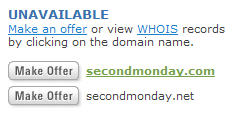
    Second Monday is not availableThis week my team is embarking upon yet another “namestorming” exercise, for yet another client whose brand name will be inextricably tied to their domain name. Once again, the process won’t be pretty. It will require lists of hundreds of word combinations. There will be disappointing WHOIS searches –brief high hopes dashed by a message like the one on the right. When I try my luck with domain name ideas, I feel like the poor schmo in the convenience store, scratching off another lottery ticket that yields — zilch.

    If there is any good news in this, it’s that the soul of good art (and branding is an art!) is constraint.

    The boundaries of the rectangular picture frame actually free the painter, and the limitation of the 88 piano keys inspires the songwriter. Struggling as we have been with the ever-shrinking canvas of available domain names, I was inspired this morning to hear on NPR a story about Theodor Geisel, better known as Dr. Seuss.

    He took the challenge of writing a book to replace the unbelievably boring Dick and Jane series of reading material. Seuss was on a noble crusade to teach six- and seven-year-olds how to read without prematurely sapping their will to live.

    Accepting the challenge, Seuss faced a huge limitation. He was handed a list of only 200 words that children this age were likely to be able to understand. According Philip Nel, the author of The Annotated Cat, and quoted in the NPR story:

    “[Seuss’] favorite story about the creation of The Cat in the Hat is that it was born out of his frustration with the word list.

    “He said he would come up with an idea, but then he would have no way to express that idea. So he said…: ‘I read the list three times and almost went out of my head. I said I’ll read it once more and if I can find two words that rhyme, that will be my book. I found cat and hat and I said the title will be The Cat in the Hat.’”

    In the end, Nel says, Seuss used exactly 236 words to write The Cat in the Hat, words that young readers can understand.

    The assignment took nearly two years to complete, but the result is a book that is still read and loved – which is inspiring until you realize that his pace works out to less than three words a week. Yikes!

    Our domain namestorming must produce a half dozen viable name options in as many business days. It’s an especially tall order because, I swear, there simply aren’t 200 good domain names remaining in all of Whooville.

  • Is One Positive Day tomorrow? Rats!

    Blogs and other user-generated content (UGC), coupled with search engines, have made negative news spread like online viruses. This news can be extremely harmful to a brand. Often the damage is unwarranted.

    A good example is the fall-out two weeks ago over the punishing flight delays that jetBlue subjected many of its customers to. Kevin Hillstrom of The Mine That Data Blog observed that in the week following these delays, more than 7,500 articles had been written about them in blogs and other UGC. The number is sobering.

    It’s especially concerning when you consider that no company is perfect, and jetBlue is better than most. From the top down, they are organized around the customer experience. Their blunder shows that with even the best of companies, stuff happens.

    In his open letter to the marketing blogging community, Kevin asks writers Rats in the NYC KFC-Taco Bellto think twice next time before braying about whatever company publicly stumbles. Outrage over poor customer service is fine, but restraint is also in order. Most reasonable people would agree that jetBlue does not deserve 7,500 voices screaming for blood. People were inconvenienced, not poisoned.

    On the other hand, poisoning would probably merit outrage from a blogger, right? Or how about the threat of poisoning, from rats in a restaurant, as shown in the photo above?

    Here’s why this is an important distinction. I promised Kevin on his blog that I would participate in his One Positive Day pledge. In this pledge, I as a blogger would not “go negative,” so to speak, just because the opportunity presents itself. In this pledge, I will not succumb to the temptation of talking about poor customer service merely as a way to elicit strong reactions from readers — strong reactions that would presumably garner stronger readership.

    Kevin proposes that One Positive Day, his moratorium on UGC negativity, would be enforced on the first day of every month. Starting tomorrow, March 1. So I only have a few precious hours to post this photo, which was taken from video footage of a Greenwich Village KFC-Taco Bell — the restaurant that made the news, and YouTube, for being an after-hours haven to dozens of cavorting rats. Yuck.

    Repeat after me. Yuck. Okay, enough of that. Tomorrow is a new day. A much more positive day. I promise, Kevin.

  • Is the music industry returning to street corner busking?

    The headline in the February 22, 2007 edition of Rolling Stone was ominous: Labels in Free-fall. It certainly looks that way. It reported that total sales of the top five CDs in January, 1997 was 865,144 units. This January sales fell short of that by 67% — only 285,702 units sold. Yes, that’s a free-fall alright. It’s also just the top five albums. Total album sales for the same two months was a drop of much less, 38%. That is, a drop from 55 million CDs sold in January, 1997 to 34 million this January.

    So is the sky really falling? Or are these figures simply showing shifts in how people are buying music? The answer, I think, is both. There will definitely be winners and losers. And a lot of the losers are Rolling Stone advertisers.

    Let’s look again at the numbers.

    First, consider the affect that the long tail phenomenon is having on sales. Although the top five CDs have dropped by two-thirds, the drop was far less severe if you add up all CDs purchased. A drop of 38% is pretty horrific, but it’s a long way from 67%. Why weren’t they closer in magnitude? The answer is exactly what Chris Anderson describes in his book. The masses are buying a greater variety of music, stealing unit sales from the blockbuster CDs. The superstars are far less super than they were in ’97.

    The article ignores that fact, because it is too busy bemoaning the imminent death of the album, and consequently, the death of the record label. I don’t argue that both are evolving fast. But dying? It’s all in how you define things.

    Now let’s look at the CD. The numbers cited combine online and bricks-and-mortar CD sales. But they are deceptive, because they look at a CD, or “album,” as something that is sold unbroken. Buying individual songs is not included. What’s more, small retailers are also ignored by the source of this data, Nielsen SoundScan. Retailers can only participate if they have “Internet access and a Point Of Sales (POS) Inventory System.” My favorite independent record store has one but not both. What’s more, labels can report sales of their CDs, but must pay $500 per year for the privilege.

    Single-artist labels are also disqualified. That means Ani Difranco was off the radar in 1997, when her Righteous Babe Records sold her CDs only (and sold them by the tens of thousands). This year there’s no telling what self-publishing artists are being ignored by Nielsen sales figures. And admittedly they’re the best we’ve got at the moment.

    Now let’s look closer at what a record label is good for (here’s a hint to their post-millennium relevance: A record “label” literally is the donut-shaped paper glued to the middle of a vinyl 45 RPM single or a 33 RPM “long-playing record”). There was a time when artists needed a label, both literal and figurative. They needed help producing and distributing their music. Much has changed.

    A co-worker, who is a niche recording artist in his spare time, describes a very different time not very long ago. Back then his home recording studio was a room with many expensive pieces of hardware, all wired together. When everything was fired up, the room became an oven. Voltage coursing through the system produced a perceptible signal hum, which itself had to be eliminated during the production process by – you guessed it – another costly gadget. All of this required money and ingenuity. My friend had enough of both to produce his albums, but most artists didn’t back then, and still don’t today.

    Luckily, a musician can record and produce albums today with nothing more than the processing power contained in a notebook computer. Buy-in, in terms of both money and intellect, is much lower. As for distribution, deals can be cut directly with sites such as iTunes (are you listening, Freedy Johnston, you neo-Luddite, you?).

    My friend is even considering placing a Paypal option on his music site. The site would accept donations, from anyone, regardless of whether they ever buy one of his songs. He tells me that others he knows can make an average of $20 a day, from total strangers, who just like what they’re doing and want to support their art.

    It sounds a lot to me like busking. That’s what musicians used to do — and still do today on busy street corners — to earn a living or a little beer money. They strum their guitars, leaving their guitar boxes open for passersby to drop donations into. The kindness and charitable nature of music lovers has always been the lifeblood of musicians. I’m seeing things come full-circle, in an era of improved access to the music that touches our souls.

    This was the meta message of Steve Jobs, in his essay last week that seemed to bite the hand that feeds iTunes. The Apple Computing CEO suggested that everyone would sell more music if digital rights management (DRM) was removed from the recordings that he and competing online music stores sell. Removing DRM would be the ultimate honor system. It’s as though he’s proposing to stop charging people a formal admission to hear their favorite artists. Instead, the artists come outside, into the open air, and sing their hearts out for those who toss their coins into a guitar case. Purchases of songs will remain retail transactions, but purchases will be made out of ethics and generosity and not punitive DRM constraints. 

    Representation and distribution were handled by official record labels, and not musicians themselves, out of necessity. Technology required it. This system worked for over 80 years but nothing lasts forever.

    Jobs’ anti-DRM essay is a signal that there must be a redefinition of the record label as we know it. Although labels won’t go away, the change will be significant. Instead of the label holding all of the power with most musicians, it will be the musician who can decide which street corner will serve his or her art the best. The label will manage the street corner. That is all. They’ll keep it clean, and maybe help to draw a crowd.

    In 2006, Time Magazine called the person of the year “You.” Is it possible that in 2007, Rolling Stone will be forced to crown, as its label of the year, “The Musician?”