Opinions are all my own

  • Will DoubleClick’s new owner trigger more market-driven ad pricing?

    There are two drivers behind the meteoric success of sponsored search ads. Yes, the main one is the pre-qualifying nature of an internet search. People signal their interest by the phrases on which they search, which makes this medium great at measurably driving sales. Linking search ads directly back to sales has transformed Google and other paid search providers into the automated equivalent of commission salespeople. (This virtual salesforce is made even better at “closing” through tools like the just-launched Google Website Optimizer.)

    The other driver of this medium’s success is the market-driven nature of buying search phrase clicks. Every keyword phrase is priced based on supply and demand, with demand expressed through what competing marketers are willing to pay for the same keyword. 

    Which leads me to yesterday’s announcement from Google, about their purchase of DoubleClick. They have once again expanded their empire, and like any self-respecting colonial power, they will be teaching their new conquest how things are done in the United Googledom.

    Banner ads and other online display ads are not nearly as successful at driving sales, although some direct marketers do quite well through sheer numbers and creative chutzpah. No, most online creative units (OCUs) support a sale in far subtler ways, by reinforcing the brand even if a click isn’t generated, and if a click does take place, by attracting consumers to sites and e-newsletters that allow for further product involvement.

    The pricing of OCUs on ad networks such as DoubleClick has been fair, in that prices are competitive across the various networks offering the same types of audiences. In this way and others, supply and demand manage media costs.

    Somewhat.

    The pricing used for ad network media buys is far from perfect. This explains the growth of ad exchanges, where inventory of available impressions across several similar sites and networks is taken into account when calculating what a marketer pays. This comes closer to the bidding model that sponsored search does so well (but not perfectly, because of click fraud).

    Not coincidentally, DoubleClick had recently announced it was seriously getting into the ad exchange business. Many theorized this was to help them become an even more desirable target for purchase. Speculation a few weeks ago was that Microsoft would be the prevailing suitor. Instead, Google is paying cash for the company. Lots of it: Twice what they payed for YouTube, at a reported $3.1 billion.

    I’ll take the experts’ word for it that this is a brilliant defensive move. It does make sense that depriving Microsoft of this massive portfolio of ad-serving sites is a big win for Google. What I haven’t read much of is speculation on the ways DoubleClick’s business model will change in the wake of this deal. 

    I’ll get the ball rolling with a few to consider:

    “AdSensible” ad pricing – This is a no-brainer. Google is essentially the biggest ad exchange in the world. It’s just that until now, most of their inventory was on search results pages, and instead of OCUs they’ve primarily served up text ads. OCUs may never be priced as dynamically as sponsored search ads, but this acquisition takes a step in the right direction.

    Better behavioral matching for improved OCU performance — Google and others have been testing products and systems to statistically model browsing behavior. It’s all in the service of predicting — on the fly — receptivity to various ads. This has been going on since the mid-90s, in portals like Go.com, and in ad networks such as Advertising.com — long before they, themselves, were bought by Disney and AOL, respectively. What has impeded everyone’s progress is a relative lack of reach (you need millions of impressions per day) and integration (across various media types). Google has both reach and integration. Especially after yesterday.

    Cheaper local advertising — Google is aware that, like politics, all advertising is local. Watch for signs that they will be leveraging DoubleClick in local advertising efforts. They are already making inroads with local businesses who can monetize geo-targeted clicks. For the majority of other local businesses, a truly inventory-driven (read: competitively priced) branding ad system would have a ton of appeal.

    I’m writing this on a Saturday, and something tells me that at this very moment Microsoft executives are scribbling on white boards in hastily-called meetings, attempting to overcome what must be a huge strategic loss. In the meantime, bloggers like me have no option but to chalk up another one for the “do-no-evil” empire.
  • E-newsletter readers hit reply: Don’t disappoint, arrive monthly or weekly, and on Mondays

    According to a survey conducted earlier this year to over 300 executives at small- and medium-sized businesses (SMBs), Monday is the preferred day to receive e-newsletters. Although half of those surveyed had no preference, those who did reported that they would rather see them at the beginning of their business week.

    The timing of email newsletters has been hotly debated since the medium first came into being. Marketers make significant investments in their creation and release, and can really stress out over things like what day they arrive.

    The reason is that e-newsletters are thought to boost a company’s perceived value, either as a pure information source (for subscription-based or advertising-supported endeavors), or as proof of a vendor’s industry leadership. The research, done by Bredin Business Information, would seem to confirm this halo effect.

    It reports that, “A third of SMB executives said they had an improved image of a vendor from its e-newsletters.” Whether this improved image will convert to more business was not explored. Which is, after all, what really matters. Especially since there are risks to this marketing tactic. The survey reported that if a vendor does a poor job with their emails their reputation will suffer. One out of seven reported that a poorly executed e-newsletter “damaged the sender’s image.”

    Frequency of delivery was another subject for investigation. As long as the quality of the e-newsletter is good, it seems more is better — to a point.

    The vast majority of SMB executives want to receive their email newsletters weekly (45%) or monthly (34%). Few want them daily (11%) or quarterly (6%).

    The take-aways:

    • Design your email newsletter to arrive more frequently than once every quarter (but not daily, unless you’re super-topical)
    • Assume you’ll be most welcome if you send on Mondays
    • Make sure you truly deliver the goods

    If your e-newsletter doesn’t excel, and you’re sending to current or potential customers, these readers could do far more than just unsubscribe.

  • Google Optimizer puts a potent tool in any marketer’s hands

    Until this week, the options for marketers who wish to test landing pages were unappetizing. You could create home-grown A/B tests, or you could turn to an online testing system offered by companies such as Offermatica or Vertster. The first option was slow and cumbersome, while the latter was yet another layer of campaign management. Google changed all that with the release on Tuesday of their Google Website Optimizer.

    The Eisenberg brothers, authors of the web marketing bible Call To Action, define a landing page as “a specialized page designed to induce the shopper who responds to an ad to make the purchase.” Once you’ve paid for a click that brings someone to this page, you’d better be sure to maximize the odds of a conversion. That’s where A/B split testing comes in. Using the original page as your control, you create a statistically reliable test with a second, similar page.

    The test’s hypothesis is this: That the test page, which has slightly altered  content such as headline, body copy, offer or pricing, will not improve response.

    Running both pages in equal numbers proves or disproves that hypothesis. If the test page does out-pull the control, it then becomes the control, and you pit something else against that. And so it goes until you’ve explored all combinations of variables or the campaign is over.

    Life was simpler for direct mail  and direct response print marketers, simply because of the time and cost restraints of that medium. You needed to test, but the number of test variables was limited by the slow feedback loop and the cost of split testing using ink and paper.

    But if you’re running an online ad — one that generates hundreds of clicks a day — you’d be crazy not to be continually testing something. All the time.

    Online marketing shifts the constraint away from the medium itself and squarely onto campaign management. In my experience, a majority of marketing organizations simply cannot manage the level of testing that they could or should be doing for a given campaign. Those who are loathe to test are spending more for every conversion they generate.

    Google has stepped in to help. Although their new tool doesn’t address the “expertise void” in testing (and they recognize that, as you’ll read in a moment), the Optimizer does promise to make the automation of testing within reach of just about any marketing organization.

    According to product manager Tom Leung, it enables advertisers to “receive up to 10,000 versions of a web page.

    “This tool lets you have one page, add a few Java scripts and
    then when visitors hit the page, there are different combinations served.”

    If the Optimizer is anything like Google’s other recent web marketing game-changer, Google Analytics (which is the refined suite formerly known as Urchin), this will be a direct response marketer’s dream.

    The Website Optimizer is free to marketers using Google Adwords. Because A/B tests require experienced content professionals to get right, it is no surprise that Google has created a legion of Optimizer Authorized Consultants. The list of consultants will be growing (hey, Google, you have my information — call me, babe!), but now includes Optimost, EpikOne and Future Now, the company that published Call To Action. Now why doesn’t that surprise me?

  • Print and other traditional media spur retail web searches

    If you thought pay-per-click (PPC) search engine marketing would make your marketing planning easier, think again.

    PPC is simple and brilliant: Show online ads to someone who is searching based on the keywords they choose as a proxy for their buying intentions. It’s a proven way to catch qualified prospects when they’re considering a purchase. Within limits, it’s also quite measurable.

    So life got easier, right? Certainly you can now eliminate much of your traditional advertising and pile on the keyword buys. There’s your plan. Now you can go home. 

    If that’s what you’re thinking, you may want to think again. 

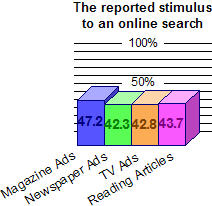
    Specifically, consider what sends prospects to their computers in the first place. A survey by the Retail Advertising and Marketing Association (RAMA) reports that consumers start their web searches based on many off-line stimuli, including much of traditional advertising.

    Consumers said that they were most motivated to begin an online search after viewing advertisements in magazines (47.2%), newspapers (42.3%), on TV (42.8%) and from reading articles (43.7%).

    Although it wasn’t specifically addressed here, you can gather that in these cases off-line advertising probably triggered a search for a brand (the advertised brand, that is), as opposed to a generic search (one on the category of product). In this way, the off-line stimulus greatly improved the odds of your PPC ads finding prospects who are ready to buy.

    Media that were most likely to motivate an online searchPut another way, the stimulus improved the PPC ads’ conversion rates. If you were to read the PPC stats in a vacuum, you’d confer more power to the medium than it deserves.

    Imagine two men in a fishing boat, one doing all of the casting of the line and reeling in of the fish, and the other man standing ready with the fishing net. It would be unfair to claim that the guy with the net was actually doing any fishing, just because he brought all of the catches into the boat.

    So which of the off-line media reels them close to the boat most effectively?

    I show the chart above not to demonstrate the superiority of one medium over another. On the contrary, I’m struck by how close they are in terms of “most motivating” a search. It instead shows what an incredibly mixed bag these media present the beleaguered marketing planner, and how technology, at least in this case, isn’t cutting that person any breaks.

  • Twitter’s sudden celebrity will soon become a fight for relevance

    Twitter is a way to broadcast via your cell phone or computer. What do you broadcast? Whatever is immediate and local. You disclose your thoughts, observations and whereabouts — and anything else you can fit within a 140-character limit text message. Here’s an unofficial Twitter wiki. Its Press and Media section has links to some of the latest buzz on this social media app.

    Twitter appeared quickly and will, in my opinion, flame out just as fast. Once it has died back down to a glowing ember, I suspect it will reside where it seems most suited: with younger students and others with plenty of time, a big friends list, and a high opinion of their own text-messaged voices.

    Because your cell phone can get deluged with “Tweets” (one attendee of the SXSW conference in Austin reported receiving 3,000 of them during her time there), it appears that most people finally turn the mobile feature off. Who of us, after all, has an unlimited text message plan and a high tolerance for deleting messages as fast as they arrive?

    But turning off the ability to receive these messages on my cell phone takes away one of Twitter’s major appeals: The ability to “microblog” from anywhere, and read other people’s insights dashed off from whatever house party or night club you weren’t able to get to.

    I’m always looking at these phenomena for how they might bubble up into the generations of working stiffs who are hoping technology can aid their productivity — or ease their workday the way a smoke break used to when more people smoked.

    This technology has me curious, but unless there is some improved way to filter the spamming effect I don’t see Twitter as surviving the battle for mainstream relevance.


    April 17, 2007 — An update:This weekend I succumbed. I needed to experience Twitter for myself, especially since I was reading intriguing comments on other people’s blogs, including this one. Keeping the mobile component turned off, I created this account: http://twitter.com/TheLarch (yes, I dropped my name’s trailing “e” — it’s a silly Monty Python joke).


    I’ll do a new entry soon with my thoughts.