Category: Web Marketing

New ways to create and measure sites so they improve their ability to bring your best customers closer and attact other individuals just like them

  • Your web site should be like the world itself: Inviting and “flat”

    When Thomas L. Friedman asserted that The World Is Flat, he was referring to the interconnectedness of this newly networked world. He could have also been referring to the structure of an ideal web site. Why should it be flat? The site needs to offer a way for nearly everyone to efficiently find everything with the fewest possible barriers.

    Ryan Singer of 37Signals reminded me of this when he wrote that web architects should think about paths instead of hierarchies. He writes:

    My friend did some work for a shoe company who wished to hide six different kinds of shoes behind a gate called “Performance”. When my friend asked 40 uninvolved people in his office what the category “performance” meant to them, only 10 had even a vague idea. So hierarchies have their problems.

    My team’s web architects have often run into the same thing when beginning a redesign of a client’s web site. The language used in the architecture often hides what users are striving to find. Ryan’s solution is to, “Collect all the paths you can think of in a pile, pull out the 8 paths that 80% of your visitors come looking for, and that’s your home page. When paths overlap or the same customer needs them, weave them together.”

    I’d council to do the following, as a supplement to this excellent advice:

    1. Build your path list, to use Ryan’s term, by scrutinizing many a visitors’ navigation of last resort. Namely, look at behavior in your site’s search function. As I’ve mentioned earlier, mining your internal search data can reveal much about what your web site is hiding from user!
    2. Consider approaching the challenge in terms of audience, and not exclusively in terms of most popular pages (such as the eight paths accounting for “80% of visitors”). The reason? Your visitors may be leaving before they find some of your most popular content.

    Finally, I’d add this word of caution — three times, in fact: Test, test test! Your key audience may be of a generation where an indiosynchatic navigation system my more useful, but too initially initimidating. Baby boomers and their elders came from a time when hierarchy was not a dirty word. They may instead have a much shorter word for an elegant but unexpected site navigation: chaos!

    Have I missed any other tips in making a site as flat as the digital world where it resides?

  • How little do web users read? Even less than you think

    Before you struggle too hard and long over that golden prose you’ve drafted for your web site, consider this statistic, as cited on Jakob Nielsen’s USEIT.com site last week:

    On average, users [in the study discussed] will have time to read 28% of the words if they devote all of their time to reading. More realistically, users will read about 20% of the text on the average page.

    The takeaway: Write as though your reader has one foot out the door and the other on a banana peel. Get to the point and then move on!

  • Today Google does a cannonball into the social networking pool

    Three weeks ago, on a lark, I registered the domain name RumSocko.com. But until just now, I wasn’t entirely sure what I was going to do with it.

    Then, just moments ago, I learned that Google has entered the social network arena in a way that only a market behemoth can. Friend Connect will allow any site to have social network functionality. This tells me two things:

    1. Google sees an opportunity in social media marketing (SMM)
    2. It’s time for me to invite my friends and relatives to submit their favorite rum drinks

    Of course, only point #1 is of real relevance to my fellow marketing technologists. There has been plenty of talk lately about how social networks are still groping for a viable revenue model. I suspect Google will lead the way to the banquet.

    An example

    The only question will then be: Must other social networks resign themselves to the crumbs that Google leaves behind?

  • StumbleUpon gets to the crux of my problem

    Sometimes I regret finding so many things interesting.

    You see, I grew up in a part of the country that was extremely remote and sparsely populated, with little cultural diversity, in an era before cable, VCRs, and of course the internet. The majority of my teachers, bless them, were clearly there for the hunting and the summers off. In other words, intellectual stimulation was not a feature of my childhood.

    Home Sweet Home

    Years later, after some lucky breaks and the support and guidance of some extraordinary people, I find myself doing work that is rewarding and stimulating. Especially stimulating. The internet has given me the freedom to explore everything that intrigues me.

    All of this became apparent as I updated my StumbleUpon profile.

    It’s as though a genie had poofed out of a lamp and given me the ability to visit the best web sites available on any subject. And unlike the genie from One Thousand and One Nights, I’m given not three wishes but 127.

    There is the rub!

    And this is just the start

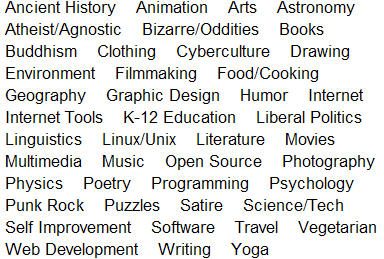
    I started with major interests, and realized that I’d checked more categories than I’d left blank. As I dug deeper into each, I was stopped at 127 interests, with the depths of many categories left unplumbed. The word cloud above shows the major selections only.

    My first bosses were a pair of brilliant advertising entrepreneurs. One had a degree in history, the other, journalism. Together they showed me the power a person grounded in the Humanities could have in the business world.

    They too were cultural omnivores.

    I thought of them this evening as I ticked off the many areas of study I wished I had an entire lifetime to explore.

    Tonight I might skip sleep. Again. I may just stay up and drink deeply from the well of StumbleUpon, a magical servant who feeds that little boy whose thirst for knowledge insists on being quenched.

  • Webby winners include new personal finance site

    Yesterday I described how Mint.com effectively used persuasion architecture modes of purchasing to acquire new users. Mint.comLater that day the site acquired its first Webby Award. Here’s a rundown from Mashable of other notable winners, including one that should have gotten Best Use of Snail Mail In Its Web Design: PostSecret.com.