Category: Productivity

  • Twiducate concept is too good to stay in the classroom

    Yesterday Naomi Harm give a keynote address at the Lake Geneva Schools Technology Academy, an educational event for elementary, middle school and high school teachers. Although I wasn’t at the event, word reached me about a social media-inspired educational platform called Twiducate. Similar to Yammer (“Twitter for intra-business communication”), Twiducate does not use the already overtaxed Twitter platform, but instead uses many of the principles that make Twitter so useful.

    I took a test-drive of Twiducate last night, and two things struck me. The first revelation I had became the title for this post; The developers of Twiducate will be hard-pressed to stop work groups other than classrooms from using the tool. The other revelation is about education reform. Yes, reform won’t happen on its own. But certain facets of it will happen naturally, “seeping in” from the emerging social media zeitgeist. Avoiding new teaching environments like Twiducate will be like holding back a rising tide.

    Here’s a video:

    So: Will the subversion of this tool be harmful?

    I think asking the question is moot. This type of thing will happen regardless. I’m thinking of at least two other examples of where a social network is forced to morph because of the unintended uses those pesky members decide to put it to.

    1. Fotolog.com started as a primarily photo-sharing site, similar to Flickr.com. But its meteoric growth in the last decade — especially in Chile, Argentina and Brazil — was due to users hopping on to connect and generally socialize. Sharing favorite pics became secondary.
    2. If the above sounds like dumb luck — like simply being in the right place with the right product (read: social toolset) — you’re right. And you’re also probably thinking of my second example. Although Mark Zuckerburg might posit that Facebook’s growth was all part of some master plan, we shouldn’t forget that he built it in his dorm, six years ago, as merely a “Harvard-thing” — primarily an easy way for him and others to organize study groups.

    Check out Twitucate. Do you agree that it’s more than education’s new “Moodle-killer?” Does it have “legs” beyond academia, and is that a good thing?
  • Dashboard liberation: Excellent Analytics moves Google application to Excel

    Although it’s easy to bash Microsoft, over the years a handful to tricks have made me an avid fan of Excel. Pivot tables and relational look-ups (all hail VLOOKUP!) are two arrows in my web analytics quiver. I’ve just added another. If you work in Google Analytics a lot, you should too.

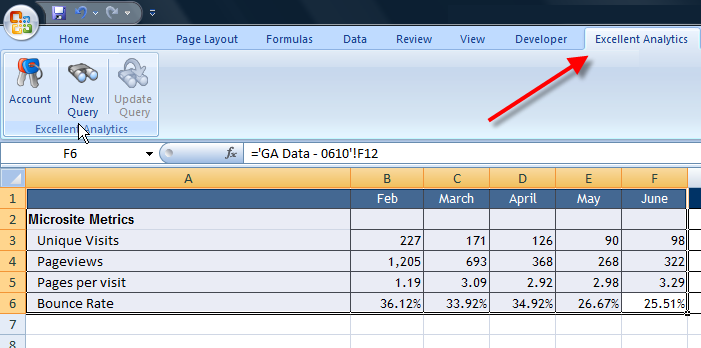
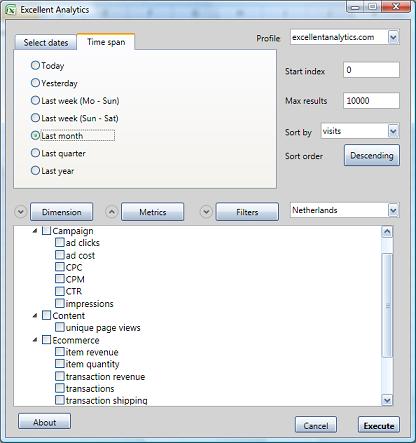
    Excellent Analytics is a free Excel add-in that truly lives up to its name. It allows you to run queries to Google Analytics’ API right from Excel, and publish its results there.

    Say goodbye to many of the “Save to Excel” hassles that used to come with wishing to share and chart Google Analytics results beyond its powerful-yet-limited dashboard.

    Go to Excellent Analytics now and give it a try. You’ll need Windows Vista or greater, Microsoft Office 7, and Windows .NET Framework 4. Give yourself a couple of hours to install and learn the system. Then start publishing, charting and sharing. You’ll fall in love the way I did!

  • Voice recognition was done first and best by humans

    Back in 2008 I theorized that it would be just a few years before voice commands revolutionized marketing and commerce. Not necessarily for everyone, mind you, but most significantly for people who wouldn’t dream of using a keyboard, or even a smartphone!

    My post, Leaping the chasm to a plugged-in construction site, predicted that voice recognition isn’t that far away, and is the only way that many professionals would benefit from the utility of digital networking and cloud computing — ranging from the “safety glasses and hard hats set,” to offshore oil technicians (were you listening BP?), and even to surgeons.

    One Million Years BC was a very cheesy movie about life before history. Original voice was mostly simple words and grunts. Heavy breathing was also involved -- at least, I'm imagining, by certain audience members.
    In the beginning, even before we had a written language with which to record history, our original form of communication was voice. The problem with voice, however, was that once the words were spoken, they were gone forever. HarQen was launched at a time of technology convergence, when original voice can be turned into an asset.

    That was as an outsider in the digital voice space. After spending time “inside,” with my friends and co-workers at HarQen, I’m realizing that voice recognition isn’t the only way to make a big difference with these types of phone users. I’ve discovered that you can derive value simply from people talking into their phones and having these snippets turned into sharable assets.

    In other words, I hadn’t considered original voice. Original voice can be thought of as voice “captured, stored and shared,” pretty much as-is.

    HarQen believes The Original Voice Matters. I recently talked about their view, of how voice is the “original rich media,” at Ungeeked Elite. Here’s a post from last week, on the VoiceScreener blog, that helps to explain why the best voice recognition software still resides between our ears — and how HarQen is using voice asset management to give clients an impressive competitive advantage.

    So I was wrong. But I’m even more excited now than I was then. I cannot wait to see what happens when voice asset management is commonly adopted. Although it might not be powered directly by voice recognition, there may be a plugged-in construction site after all, using speech in the way it was used in the days when the only construction sites were in barely habitable caves!

  • Voice: The original rich media

    I had a fun time talking to the group this morning at UnGeeked Elite. I spoke about the power of voice asset management. If you’d like to know more, here’s a post recently on our VoiceScreener blog, by our CEO, Kelly Fitzsimmons, describing Voice as an Asset (VaaA).

    I promised to post a mind map of the post-presentation discussion. Here it is (click to expand):

    Also, if you want to check out that TEC video, here’s my original post about it, Jeff Han’s demonstration of multi-touch screens. I was wrong in that it’s more slanted than vertical, as I had said in the presentation. I had seen another video of him demonstrating the screen somewhere else, and that one was more vertical, and shot more at a distance.

    Finally, Jonathan Brewer, (@houseofbrew) of FirstEdge Solutions had dared me to show him that super-comfortable office chair I work on. Here’s the photo I just posted of it on TweetPhoto (click to expand):

  • Why I joined HarQen

    Today was my first day as a HarQen team member. Although my title is Director of Client Services, I’ll be wearing many hats. What, you haven’t heard of HarQen yet? You can be excused. During its young life, the members of this lean start-up have built from scratch a set of web-based services in an entirely new category: Voice Asset Management (VAM). It is ambitious in the extreme — and leaves little time for a focused PR effort.

    That’s one place where I come in. I’ll be wearing many hats here, but two are social media “ambassador” and PR leader. I’ll be helping HarQen clients share their stories about these astounding services. Chief among those offerings is VoiceScreener, a way to vastly improve the quality and speed of hiring.

    I know from personal experience the value of the VoiceScreener VAM system. (Yes, VAM. There’s that acronym again. Here’s another for you: VaaA, which stands for Voice as an Asset.)

    In a previous life I was the defacto recruiter for the digital marketing team I led. One of the most grueling searches was when I was looking to hire a truly stellar project manager. VoiceScreener would have helped me, by inviting the dozens of applicants to answer a few guided questions over the phone — all at their convenience, talking to an automated “interviewer.” Answers are turned into the voice assets that can be quickly reviewed, sorted and forwarded — all as easily as processing emails.

    One VoiceScreener client brags that the application dramatically accelerates the preliminary phone interview process. He contends it literally doubles the odds that any given applicant is going to be hired. He’s with a large recruiting firm, where twice as many high-quality applicants means, over time, twice as much revenue for him and his company.

    Follow me and you’ll likely hear him tell you about it. All I’ll be doing is providing the megaphone.

    I’ll be posting fewer entries here, at DigitalSolid, as I focus on the blog at VoiceScreener. I hope you follow me over there. The category of VAM is about to heat up and I’d love to share my experiences in this exciting new adventure.