Author: Jeff Larche

  • OK Computer: What is this CD worth?

    One thing you have to say about the changing business model for the music industry: It gets people talking! My post a while back about how this change is bringing musicians back to their “roots” as street corner buskers generated a lot of great comments. This post on the Freakonomics blog last month has generated 81 comments and counting! Now Radiohead, the popular alternative (oxymoron?) recording act has upped the ante, and in doing so has kicked discussion into high gear. They’re asking fans to determine the cost of their new downloadable CD.

    According to this piece in Music News, Radiohead is releasing their DRM-free CD online and letting fans determine its monetary worth:

    Radiohead said its seventh studio album “In Rainbows” would be available from Radiohead.com from October 10 in MP3 format, meaning it can be played on all digital devices. In the latest twist in the move to digital music, fans can choose how much to pay, or can pay nothing if they prefer.

    If this scares you, you’re probably a record label, or some other member of the entrenched (many would say hidebound) music industry. Conversely, if you’re smiling, you’re probably like me: A fascinated observer of how technology is shattering pricing constraints and distribution barriers between artists and those who appreciate them. And did I mention I’m also a huge Radiohead fan? My smile just grew into broad grin.

    Maybe, as a show of support, I’ll pay more than the cost of their physical CD (which will be distributed through conventional channels).

    For instance, I might pay as much as I’ve ever paid for one of those glorified coasters. I’m guessing that was $18, ponied up sometime in the late 1990s. The CD that 18 bucks got me was, I’m sure, packaged in a crack-prone jewel case, and came complete with booklet featuring unreadable mousetype lyrics and liner notes. I’ll certainly miss that royal treatment.

    For once I’ll be opening my wallet without feeling fleeced. That sounds pretty terrific.

  • Gamers in the ivory towers

    A recent survey of 7,100 executives revealed a secret C-level indulgence: video games. PopCap Games conducted the survey, and here is a summary of their findings:

    This representative sample suggests that as many as 80 million white collar workers play casual games. Of those white collar workers surveyed, nearly a quarter (24%) said they play “at work” — with fully 35% of CEOs, CFOs and other senior executives saying they play at work.

    Tameka Kee of MediaPost points out the most promising implication for business-to-business (B2B) marketers: “These ad-supported games reach their targets on an unexpected, but increasingly popular medium.” In other words, they reach the men and women who screen their calls, have someone else sort through their mail and block unknown emails.

    At last we know what they’re doing behind those closed doors.

  • When an online social media effort goes terribly wrong

    Marketers love the idea of using online social media. Why shouldn’t they? Promotion on online communities provides something no advertisement could ever deliver: Authenticity. After all, another term for online social media is electronic word of mouth. So what happens when a marketer is behind the community postings on a subject, and gets savagely “outed” by a prominent member?

    Here’s a compelling and instructive story of online “gotcha” at its worst. Read this story by online marketing expert Jennifer Laycock and heed its warnings. Three of her tips are the following:

    1. Never respond immediately when things get sour
    2. No matter how valid it may be, don’t attack your attacker
    3. If there’s anything you are guilty of, admit it immediately

    Sadly, at least one of these was learned the hard way.

    Enjoy the story, and let me know of any other social marketing tipsheets that you think are based on hard-won knowledge instead of the standard best practices.

  • Taking a break for two weeks

    Last week I clicked on a link to a friend’s blog, only to find this message. It seemed an apt metaphor for why I am taking a brief break — the first extended vacation since I started this blog in May of last year.

    Bandwidth Exceeded

    I look forward to returning the fourth week of September, rested, refreshed and ready to continue my exploration of marketing technology with you.

  • Sponsored SMS bulletins show promise

    New media consultant and columnist Steve Smith speculated recently in MediaPost that we will soon be receiving many more sponsored messages with our cell phone’s text bulletins. These text bulletins, also known as SMS messages, are the 140-character packets that helped Justine Ezarik rack up a 300-page AT&T cell phone bill. (She reports that Twitter and the SMS feature of Facebook were the biggest culprits. Each message sent and received was separately itemized.)

    The good news is these messages will be extremely targeted, and are “opted into” in exchange for the content received. An example cited by Smith is NASCAR race updates, sent to the 200,000 subscribers to this branded program. He explains that if a supermarket chain would want to target those interested in NASCAR, “There is enough mass there to net perhaps 80,000 users in a general geographic region.”

    That’s enough to make quite an impact. Especially since response rates are impressively high.

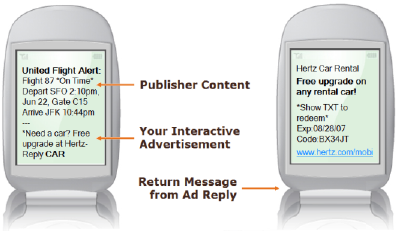
    Although the initial calls to action must be quite brief — 20 to 80 characters — the extremely targeted nature of the messages helps response. A “response” is usually hitting reply, to receive a full (up to 140 characters) expansion of the offer and a URL to click on. This graphic , provided by the MoVoxx site, helps illustrate the typical process:

    How InTxt by MoVoxx works

    Alec Andronikov, who is the managing partner of MoVoxx, says that of the many billions of SMS messages sent each month, somewhere around 500 million of them are some kind of publisher-pushed alert. And each could conceivably be sponsored. Smith continues:

    Right now, [Andronikov] claims about 3.5 million uniques with sports, travel, dating and newspapers comprising the largest content categories. … Andronikov claims a response rate of 2.5% to 4% on the SMS ads.

    That means a hypothetical, regionally-based supermarket chain running a NASCAR promotion could get their entire message in front of at least 2,000 fans (80,000 recipients of the initial, sponsored message multiplied by a 2.5% response rate). If the offer is compelling enough, this can win the chain hundreds of new customers.

    The ability to target consumers by age, gender and zip code — as well as areas of personal interest, as implied by the content to which a consumer subscribes — promises a way to take the junk out of junk text messages.

    Through testing we’ll soon see whether these campaigns “have legs” — whether they can generate enough of a return on investment to make them a smart, new marketing tactic.