Author: Jeff Larche

  • BarCamp Milwaukee reflects the wealth of talent and intellect in my city of choice

    This afternoon I attended Milwaukee’s second annual BarCamp, which is about a lot of other things, but is primarily smart and creative technologists coming out to play. (The tag clouds below are from the BarCamp Milwaukee site, where attendees are asked to state their interests in the same way that presentations / activities are given relevant keywords.)

    BarCamp TagsIt was stimulating to experience the free-form workshops, and exciting to imagine what this event will grow into with a few more years of publicity and support.

    As I write this late on a Saturday night, the events are still taking place. BarCamp runs non-stop through tonight and into Sunday afternoon. When I return to give my presentation at 10 AM tomorrow, it will be interesting to see the level of wakefulness of my audience.

    Under the influence of seminars on topics like improving streaming video and using Ruby On Rails to build better sites, I couldn’t let the night go by without doing at least one software change to improve Digital Solid. It’s nothing you can see, but I’ve removed the nofollow attributes that appear in links with the comments that people leave.

    Thank you Douglas Karr of The Marketing Technology Blog for this important search-engine-related modification to WordPress blogs (like this one). Doug, I owe you a lot. You’ve given me the strength to face a roomful of mostly developers tomorrow morning, safe in the knowledge that I too can hack code — okay, when given simple and explicit directions!
  • Unilever discovers, then embraces, the power of online social media

    As a marketer I read too many cases about companies who do one of the following:

    1. Ignore the power of online social media, in spite of their brand being ideal for its careful use
    2. Run headlong at this Web 2.0 phenomenon, throwing caution to the wind, only to do more harm than good to their brand

    danah boyd [sic], the well-known anthropologist and “youth and technology” expert, gives a very personal account of the spread of Unilever’s Dove Evolution campaign. It’s a case study for how an exceptional marketing idea can gain legs through sites such as YouTube.

    In the post she recounts how she was acting out of what she perceived as the public good, and not as some shill for the brand. Truly inadvertently, she says that she became “a marketer’s dream.”

    I agree. But what still amazes me is that similar efforts for less savvy brands would be viewed by their stewards as unacceptable — nothing more than the unauthorized spread of their content.

    These folks would look at the Danah Boyds of the world as more of a nightmare than a dream. Go figure.

  • Jeff’s first Pecha Kucha

    It was actually Charles Dudley Warner — and not Mark Twain as is commonly thought — who first quipped, “Everybody complains about the weather, but nobody does anything about it.” Boring slideshow presentations come in a close second behind the weather for producing the most heat for the least real flame.

    As I’ve noted here before, Edward Tufte is that rare exception. He’s written extensively on alternatives to the presentation status quo.

    On the other hand, the inventors of Pecha Kucha tell the press that they have no goal more lofty than putting butts in seats at their Tokyo performance space. But I really think they’re onto something.

    [youtube C_5l6hXwzUo]

    As I mentioned a few days ago, I presented my first Pecha Kucha on Saturday, to support the discussion of a new web metric called the Content Interest Index. Today you can find it posted on YouTube (embedded above), to make viewing and sharing a little easier.

    I hope to soon attend my first Pecha Kucha performance event in Chicago (the date is TBD), where I know the quality of the presentations will make me glad I didn’t quit my day job. But until I see what a real Pecha Kucha can do, I’m fairly happy with this quirky way to explore an otherwise “bland” topic. I’m also glad to do my part in “doing something” about the scourge that is SDD (Slideshow Deficit Disorder).

  • New billboard mascot is another case of Analog = Tired, Digital = Wired

    When I was in high school, in my sleepy, remote hometown, the local shopping mall wanted to do something different for the holiday shopping season. Not content with a mere Santa Claus, they had plans to build and “populate” a talking Christmas tree.

    This hollow tree would contain a person — someone who would sit there all day and accost passersby, engaging them in clever yuletide banter. I must have gotten a reputation as someone who you couldn’t shut up, because I was offered the gig.

    I declined.

    I was 13 years old, and acutely aware that as soon as word got out I was the voice behind this blight on the retail landscape, I would become a serious candidate for after-school deforestation.

    Everyone knows that mascots are not cool.

    I must have given off a serious death wish, because I got a similar offer when I was in college. I was working as an intern at a bank.

    They were shocked and crestfallen when I told them no, I would not spend my weekends prancing through the aisles of our football stadium dressed as a giant foam checkbook. What could I be thinking? I’ll tell you what I was thinking: Mascots are not cool.

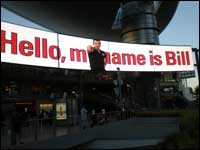
    The Digital MascotThat’s why I took special note when I heard this account on NPR’s On The Media. It’s of a mascot that is actually, certifiably cool. The podcast segment includes an interview with the actor who brings this mascot to life. And yes, he fully grasps that he has landed a truly plum job.

    He’s the star of an animated, digital billboard in Las Vegas. Hidden cameras and microphones allow him to carry on conversations with pedestrians, while images of the products and services he’s hawking stream and flash in the background.

    I’m still trying to fathom why this is so dramatically different from a talking Christmas tree in Escanaba, Michigan. I’ve concluded that it’s another example of The Age of the Nerd.

    If it’s digital, it is most likely pretty awesome.

    So, if the marketing department of that bank where I interned is reading this, I have something to say to you:

    I’m a little long in the tooth to sell checking accounts in football stadiums, but if the offer still stands, I’m your man, on one condition: It’s got to be electronic checking.

  • How well are you feeding your web site’s antlions?

    Earlier today I spoke at a conference for web marketing professionals in Jacksonville, Florida. My topic was web analytics. It was a well-timed opportunity for me. I used the talk to do these two things:

    1. Discuss the new web metric my team has innovated, called Content Interest Index
    2. Try out a form of condensed slideshow presentation called Pecha Kucha

    As I described in a prior post on Pecha Kucha, this is to slideshows what the haiku is to poetry, and Dogma 95 is to film making. It has strict rules designed to bring out the soul of a presentation — especially if you subscribe to the phrase “the soul of brevity.” The rules are that you have exactly 20 slides, and each is up for exactly 20 seconds. That means after 6 minutes and 40 seconds, you come to a full stop.

    For those of you as nutty about films as I am, you know that Dogma 95 was borne out of the desire of a handful of directors to treat their audiences like grown-ups. Pecha Kucha may not pretend to be anything loftier than playful fun, but it does respect the audience’s valuable time. How refreshing!

    My presentation needed a “hook.” I chose a doozie. I compared a web site’s conversion funnels to the lairs that are built by antlions. These critters were an obsession of mine when I was 10 years old (I even kept one as a pet, in a sand-filled coffee can in my bedroom!).

    I frankly could not resist using graphics of the antlion’s traps as ways to illustrate aspects of measuring web conversion. In this elaborate comparison, ants unwittingly encircle the antlion’s lair and some tumble to their doom, in the same way that web visitors cruising around a site’s pages are attracted to offers (the “mouths” of conversion funnels).

    Hey, no one ever said marketing was pretty.

    The Antlion’s Lair

    Yes, this comparison is a bit of a stretch — if not downright grisly — but I do believe I got my point across. Especially with the help of a supplemental presentation, given in mind map format (here is the map, in Acrobat format … watch out, it’s a quite large file at 2,310 KB). My presentation included excerpts from the CII case study that you can download from this blog entry.

    Let me know what you think, and more importantly, if you think the antlion should be some sort of Web 3.0 mascot. What’s the reasoning behind that suggestion? None whatsoever, except the antlion is a very clever creature.

    And hey! What the heck. A creature looking this monstrous really needs a break.