Author: Jeff Larche

  • This Thursday’s Interactive Marketing Assoc. speaker weighs in on Influentials, NPS and social media

    The Milwaukee Interactive Marketing Association has come back to life, and its first event of what promises to be a fascinating season will be Thursday night, at the William F. Eisner Museum of Advertising. Bryan Rasch of Hanson Dodge will discuss how to meet the online needs of what his firm calls Brand Champions. It’s a somewhat ironic term, since the sites his company creates for their core clients (including Trek Bikes) are for “active lifestyle” consumer products. These sites cater to champions of all stripes — some of the most active consumers, including triathletes, pro fishermen and other avid outdoors people.

    I spoke with Bryan to get a feel for his company’s approach to online branding. I wanted to know his thoughts on three topics that are being hotly debated today. They are as follows:

    1. Influentials: Do Malcolm Gladwell’s Influentials really exist? And if not, aren’t any efforts to court brand champions ultimately wasteful?
    2. Net Promoter Score (NPS)*: Where do you stand on the topic of this metric?
    3. Social Media As Brand Promotion: Isn’t the potential for negative online reviews too harmful to warrant opening your brand to public discussion?

    JL: First, Bryan, I’d like to know what you think of those people, such as Bob Garfield (the AdAge columnist) and Clive Thompson (in his February Fast Company piece) who have claimed that there is no validity to the concept of courting a product’s Influentials?

    BR: They have a point in that you can’t identify a small number of extremely influential people, to whom everyone else turns for advice on a brand. Brand champions are a much broader base of product users. They are vocal, and they particularly prefer the web as their megaphone. But aside from their passion for the brand, they are no different from other customers. They may make up large numbers — upwards of 10% of the total number of visitors to a typical brand site.

    JL: I’ve heard you talk about Net Promoter Scores (NPS) as a metric. Do you encourage this type of evaluation, or do you agree with those who think it’s too simplistic?

    BR: I do encourage the use of NPS, but primarily as a measure of true customer satisfaction. The strength in this measurement lies in knowing that it doesn’t predict a user’s likelihood of being a brand champion, but the likelihood of that customer buying from you again. But I think this score can also help you understand the likelihood of your consumers to speak out … to write positive reviews, recommend your brand to others online, etc. Thus the metric is helpful as a barometer of how your brand may perform within Social Media formats.

    JL: If you want to encourage brand champions online, you have to open the gates and let in all opinions. A minority of brands are comfortable with a certain level of negative buzz. But most refuse to provide forums for discussion because they’re afraid of getting flamed — of being host to unfavorable reviews. What is your response to those fears?

    BR: The negative reviews will happen, and often they’ll happen first. But reviews seek an equilibrium, just like water. Initially, a negative review may show up, because a consumer is angry. But over time, other consumers who love the brand tend to prevail. Over time the sum of the reviews reaches the proper level of consumer opinion.

    I’ve never come across a set of reviews where it wasn’t an accurate barometer of how the brand fulfills consumer expectations.

    Do join me Thursday night at what promises to be a provocative and informative presentation. Visit the Milwaukee Interactive Marketing Association site for details.


    * NPS asks customers one question: “How likely is it that you would recommend us to a friend or colleague?” Customers reply with a score on a scale of 10, with 10 being “Extremely likely.” The net score is the sum of all customers scoring nine and 10, minus those scoring six or less. Incredibly high scores are in the 75 to 80 percent range of your customers. The average is only 15%.


  • Research proves it: People like it when your web site is nice to them

    As mentioned earlier in this blog, Daniel Pink has done informal research into how your web site’s prompts and error messages could stand a little humanity. Now there is formal research to back this up. New Scientist magazine (paid registration required) covers research that proves “computer glitches would be a lot less annoying if the machines were programmed to acknowledge errors gracefully:”

    The trick, according to a researcher who has analysed users’ responses to their computers, is to make operating systems and software more “civilised” by saying sorry more often. That way people won’t feel they are stupid or at fault, so they become less apprehensive about using computers, and perhaps more productive and creative.

    National Tsing Hua University’s Jeng-Yi Tzeng is quoted in the article as being inspired by the Chinese saying, “No one would blame a polite person.” He wondered if this applied equally to “polite” computers.

    So Tzeng wrote a couple of versions of the same computerized guessing game, and recruited nearly three hundred students to play one version or the other. The control group got a brusque version, and the test group, an apologetic one.

    The game’s goal was to guess a Chinese saying, but annoyingly, the program often made users guess the same sayings again and again. It was also unhelpful in the clues it supplied during the guessing process. The control group received a typical set of error messages, but the test group saw messages such as, “We are sorry that the clues were not very helpful for you. Please try the next game.”

    After half an hour’s play, users of both versions were equally disappointed with the game itself. But those who had played on the apologetic version were more likely to describe it as fun, and 60 per cent of them said the apologetic feedback made the game more enjoyable.

    However, apologies made no difference to 25 per cent of them, and 12 per cent said they felt they were being manipulated. Tzeng will report his findings in a forthcoming edition of the International Journal of Human-Computer Studies.

    “It is what I expected,” comments Eric Horvitz, manager of Microsoft’s Adaptive Systems and Interaction Group. “Arrogant software rubs people up the wrong way just like an arrogant person would.”

    The take-away: Take another look at the error messages you show your prospective and current customers. Although hyper-politeness can be as grating in certain cultures as bluntness, softening messages, and making more “human, ” can only serve to improve outcomes.

  • Andy Sernovitz provides disarmingly love-filled advice to a b-to-b crowd

    I’ve wanted to see Andy Sernovitz speak for several years. This Milwaukee-boy-made-good is the author of Word of Mouth Marketing: How Smart Companies Get People Talking. He’s a terrific dose of inspiration for any marketer facing the terrifying prospect of helping a brand “go viral.” Today he provided that inspiration — along with some excellent tactical ideas — to my city’s Business Marketing Association.

    Sernovitz’s presentation clearly had a consumer marketing origin, but he did an excellent job of reminding the business marketing group that we all go through the same decision stages in a considered purchase. Whether the person is a retiree buying his first recreational sailboat or a young design engineer considering parts suppliers, we’re human first. We’re swayed strongly by the opinions of others.

    We’re also moved by the creative imagination of smart marketing. Andy reminded us that we love what a brand does for us, or how it tickles our fancy.

    Ah, love. Who knew there would be such a strong tie-in with Valentine’s Day?

    Joking aside, here are two of his tips that are dead-on when it comes to marketing to business buyers:

    • White papers are still effective viral marketing tools
    • Email-a-colleague tools on your b-to-b web site are as well

    Andy also mentioned that it was the viral aspect of YouTube that has it valued so high compared to other video sharing sites. He counted 13 ways that YouTube helps people email or otherwise share its content with others.

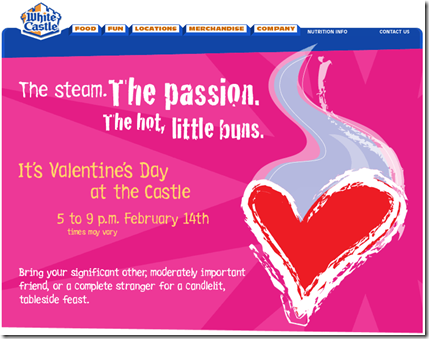
    Online support of smart promotions can also help to get people talking. As a topical example, Andy mentioned this brilliant way that White Castle is getting people to talk about their restaurants on this day:

    A great ad, cited on Andy’s blog today

    Now there’s one more restaurant that you can’t get into tonight without a reservation!

  • CareerBuilder’s plans for grabbing and keeping Sunday’s Superbowl viewers

    Like millions of other Americans, I try to catch the Superbowl every year. But I’m a marketer, so my priorities are warped. With DVR remote in hand, I often time-delay the event by 45 minutes at the outset. This is so I can fast-forward through the often painfully one-sided game (and yes, Ron, your Pats will cream the Giants), and focus on the commercials. Laptop at the ready, I hop from one web address advertised to another, seeing the latest trends in corporate integrated marketing. Less strenuous than birding or trainspotting but just as geeky, I chalk the task up to research. But with this research, drinking pale ale is mandatory.

    This year CareerBuilder is whetting my thirst for — ahem — knowledge with teaser emails. As usual, they are using the spendy ad space to kick off their annual ad campaign. Something tells me there will be a cool viral microsite to go along with it, to keep the $3 million (which is the reported cost of one of this year’s 30-second Superbowl ad slots) working throughout the year. Here’s their email to me:

    CareerBuilder Email From Tuesday

    Notice that I turned off the graphics to help you focus on the content. Kudos to CareerBuilder for constructing an email that “looks good naked.”

    I’ll see you online, CareerBuilder!

  • PRISM, a bricks and mortar store analytics effort, takes its cue from e-stores

    It seems improbable that there was ever a time when skilled marketers didn’t use at least some traffic data to make improvements to their sites. The availability of this data, no matter how flawed, has been a chief impetus for the growth of web marketing as a discipline. The comparison was always with the dearth of similar data from bricks and mortar stores. Here are a few specifics:

    Stage of Purchase Web Metric Store Metric
    Initiation Unique Visits Foot Traffic Counts
    Consideration Page Views None Available
    Completion Transactional Data Transactional Data

    This list is over-simplified, but it makes a point. In the Consideration Stage — between the time when the door store swings open and the time the purchase is rung up — there is little to help the bricks and mortar marketer understand the motivation of the customer.

    By comparison, a web marketer has a full toolkit of metrics. There are page views to show visits to specific product pages and web site sections, exit pages to show when a consumer decides to leave without buying, and shopping cart abandonment metrics to show exactly when a consumer decided to stop his or her purchase.

    This stark difference is changing fast.

    PRISM (short for “Pioneering Research for an In-Store Metric”), is a Nielsen Media / In-store Marketing Institute co-production. Working with a consortium of retailers and consumer-goods manufacturers, the duo completed a test recently using sensors placed at key points in over 160 stores around the country. These sensors monitored the entrances and exits, as well as some store aisles, composing data sets and even heat maps of customer-traffic patterns.

    In a way that is uncannily similar to web analytics, the PRISM system combined these traffic data with transactional information. The end game is to achieve greater insight into consumer behavior.

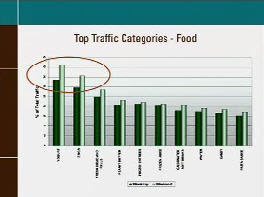
    A chart from the videoAs you can imagine, the potential for improving the in-store experience is huge. Just as web marketers have walked away with significant improvements to their sites through web analytics, these marketers are nearly giddy with new-found knowledge. At least, that’s the impression I’ve received by press accounts of PRISM. This piece in In-Store Marketing Institute’s site is characteristic of that excitement, particularly in this accompanying Flash and Quicktime video. (Warning: The video is all talking heads. Sadly, demonstrations of the system at work are being held closely under wraps.)

    Here is a typical insight, disclosed in the video by David Calhoun, CEO of the Nielsen Company:

    “In some food stores, the heaviest traffic flow is not through the carbonated beverage and snack aisles — which might be the conventional wisdom based on sales rates — but through the yogurt and eggs section of the store.”

    The chart above shows this (but not very well — it was captured from the video and only Calhoun’s narrative can identify the categories), with the two circled categories being the Yogurt and the Eggs sections.

    Since the advent of web analytics, physical world marketers have looked at us web marketers with envy. It appears their time to play next to us, in the sandbox of database marketing, is just around the corner.