Author: Jeff Larche

  • Watching your unsubscribes: Content and frequency are open to negotiation

    In sales there is a belief that each objection is an opportunity. Each “no” you hear is simply a stepping stone to a sale. This attitude helps salespeople continually refine the conceptual packaging of their wares. If the objection is “I don’t have room for it in my house,” this is an opportunity for the salesperson to stress how the product packs flat, or serves a second use that helps it earn its keep.

    Now consider the unsubscribe action in an opt-in email series. Melinda Krueger, MediaPost columnist and email expert, recounts a recent In-Box Insiders discussion about how approaching “unsubs” needs to be more like approaching any other type of objection (registration required for MediaPost). Ultimately it’s an opportunity for a more satisfied subscriber.

    Several aspects of your unsub process should be examined, Krueger advises. Of her list, two provide a real opportunity for negotiation. These are chances for departing subscribers to come back to the fold by refining how they receive the emails:

    Content Preferences — Give subscribers the options to indicate their preferences to improve relevance. These can either be positive “I am interested in silent sports” or negative “I am not interested in articles on camping.”

    Frequency Preferences — Allow subscribers to reduce the volume of communication: “Send me email only once per week/month/quarter/year” (depending on your sending frequency). According to Stephanie, “offering even simple frequency options at the point of unsubscribe helps preserve up to 50% of those ‘exiting’ subscribers.”

    Just as in sales, an unsub is an opportunity for a win-win with the customer. And like the classic sales objection, even when the outcome of meeting an unsub isn’t ideal, the chance to learn more about your product is significant. All you need to do is politely refuse to settle for a simple “no.”
  • Vibrant reading list sites suggest there is hope for book publishing

    In his long career, Si Newhouse has shown shrewd business acumen. In the 1990’s, when many said it couldn’t be done, he pulled off an impressive turn-around of New Yorker magazine. This was accomplished in part by hiring Tina Brown, whom Michael Kinsley has called “The very best magazine editor alive.” At the time she had done a similar remake of another Conde Nast property and money-loser, Vanity Fair.*

    While Newhouse was working his magic on these magazines, he was also busy in book publishing. But here he was selling off, not rehabbing.

    He sold Random House, his company’s huge and respected book publishing unit. The financial calculus was unmistakable: With a few notable exceptions — such as Wiley Publishing (the folks behind the brilliant For Dummies series) — the business model of book publishing cannot generate profit margins that more modern media such as films are commanding. With the rising cost of printing and shipping, this will likely remain the case until e-books such as the Amazon Kindle become easier and more affordable.

    So what do you do if you’re a Si Newhouse wannabe? What if you wish to make your reputation and fortune in books?

    The leaders of two enterprising companies have decided to ignore the headaches of production and focus instead on bringing readers together. Although the viability of these two businesses will continue to be in question, they have survived their crucial first year. GoodReads.com was a year old in January, while Shelfari.com will mark its first anniversary in a week.

    As anyone who has ever joined a reading club knows, in spite of the reclusive nature of reading, book lovers can be a surprisingly social breed of bird. Like so many distinctive tail feathers, they flash their lists of favorite books and authors as a way to bond.

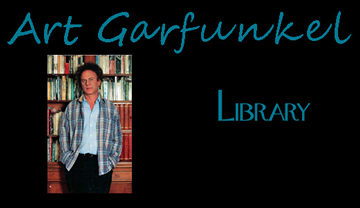
    Reading lists, and the opinions associated with them, can become an obsession. Take recording artist Art Garfunkel. His web site includes a reading list, in chronological order, of every book he has read in the last 40 years. The list tops 1,000 of some of the most respected books in literature (“I avoid fluff,” Garfunkel recently told a reporter).

    Art Garfunkel has a habit and he has it bad

    Is the urge to list online an act of ego, OCD, or intellectual outreach? Or a little of all three?

    The founders of GoodReads would tell you that Garfunkel is merely trying to display his tail feathers on a more world-wide strutting ground. And they’d point out he is not alone in this instinct to share his list online. GoodReads currently sports over 300,000 members. On average, only one in five online community members is truly active. But those who are active on GoodReads are extremely so.

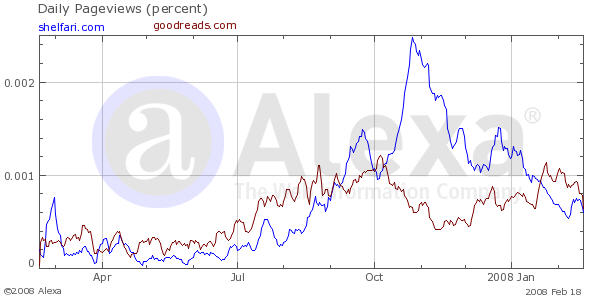
    The site reports that more than one out of a hundred members (3,708) have taken the time to review J. D. Salinger’s Catcher In the Rye. (This number is extrordinary for such an “old” book. Slightly fewer people – 3,641 – reviewed the first Rowling book, Harry Potter and the Sorcerer’s Stone.) Below is a comparison of the two sites in terms of Page Views, according to Alexa.com. (Click to expand the thumbnail below.)

    Click to expand GoodReads vs Shelfari, in estimated page views

    It’s ironic that social networks built upon a moribund business model may soon become future sweethearts of venture capitalists. Whether this is so will depend on the speed with which the internet becomes as effective an e-book delivery system as it is virtual reading club.


    * At the New Yorker she introduced such innovations as the following:

    • Short articles, so they could be mostly read in one sitting
    • An edgier aesthetic, guided by Pulitzer-winning graphic novelist Art Spiegelman and a slew of new editors
    • Actual photography in the editorial space. (I’m not kidding. What’s more, some of these photos were– Gasp! – in color)
  • Interactive design requires living life with your “eyes wide open”

    Our very own interactive creative director Clay Konnor was interviewed yesterday on WUWM FM, Milwaukee Public Radio. You can listen to the podcast, but why not see him live? He’s a co-presenter tonight at the Eisner Museum of Advertising and Design. It’s a panel discussion that’s part of an excellent series by 800CEOread.com. Clay offers this advice for those seeking to excel in the interactive design field:

    My chief piece of advice is to practice your craft. Really the best interactive designers I’ve ever run into are just well-practiced. They’ve solved similar issues time and time again.

    The other thing I recommend is to go through life with your eyes wide open.

    Every day I make a point of reading both the New York Times and RealSimple magazine. I listen to both Pat Metheny and Dolly Parton. In the same day. The idea is to expose yourself to a wide breadth of what’s going on. What are the trends, and how can they be used to cause conversions on a site?

    The presentation Business Meets Design: A Panel Discussion begins tonight at 7PM. If you’re in the Milwaukee area, I urge you to sign up online and enjoy some interesting perspectives on modern product design.

  • How to handle blogged ambivalence (or worse!) of your product

    I agree with Sam Decker that a lukewarm or negative review posted online is not a terrible thing. Since there will be many glowing reviews of your product (one hopes), the contrasting viewpoints will lend authenticity to the whole.

    But how does one respond to a negative review — especially one from a respected and well-known source?

    In other words, talk of social media firefighting is common, but where are good examples of a well-deployed firefight in action?

    I’ve come across a few, but the one I found yesterday is excellent. Be sure to scroll down this post by Dave Berkowitz to see the comments of affronted author, Joe Jaffe.

    It’s not surprising that a veteran blogger would step forward to assert his side of the discussion with measured tact plus a sprinkling of clarifications. Jaffe’s comments are a textbook example of how to properly defend your brand in a public forum.

    My one edit, if I had advised Mr. Jaffe, was to cut the line, “Not much more to say except thanks for taking the time to read 27 pages [of the 300-page book].” Ouch. That sounded defensive and unfair.

    Finally, to David’s point in his Caveat #6, I too find marketing today a great amount of fun and I think most in the business do.

    Marketing is especially fun when the rules of engagement are being written in real time. To paraphrase jazz poet and musician Gil Scott-Heron, the marketing revolution will be televised.

  • Costume company uses political widget to predict election results

    If you’re an online costume company whose biggest sales day is in late October (Halloween of course), how do you use social networks and current events to generate buzz? The leader in this category, BuyCostumes.com, created a widget that claims to be an accurate predictor of Presidential election results. Check out this clever way to cause a stir — and sell a vertiable Washington Beltway worth of cardboard masks!


    Thank you, Jon Krouse, for the scoop, the good conversation, and the cookie. (Full disclosure: The only payment received was a wonderful Alterra brand Cowboy Cookie, at the coffee shop where we met last week).


    What do you think? Is this type of promotion worth it? Let me know your thoughts. I’ll be checking with Jon after the election to see if the ROI on was as strong as I suspect it will be. In the meantime, he encourages you to click through, vote early, and vote often. 🙂