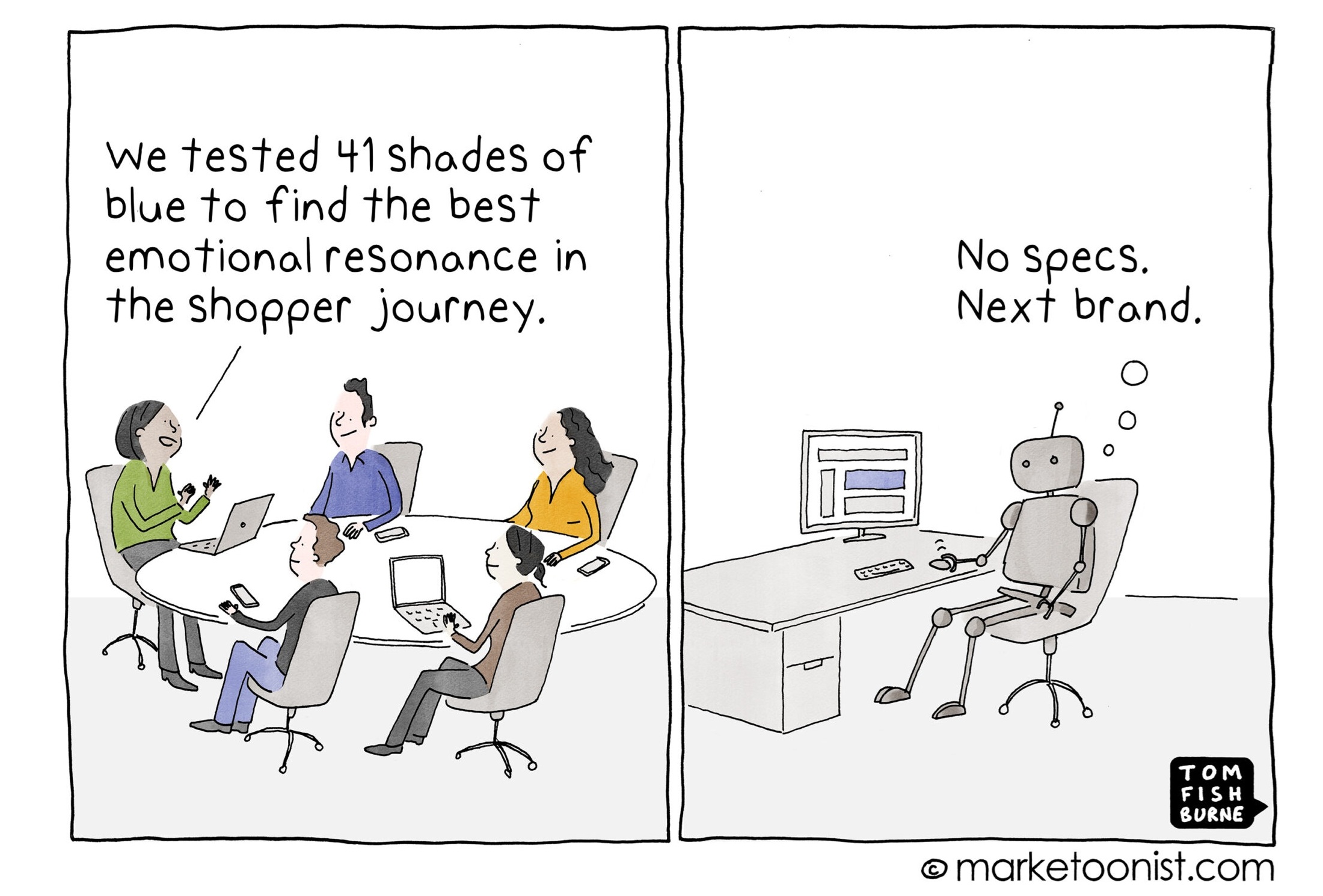
I just read a book that describes an important use case for AI automation. If you work in the marketing of enterprise brands, you should read it too.
I’ve licensed the above cartoon because it aptly reflects a major challenge facing brands in an increasingly complex shopping environment. Today product description pages (PDPs) need to serve two masters: The humans who shop for a product, and the AI agents shopping on those humans’ behalf. Agents like Meta’s Muse1, a new assistant whose app was downloaded 5 million times in its first three weeks.
Muse and other agents don’t care about carefully crafted packaging, emotional storytelling, or brand heritage. They want one thing: product facts … and plenty of them. Marketers who don’t do that work — inserting those facts into PDP data schemas — are doomed to lose progressively more share to upstart competitors who do.
It’s only one of the challenges facing enterprise brands that are explored in the opening chapters of Competing at Machine Speed. That section delves deeply into a daunting list of brand marketing headwinds, using many real world examples. Notably, the book describes the emergence of new, post-pandemic battlegrounds where brand sales are won and lost: the retail sites.
Each major retail platform (Amazon, Walmart, Target, Kroger, Instacart, Albertsons, and the rest) runs its own proprietary algorithm for determining where products appear in search results, which sponsored placements convert best, and which content signals it uses to judge a product’s relevance and quality. Those algorithms are not published. They are inferred from performance data, industry reporting, and trial and error. And they change.
That last sentence is key, because changed requirements by the platform must be addressed quickly just to maintain placement prominence.
Before these retail sites emerged, the marketing of your product was simpler. You promoted the product and ensured physical store shelves were stocked. Yes, there were competitors in your category on those same shelves, but their number was physically limited. You could adjust your advertising to elevate your comparative primacy and make the sale.
Of course you still need to do that. But today important retail sites have their own “shelves”: the product listing pages (PLPs). And because of long-tail economics, the platforms have an incentive to include in their PLPs and search landing pages as many competing brands as meet their low cost of entry — dozens or more of them, all vying for your customer.
This has turned selling on retail platforms into ruthless cage matches. Bidding determines which brand gets primacy on PLPs. The auctions erode margins and can even exert downward pricing pressures. Add to that the fact that you can see your prized brand demoted because of changed requirements I mentioned above. Those must be addressed, and often are not in a timely manner, because you and your colleagues are busy making similar changes for higher priority brands in the portfolio.
A challenger brand with one hundred SKUs and a team focused entirely on its digital shelf can manage every product with the intensity a major brand reserves for its top 10%. Its Long Tail does not exist. Its entire portfolio is the Head.
Competing at Machine Speed
The primary way to win these cage matches is automation. That is the agentic use case the rest of the book covers.
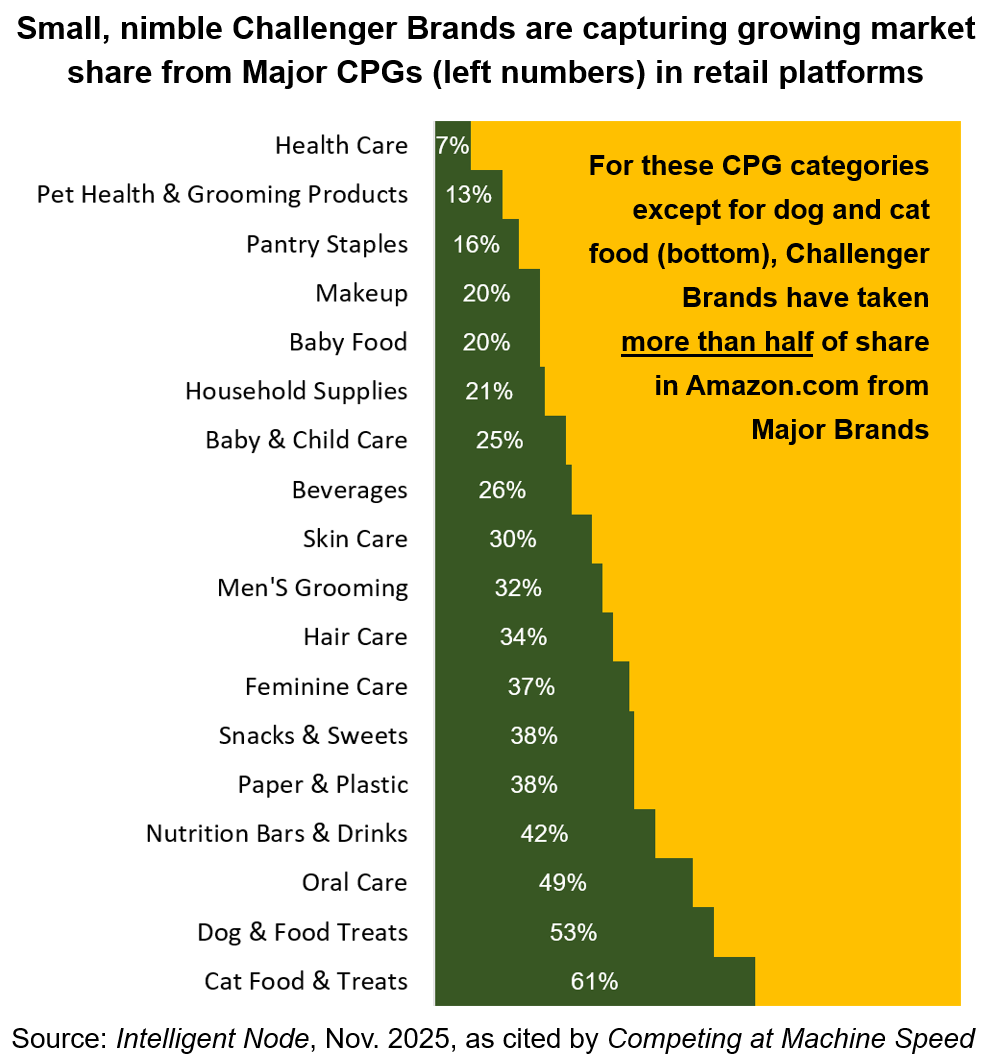
Change of this magnitude is hard, especially in an enterprise with many layers of oversight and governance. The authors knew it will take a lot to persuade the C-Suite. That’s why the book presents, near the end of that first section, ample evidence of small, nimble challengers “swarming” most brands, in most categories, and stealing their market share today.
Challengers use their small size as an advantage. Industry metrics show they are succeeding:
Beating the challengers at machine speed
The book’s solution — the bulk of the book — is to employ agents that “think” like start-ups, meeting challengers where they live:
The swarm’s advantage is structural, not strategic. It is the advantage of being small, having little to protect while attacking everything.
What changes the calculus entirely is when the incumbent builds a system that matches the swarm’s operational speed while applying the advantages that only the incumbent has: the brand equity, the category expertise, the retailer relationships, the consumer trust built across decades, the capital to invest at scale. The swarm can replicate keywords. It cannot replicate twenty years of consumer loyalty and clinical investment. What it can do, and is doing, is render those assets invisible by competing in an environment where the [incumbent] brand cannot show up consistently.
The system architecture described is detailed and comprehensive. So much so that the book’s text can be used to align enterprise LLMs on how to organize themselves and get to work.
I don’t want to give too much away, because you really do need to buy the book and study their proposed architecture first-hand. But one thing I want to emphasize is that this agentic use case is not a strategy for shedding headcount:
This is not about replacing the humans on the commerce team. It is about reassigning them to work that their intelligence is suited for. The category manager who spent 40% of their week pulling data and updating reports can now spend that 40% developing the commercial strategy that the agents then execute. That is the shift the system enables. Operators become Orchestrators.
Two of the authors are work friends of mine, esteemed colleagues from my tenure at Accenture. But I have no financial or personal stake in endorsing this book. You should keep that in mind when I tell you that this book blew me away. I’m confident it will become a business category best-seller.
If you’re a marketer at an enterprise brand, you need to understand how to meet today’s challenges. This book gives you the blueprint. Whether you’re a CMO, category manager, or digital strategist, it will fundamentally change how you think about your role in the commerce chain.
1As of this posting, Amazon is blocking Meta’s agent. This may change. In my opinion it will, when Meta works out with Amazon ways to compensate for the likely loss of income from the leapfrogging of Amazon’s profitable Marketplace ecosystem.