Search conversion lift seen from social media

Written by Jeff Larche on March 9, 2010 – 7:05 am -

On Friday I gave a presentation in Chicago, at Loyola University, on social media and compliance. We covered many topics dear to the hearts of those who participate in social media and would prefer not to go to jail due to SEC or HIIPA violations. Left to other presenters was the topic of social media’s importance in today’s marketplace.

It’s just as well that I left the topic out. Since most of the attendees were bloggers themselves (yes, more than half of them — I counted hands!), covering the importance of social media would have been preaching to the converted. But recent research, by GroupM and comScore, helps remind us all that some of the strongest reasons to engage in social media aren’t readily apparent.

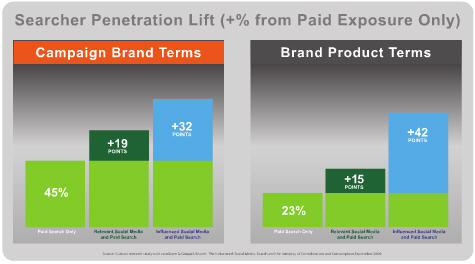
The study showed that people using search engines who also use social media are “more engaged consumers” and “more likely to be looking for places to buy and brands to consider.”

The research found that consumers using social media are “1.7 times more likely to search with the intention of making a list of brands or products to consider purchasing compared to the average internet user.”
Here are more findings from the study:

  • Consumers exposed to influenced social and paid search exhibit 223% heavier search behavior than consumers exposed to paid alone
  • Fifty percent of social media-exposed searchers search daily for product terms, compared to 33% of non-exposed searchers

And finally, this is the finding that I thought was most revealing: “In organic search, consumers searching on brand product terms who have been exposed to a brand’s social marketing campaign are 24 times more likely to click on organic links leading to the advertiser’s site than the average user seeing a brand’s paid search ad alone.”

How much do you spend on paid search ads? This finding suggests to me that whatever you invest in pay-per-click advertising, you can reduce that cost or improve its reach by combining it with a well-planned social media engagement.

Great post-presentation feedback

After the presentation I met a ton of the audience members through Twitter. This is a group who really understands how social media can extend the value of a presentation! One participant, David Kamerer, had a great suggestion for a way to improve my compliance presentation. He suggested I add some content on the CANN-SPAM email marketing law. Thanks, @DavidKamerer, and the other folks attending the talk. I had a blast!


Tags: , , , , ,
Posted in Search Engine Marketing, Social Networks, Web Marketing | 1 Comment »

More answers and links for vet practice managers

Written by Jeff Larche on March 31, 2009 – 6:59 am -

Let’s say you’re a practice manager for a veterinary clinic or animal hospital, and you realize you need to change your current marketing budget. Like last year and the year before, your marketing spend heaps way too much money on print and other tactics that are missing many of today’s consumers.

So what do want to learn most desperately when a skinny, still-slightly-contageous (cough, cough) marketing geek climbs behind the podium at your conference (organized by the AAHA)? Well, I’ll tell you.

What follows are links to resources that should come in handy if you live in the world of a practice manager, and will come in particularly handy if you attended my presentations. These are a Greatest Hits of sorts, based on the questions posed at the end of each of four presentations, and in emails I’ve received as recently as last night, requesting specific answers to question.

First, here are the topics we covered, linked to their mind maps — which served as outline during the presentations:

Most Popular Questions Posed

I took a while to post this because I wanted it to be comprehensive, and until even last night, I was getting requests for specific information. The profession of veterinary medicine is clearly waking up to the ways a strong online presence can help grow a practce and keep it vital!

Q: If you say a site that is “content managed” is ideal, what is the best person in my organization to manage that web content?

A: The simple answer is it’s the person closest to the authoritative content. Content management systems have opened businesses up to a greater intimacy with their customers by making web sites more useful. If you know that a business’s site will provide you with realiable, time-sensitive information, you’ll return to the site more often. And ostensibly, you’ll be more ready to refer the site — and the business — to others. What sort of information can an animal hospital site provide? You do not have to talk about animal diseases or treatments. Other general sites do that. Talk about how your services may be accessed (hours? phone numbers?), the way your services are provided and what I can expect if I go to you. Know your audience, and provide every scrap of information that could be useful.

This will require someone close enough to the answers, but obviously not a veterinarian whose hours would better serve the business by being devoted to billable work. Is there an assistant or clerical person who feels good about writing short snippets of information? Expose this person to all the facts needed and then let that person go!

Q: Regarding search engine marketing: What if I have a new site that is competing against large, established practices for the same keyworks. These older sites are “owning” the keywords. My site barely shows up in search engine results pages for them. Help!

A: You’ve done the first step. You realize there is a problem. One should consider a site’s real home page to be a search engine results page! The first step is to do a compehensive inventory of all keyword phrases you want to go after. The odds are, your competitor won’t be present for all phrases for all major search engines. You can start by creating content that is optimized for those unclaimed phrases. As for the others, realize that search engines favor age over “youth” when they look at web sites, so your new site will be viewed skeptically by Google, et al. So the second step is to find more backlinks than your competing sites have. Truly high-quaity backlinks can confer credibility fastHere’s a post to help you establish backlinks.

Q: Can you help me read up on social network marketing?

A: It’s the hottest top around in online marketing, and that was clear from the volume of questions I received immediately after my presentations, and subsequently, via email. Luckily there is a ton of material out there. Start with my post on why Facebook is a good set of “training wheels” for those unsure about how to begin. This post specifically addresses why Facebook is superior in its ability to instruct a user than Twitter. For an overall map of the social network space, I posted one nine months ago that gives you a taste of its size and complexity. The most valuable aspect of the map is the categories. You don’t have to follow many. Just think of the types of social sites that might have users talk about you.

Yelp was discussed a great deal in my AAHA talk. Here is a link to that outstanding On The Media podcast, where Bob Garfield (of AdAge fame) explores what you can do when someone dishes dirt about your business on Yelp and elsewhere (the short answer: Precious little! But it helps to know when dirt has been dished). This link to OnTheMedia.org includes an embedded sound player, a way to download the MP3, and even a link to the transcript, if you’d prefer to read instead of listen. It’s a great show overall — I cannot recommend it more highly for understanding how media of all types are influencing us … and are themselves influenced, by politics, business and society.

Q: I like the idea of a new media refrigerator magnet to promote my practice. Tell me more about Digital Pet Parade.

A: That’s the Facebook widget that can also be viewed in higher-end smart phones, and can even be embedded in the blogs of your biggest fans (by one fairly recent count there are over 70 million blogs out there — certainly some of those are written by people your practice delighted). Read my post and then contact me if you’d like to be part of the beta test for this exciting marketing tool.

Did I miss any?

Let me know in the comments section below what other questions you’d like answered!


Tags: , , , , ,
Posted in Mobile Marketing, Search Engine Marketing, Social Networks, Web Marketing | No Comments »

7 Types of Backlinks For Better Search Ranking

Written by Jeff Larche on March 24, 2009 – 9:37 am -

In the internet before Google, Yahoo was the leading search engine. To be more precise, Yahoo was a web directory. That’s an important distinction, because it meant ranking high in Yahoo (back then) required a single editor’s effort. Yahoo editors approved or overrode recommendations for how sites might be categorized in their directory. This was kludgy, imprecise, and definitely not scalable for a fast-expanding web.

Google changed everything. Their search spiders scour the web and look at how peer sites link back to yours. It’s overly simplified, but for the most part, here is the equation if you want high Google placement for your site:

Number of Peer Site Backlinks multipied by The Authority of Those Referring Sites equals The Magnitude of Your Chances of Ranking High in Search Engine Results

In today’s Google-dominated search environment, backlinks are king.

7 ways to boost backlinks to your site

Most search engines have followed Google’s lead, and to at least some extent take into account the quantity and quality of sites linking back to you. Here are seven types of backlinks for you to pursue:

  1. Vendor Sites — If you use specialized supplies in the course of your business (anything from custom mailing labels to MRI devices), talk to your vendor about linking back to your site. And don’t hesitate to suggest specific keywords to use when pointing back to you (more on that at the bottom of this post).
  2. Organization Sites — Any site from the Chamber of Commerce to the Better Business Bureau can be a referring site for you. Make sure you’re listed there and listed properly. These geographically-specific sites are especially important for businesses that are in some why land-locked in their marketing. These local sites help search engines rank you in regional searches. (Example: Last time I checked, this site ranks #2 in Google for “milwaukee marketing technology analytics”)
  3. Community or Non-profit Sites — Are you involved in any charitable work, or do you support local or national causes? Talk to their sites’ managers about being acknowledged with a link. Also, it’s good marketing to tell the world about the ways your business is helping to make the world a better place! It certainly can’t hurt to provide a page of your own, called something like “XYZ Gives Back,” where you show a little gratitude and link back to them.
  4. Press Release Services — Services such as PRWeb help spread news about your site throughout the web. If these electronic press releases are properly worded (again, think about key words people search on!), they can do much to send you both business and boost your search rankings.
  5. Blogging and Twitter Strategies — Done poorly, backlinks from blogs and micro-blogs (such as Twitter) can come back and bite you. But done sincerely, you can share information about your business to audiences who care. And many of these types of backlinks carry considerable search engine mojo. Check out this famous four-minute video for a primer on how an interconnected web of social links helps make for a better online experience.
  6. Reputable Directory Listings — There are a few reputable directories out there you should consider submitting your site to. Yahoo stills has its directory. The DMOZ Open Directory Project is also worth trying (although its editors are volunteers, and I’m unsure how successful new entrants have been in getting listed). You definitely can get into The Best of the Web, however, and should. Industry-specific directories can also turn out to be a good source for reputable backlinks.
  7. Comments on Social Sites — Join the social network conversation, and be sure to include your web address in your comments (comment forms all have a field you can fill out for this purpuse). Be helpful and courteous. Do not self-promote. Follow this advice and you will find that your site will receive some direct clicks from the comments. A handful of curious readers will inevitably investigate the source behind the contribution. But more importantly, some search engines appear to consider these types of backlinks in their algorithm.

One Last Backlink Tip

I mentioned in #1 above to not hesitate to suggest that backlinks be hyperlinks with the key words you care most about. Instead of having the link mention your business name, consider having it mention the line of products you’re known for — in the language your prospects typically use when they are searching for a source. But be careful about spreading the same phrase to all backlink sources.

The reason is search engines are vigilant about sniffing out marketers trying to game their system. One way is looking for identically-worded backlinks … especially those that spring up nearly at the same time. These can flag your backlinks as potentially coming from a “link farm.”

That said, all of the tips above are “white hat methods” of helping people find what you have to sell. In a way, these backlinks are nothing more than good, electronic word-of-mouth advertising.


Tags: , , , ,
Posted in Search Engine Marketing, Web Marketing | 2 Comments »

Give your site a marketing checkup with Web Grader

Written by Jeff Larche on November 5, 2008 – 8:15 am -

No system for measuring the marketing power of a site is perfect, but one of the more comprehensive I’ve come across lately is WebSiteGrader.com.

This system takes your web address, looks over the site, and reports back on features such as the following:

  • How optimized your site is for search engines
  • How well you’re placed with major directories
  • Your currrent Google Pagerank and Alexa rank
  • The quantity of inbound links
  • Much more!

Web Site GraderIt even evaluates the reading level of the site, to make sure you’re not turning people off with your language. As a point of reference, this blog got a Secondary / High School rating.

The end of the report is a single score out of 100 possible points. Is spite of some obvious gaffes, such as no listing in DMOZ, this site got a 94. That means out of a sampling of 100 randomly selected sites, DigitalSolid’s marketing power is better than 93 of them. As of today, the process is free. Give it a try. In five minutes you’ll have a thorough web site marketing “check-up,” and concise recommendations on how to improve your score. Do you have any other favorite marketing power evaluation systems? Let me know.


Tags: , , ,
Posted in Social Networks, Visualization, Web Marketing | No Comments »

Survey of marketing tech types finds ROI strongest for search and internal email tactics

Written by Jeff Larche on December 18, 2007 – 3:48 pm -

A recent survey has shed light on what one breed of marketing professionals are perceiving as good bets in terms of measurable return on investment (ROI). The tactic leading the pack is email, sent to an internal — or “house” — list. This is hardly surprising, since it is a relatively low-cost way to announce new products and deals to customers and prospects. What is more interested is seeing how both organic search marketing (i.e., search engine optimization) and pay-per-click (PPC) search marketing are viewed by these same executives compared to other tactics. Here is the full run-down:

Perceived ROI by tactic, from 3,000+ search marketing pros

Considering the search-centric executives surveyed (these were 3,186 “in-house search marketers or agency executives,” as reported in eMarketer.com’s ROI for Select Marketing Tactics according to US Search Marketers), it’s not surprising both are regarded highly. Both are deemed as “Good” investments in respect to the return they typically provide by one out of every three respondents, and another third (34% total) considered one of these two tactics “Strongest” in terms of ROI.

This would be a glowing assessment of search when compared with other tactics, if only PPC weren’t also deemed as “highly variable” by 28% of respondents. Considering how much control one has on the risks and rewards of PPC, this makes me wonder if that measurement isn’t the voice of a minority who either hasn’t conducted a PPC campaign or hasn’t done it properly.

The booby prize goes to online advertising (“banners, etc.”), deemed “Low Value” by 43% of the group. With opinions of online ads being this negative, is it any wonder ad networks are scrambling to sweeten the kitty with more behaviorally-focused targeting?

What is your response to these numbers?


Tags: , , , , , , , , ,
Posted in Direct Response, Email Marketing, Search Engine Marketing, Web Marketing | 8 Comments »
RSS

  • Explore by Tags

  • Explore by Category

  • Where To Find Me Online

  • Where I Work

    HarQen
  • Blogroll