Opinions are all my own

  • Automotive ad dollars rush online

    Last week’s post on behavioral ad targeting generated a spirited online dialog. I’d like to thank James and Ron for their thought-provoking comments. The example discussed was online ads in the automotive industry. It was aptly timed.

    As this new report from Borrell Associates indicates, there are several firsts for this category of advertising (emphasis is mine):

    By 2010 online car marketing will reach $4 billion, says the report, and become the second most-used medium for automotive advertisers, surpassing newspapers, cable, radio and direct mail and trailing only broadcast TV. Budgets for offline auto ads in newspapers, direct mail and directories will decline by 20% each during the same period.

    Online will become the top marketing channel for used-car marketers this year at the local ad level, surpassing newspapers for the first time.

    With all of these dollars rushing online, the winning advertisers will be those who reach consumers when they are most open to influence. Only time will tell exactly how behaviorally-targeted ads will fit into these ad buys, but clearly there will be much opportunity for innovation.

  • Of operant conditioning, text messaging and college admissions letters

    In a few days I’ll be giving a speech to a group of university and college recruiters. The talk is about new technologies and how they might shape academic marketing and recruitment in the future. I’m fairly sure how I’ll lead off. Not surprisingly, I’ll touch on reaching students through their cell phones. But it got me thinking: What practical advice can I provide recruiters about using mobile marketing?

    That was yesterday. It was the same day I received a cheering email from my friend Mike. His daughter has been going to a West Coast college that is extraordinary in the way it teaches. But after a year of this non-traditional teaching approach, she has decided it’s not for her. Instead, she applied to a university in Massachusetts. She was on pins and needles, as were her parents. Until yesterday, when the acceptance letter arrived.

    Now, my friend’s daughter didn’t have a second choice. She was willing to take a year off and try again at the same university if she didn’t get accepted. She’s unusual in that regard. Most students apply to several, to see which of them accepts them. To my knowledge, each acceptance (or rejection) arrives by the U.S. Postal Service. I wonder why. And I wonder if a more immediate notification might give the college that uses it an edge over the others competing to be the one they choose to attend.

    I’m thinking it might. I’ve been reading lately about why email is so addictive. According to this excellent post, the culprit is operant conditioning.

    This phenomenon is the mechanism by which behavior is influenced through outcome. It’s the explanation for “once burned, twice shy,” as the saying goes. And on the other end of the spectrum, it’s why we respond to a teacher’s compliments with harder studying, and to a casino’s winning hand with another gamble.

    These last two examples are appropriate because in both, the reward does not come every time. Both teachers and casinos know the same key to success. It’s a secret confirmed by scientists through careful testing.

    Namely: That the best way to reinforce behavior is to reward that behavior, but not every time. Instead, you reinforce randomly.

    This is why email gets us hooked. We don’t receive emails that reward us every time we check the Inbox. But it’s enough to cause us to check again and again — more frequently than we probably should.

    Going to your physicial mailbox was at one time the best example of this virtuous cycle of looking, discovering, and looking again. But the pace of our world has accelerated, especially for those in the school-aged generation, and a U.S. Postal mailbox has lost much of its power. Now we’re a society hooked on email, and computer-based instant messaging, and mobile text messaging – listed in order of addiction intensity. Text messages are immediate, intimate, and the most effective mechanism for keeping a person yearning for the next positive reinforcement.

    I suspect some schools already offer applicants the chance to opt into receiving initial news of their acceptance (or rejection) by email. (Official word would still arrive in print, however.)

    But I wonder: Why not cut to the chase and use the medium that truly gets students where they live? Why not use their cell phone?

    Would receiving word of your acceptance be more of a thrill if it arrived by SMS (i.e., text) message? And if so, would this allow for a more social celebration with peers? And would this high-fiving lead to more students choosing the “text messaging” school over the others?

    I know, there are many factors in a choice of college: financial aid, reputation, convenience, friends. But could this message, received  through a student’s most powerful “operant conditioner,” tip the balance when all else is equal?

    Please let me know. My talk is on May 23. I’d love to step in front of the group armed with your perspectives.
  • Is behavioral ad targeting really worth it?

    Behavioral ad targeting is the process of predicting who will be most responsive to online ads based on clicks and search behavior. In the mid-90’s, portals and ad networks (primarily Go.com and Advertising.com, respectively), took the first steps in using browsing behavior as a proxy for consumer interest in an advertiser’s products and services. There are many more companies doing it today (and Go.com, after its sale to Disney, is out of the game entirely)*. The whole process has gotten better and smarter. But has it gotten smart enough to earn its keep? 

    To understand this type of targeting, keep in mind that these systems are context agnostic. They don’t attempt to judge why more people who viewed a particular sports site and music site shortly thereafter clicked on a banner for car insurance. These systems simply watch and learn.

    The promise of behavioral ad targeting is that advertisers will ultimately be able to make ad buys where fewer people may click on ads, but those who do convert to customers far more often. Has that promise come to pass?

    An ideal product for this type of targeting is a car. Nearly everyone will want to buy one sooner or later, so the challenge is to talk to consumers when they are in the consideration process. Sure, you can run contextual ads — in other words, run them on a car-centric site, or in online publications that happen to be reporting on cars. That works. But there is far more ad inventory out there, and many people in the market for a car are visiting these other sites, and not car sites. They would never dream of researching their next car online. Contextual ad buys overlook these people completely.

    It’s wasteful to advertise in a scatter-shot fashion across sites, but what if the probability of consumers clicking on your car ad could be improved by sprinkling your ads throughout a vast network of sites, and then having the behavioral targeting (BT) system note those sites visited just before one of your ads generates a click?

    Which brings us to Jumpstart Automotive Media, which created this microsite to explain BT to potential advertisers. It even provided a case study. Terrific! I’ve been eager to read an example of the huge ROI that modern BT can deliver.

    Well, I wasn’t terribly impressed. The case study describes these results:

    • Contextual placements received a 36% higher click-through rate than Behavioral placements
    • The conversion rate on behavioral placements was 42% greater than on contextual placements (conversion is a specific navigation path that takes place on the client’s web site)
    • The cost per action on behavioral placements was 4% lower than on contextual placements

    Is it just me, or does this 4 percent reduction in acquisition cost, for all of that extra work, just seem a little … disappointing.

    Am I missing something here? Am I missing something period? If you have insights about this case study that have escaped me, or if you have better evidence that behavior ad targeting is really worth the effort, I’d love to hear from you.

    * 5/16/2007 Postscript: Today’s New York Times had a good article on the entire field of ad analytics. You’ll find it here, as part of their Small Business special section.

  • What I learned from my Twitter experiment

    Two weeks ago, at the end of my latest post exclusively about Twitter, I announced that I would let you know the outcome of a little two-week test. In it, I temporarily opened my “Tweets” to the world, so to speak. My posts became part of the Public Timeline of Twitter posts. In that time I’ve continued to enjoy what I like about Twitter: Being able to keep in touch with friends who are on it. But I have to say the foray into the public conversation didn’t amount to much more than that.

    I didn’t know what to expect, but here were a couple things that I considered possibilities:

    1. Some people might pick up on references to my more provocative blog entries (such as this one, about mobile communication and the Virginia Tech shootings) and respond directly through Twitter
    2. Others would actually click through to those entries, using URLs that I inserted in the Tweets, and possibly even comment on the blog entry

    Someday this might happen for someone. Neither did for me. I suspect that my Tweets were too diffused among the millions of others. Without a way for users to filter by preferences or topics, my Twitter posts became a few needles in an ever-growing haystack. Without context, these “microblog posts” zoomed past and faded without incident.

    Well, almost. The day after I began the experience, I received the following:

    • My one and only visit to this blog that I can directly trace as a click-through from the Twitter public timeline (sheesh!)
    • A single message from an “admirer” of my golden (albeit truncated) prose: A spammer trying to get me to visit his site where he was selling something (Does my prose look like I need Viagra?)

    It’s not that I was expecting the sort of bank run that Digg.com got when its users started posting an illegal DVD unlock code. But I was hoping for something of interest.

    Especially, I was wondering if I could expand my online social network, as I have recently with activities in LinkedIn. I’ll be writing more about LinkedIn in a future post. As for Twitter, starting today I’ll be henceforth mum on the topic.

    If you want to reach out to me in a public network, you’ll just have to join my growing — and quite interesting — LinkedIn connections list. Here is my Profile: http://www.linkedin.com/in/jefflarche

    Postscript: I just went on the Public Timeline and was astonished to see a friend’s Tweet: Way to go, Jazyfko! I hope your cold is getting better.


    Update on May 26, 2007: One of the more promising applications of Twitter so far is the recently launched Truemors, the latest start-up by Guy Kowasaki.


  • Name-googling matters in business, even for execs still in the womb

    A term made popular in the 1990s was You, Inc. As we travel through our careers, each of us needs to think of ourselves as brands. These individual brands are like product brands. They have names and reputations, to be nurtured and merchandised. Two recent stories from the Wall Street Journal (WSJ) remind us of the new power of our personal brand names in a world where Google has become a verb, as in “to google.”

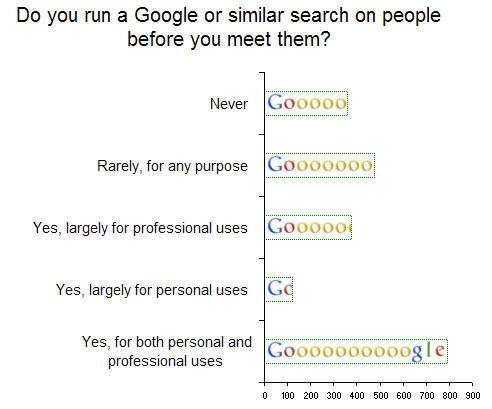
    The first story talks about how often executives do search engine research on business contacts before they meet them. You may be surprised that more than a third of those surveyed by the WSJ (37%) said yes, they google people for “both personal and professional uses.” Another 18% said yes, but largely for business purposes. Taken together, half of all of the 2,118 executives surveyed use search engines to check out business contacts.

     More than half of those surveyed use search engines to check out business contacts

    The other WSJ story makes sense in this perspective, because it describes how many expectant parents are choosing the names of their unborn babies based in part on the name’s lack of competition in search engine results. As the title of this article suggests, You’re Nobody Unless Your Name Googles Well.

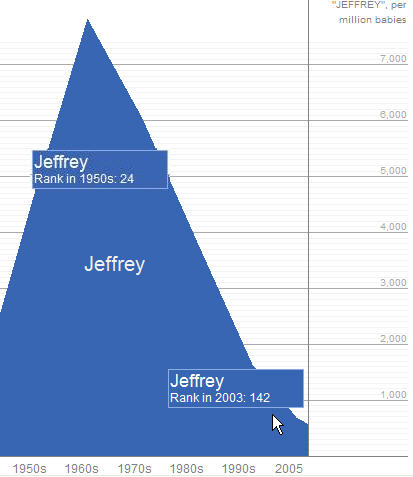
    As a side note, I was humbled at what a flash-in-the-pan my first name has been when you see its popularity charted over the decades. Check out this fun iVillage Baby Name Wizard to see how your name has held up over time.

     Are you expecting a baby? PLEEEASE name him Jeffrey!