Opinions are all my own

  • Thinking in mapped networks, with connections real and implied

    More than a year ago I started telling trusted friends and colleagues about a great piece of software. Half-joking, I would lean forward and confide that this is one secret too valuable for me to blog about. The digital equivalent of a performance-enhancing drug, it was something I’d prefer not to leak to competitors. That is, until today. In the spirit of openness, and timed to coincide with my friend Kevin Hillstrom’s One Positive Day campaign for blogging civility, I am ready to spill the beans.

    Thinking With Both Sides of the Brain

    Ever since my college days I had wondered if there was a smarter way to organize my thoughts. Common note-taking techniques didn’t seem to cut it. Looking around, I wasn’t optimistic. Certainly the first personal computers, with their DOS-like lists, hierarchies and sequences, were of no help.

    Then I found the books of British “pop psychology” author Tony Buzan. In a Madison, Wisconsin used bookstore, I discovered the first: a copy of his 1974 Use Both Sides of Your Brain, where he talked about something called mind mapping.

    Buzan wrote that standard outlines require scanning from left-to-right, top-to-bottom. This causes the brain to work harder to make the interconnections between concepts.

    Back then Buzan couldn’t have envisioned the modern solution to this dilemma, which is to boil lists down to a point where they lose much of their potential meaning and utility. Or conversely, the author will stretch out the information across a blinding sheaf of slides and spray of “bullets.”

    I’m referring to Powerpoint of course, a product that Edward Tufte, author of The Visual Display of Quantitative Information and other classics, so eloquently lambastes in this essay.

    Our brains are built to survey information as it is seen in the physical world, making associations through placement, space, distance and color. The more complex the subject, the greater our brain resists tidy categorizations and rankings.

    Thinking In Mapped Networks

    Enter the mind map. The illustration below shows a hand-drawn example. It’s one Buzan that would have been proud to call his own.
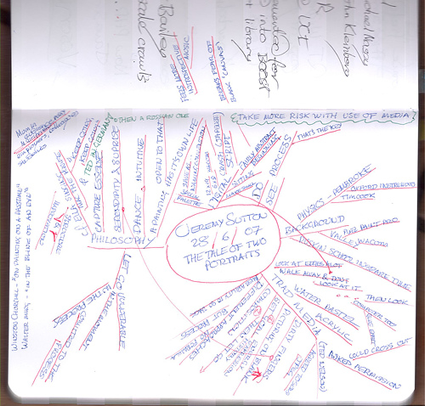
    An example of a hand-drawn mind map

    To the person who drew it, there is more meaning here than could be crammed into a dozen pages of lists.You can instinctively see how these maps help with lateral associations while still allowing for more formal hierarchies and sequences. As you might expect, some maps are never really completed by their owners. They are continually refined. New insights and perspectives leap off the page with every rereading. This is a good thing, because it shows how concepts can grow and deepen over time.

    That was Buzan’s point, and luckily, many modern software developers have listened.

    An advantage of the computer-based mind mapping tools is they are easier to share with others (you can even port some softwares’ output to other programs, including … Powerpoint!). Annotation features also help. They add explanation that is needed when you’re showing your map to others — or just trying to remember what the heck you meant when you drew it!

    The best mapping tools can even be used as collaborative brainstorming aids. I’ve checked out several over the years, and the best by far is the award-winning Mind Manager. Visit MindJet.com to see for yourself.

    Put bluntly, it could change the way you think.
  • Dracula vs. Frankenstein: The latest in the battle between Facebook and MySpace

    The Frankenstein’s monster of the Universal Studios film was hideous. A product of an unholy experiment, it was gruesomely assembled, yet through a miracle of science walked the earth, wrecking havoc. Count Dracula, from the same studio at about the same time, was mysterious and elegant. This monster’s seductive powers were finely focused. Dracula came from a remote, distant land. And, like the heretofore Mary Shelley invention, wrecked his own considerable share of havoc. Guess which is MySpace and which is Facebook?

    Dracula vs. Frankenstein: According to IMDB, a really bad movieAnd if you’re wondering who is winning the battle of Dracula vs. Frankenstein, well, it’s too early to tell. They are definitely using their differing powers differently, and with equal aplomb.

    It was exactly a month ago when Facebook announced it would open its platform to outside developers. This online social network certainly regards no site more of a competitor than MySpace. The move to a great extent was to blunt the loss of users over to that site.

    It’s an important strategy. Facebook has only a quarter of the members as MySpace (28 million versus MySpace’s 108 million). How do you argue with that that kind of success? Or compete against these kind of numbers? If you’re Facebook, the answer is you reverse course.

    In their game-changing move, Facebook chose to swing open the doors to their platform to all manner of third-party widgets and software. This Slate article explains how these applications individually amount to little, but cumulatively they can spell a huge advantage (thanks, Bryn, for the link):

    None of the nearly 900 (and counting) programs released so far are particularly life-changing—among the most popular add-ons are a “Graffiti” program (downloaded by more than 3.3 million people as of this writing) that lets you doodle other people’s profiles and an “Honesty Box” that lets your friends say, anonymously, what they really think of you. Collectively, though, these programs are hugely significant. If the site figures out a smart way to deploy these mini applications, it will be more than just a social network. Facebook will turn into a do-everything site with the potential to devour the whole Internet.

    Good move, Facebook. That had to smart. What would you do in response if you’re MySpace — a site that has been, after all, the anti-Facebook? MySpace has always been open to all comers, fertile soil for application developers — including YouTube videos, which are embedded in MySpace profiles by the millions.

    So what do you do? You selectively compete against the very products you’ve allowed to thrive in your garden. Starting with YouTube, itself a threat. This week we learn that MySpace has improved their own embedded video product: MySpace TV.

    The clearest damage that could come of this is to YouTube. And it’s a good thing, because YouTube is developing its own social network chops. But the move also shows a different approach to getting and keeping users: Don’t rely on others to produce your most popular applications. Instead, provide them yourself, so you can get traffic to both your own social media site and the site that feeds it.

    Mind you, MySpace TV is no copy-cat of YouTube. Instead of trying to engage YouTube at its sweet spot — user-generated videos — MySpace TV focuses on professionally produced videos. Very smart.

    It’s a characteristic move from a company that has so far behaved surprisingly shrewdly. Even a patchwork Frankenstein’s monster can display uncanny survival instincts.

    To see an excellent face-off between Facebook and Myspace features, check out this recent evaluation of the two by our friends at Mashable.

  • Internet Radio royalties need to be more fairly assessed

    I’m a regular listener to Milwaukee’s latest public radio format, 88Nine Radio Milwaukee. It’s a terrific FM station with many “degrees of connection,” so to speak, to the web and new media. First, they have a great site. They also have a high-quality, 128k internet streaming signal — one that I use frequently through iTunes. They even have a member of their on-air talent who co-produces his own extraordinary podcast. That would be Sam Van Hallgren, who is co-star with Adam Kempenaar of the best film buff podcast out there, Filmspotting.

    Today you won’t be able to sample 88Nine’s streaming signal. That’s because they, along with other web stations, are protesting a fee increase for use of licensed music. This increase is huge, and threatens to put most of their ilk out of business. I’ll let LaCrecia Thomson, RadioMilwaukee’s new Listener Relations Director, explain:

    On Tuesday, June 26th, RadioMilwaukee will join other Internet radio providers in a “Day of Silence” for net radio. Internet radio is in immediate danger of being silenced permanently through new, government-imposed royalty rates that are so high they will shut down most webcasters and could force RadioMilwaukee to severely limit our stream.

    BE HEARD.  Preserve the diversity of service web radio provides and the voices it inspires.  Without action, your listening choices will be limited.  Support net radio and RadioMilwaukee.  Wisconsin’s U.S. Representatives Gwen Moore and Tammy Baldwin have already sponsored the Internet Radio Equality Act.  Let senators Herbert Kohl (202.224.5653) and Russ Feingold (202.224.5323) know you want a diversity of entertainment options.

    All I can add is if you have a favorite streaming radio station, check it out today. It will likely be silent as well. I’m sure their site will point you to the appropriate lawmakers who can help ensure that the silence doesn’t continue indefinitely.

  • Out-of-home and into phone: Spectacolor HD boards add a mobile component

    It was announced on Wednesday that a new type of digital billboard, Spectacolor HD, will be capable of presenting dazzling video and graphics. But eye candy is as cheap and ephemeral as the name implies. Where is the power to really engage a consumer? I got my answer in the fleeting, fifth paragraph of this BrandWeek article:

    The Spectacolor HD board also promises to take the transformation of the outdoor medium one step further to engage the consumer through interactive features. Using mobile phones, passersby will be able to listen to audio for the board, play games on the screen, send text messages or download audio and video files.

    Those who visit DigitalSolid regularly know that I get particularly excited by the prospect of ads with a mobile phone component. In prior posts I’ve discussed the direct marketing implications of standard digital ads, as well as the print-to-mobile promise of ShopText.

    So you know my priorities.

    I believe the news about Spectacolor HD that will have the biggest impact on us marketing technology types is the ability to push content to consumers for them to keep and share. As with the other examples I’ve discussed, this will truly use all of the marketing power of a digital ad.

    How would it harness this marketing power? Well, what if, from this billboard, you could download a podcast to your cell phone — for instance, a song with a branding element or offer presented at the end, or a walking tour narrative? Or even a “treasure hunt” set of instructions? (Think Geocaching — a fast growing hobby for the GPS enabled.)

    This would give your brand a tremendous amount of bang for the buck. It could be listened to multiple times and shared with others who haven’t seen the digital billboard. This is huge if the campaign is properly crafted.

    But the billboard being discussed in the BrandWeek article is an exotic, rarefied animal. It will go up in New York City’s Times Square, at 47th Street and Broadway.

    Most digital billboards will be on the sides of teeming freeways, where viewing time is brief, and the opportunity to download something, based on the range that Bluetooth grants you, is minimal indeed. Too bad there isn’t a way to pass information to a more far-flung group — a group of people who must stand still long enough to receive it.

    Yours Free To Download (Just Wash Your Hands First, Please)

    Should the meme of downloading from digital ads become more commonplace, I know of just such an audience. They are standing as I type this, gazing at digital ads all over America. I’m referring to the men in public restrooms equipped with digital, ad-serving monitors.

    These units have always struck me as too clever by half. For one thing, they are positioned on the wall above a urinal mere inches from the viewer’s nose (I hope!). That makes ignoring the ads it flashes all but impossible, but it makes focusing on said ads just as difficult. And these ads have never promised me anything of value.

    What if these same monitors were equipped to send the people in the restroom (hopefully after they’ve washed up!) the same goodies that were heretofore only available to New York tourists? 

    Once you’ve stopped chuckling, think about the valuable mobile marketing you could accomplish by designing and executing a campaign that people receive by using any cellphone equipped with both Bluetooth and an MP3 player. It’s not so farfetched a future to imagine.

    Ironically, these audio media may be delivered by a digital display ad. In an odd way this makes perfect sense.

    And hopefully, by the time all the other moving parts are in place to make this advertising feasible, there will be more types of public spaces available where digital ads are displayed.

    In the future, I would hope these campaigns wouldn’t be relegated to the type of room polite people excuse themselves to visit.

  • RiffTrax delivers DIY laughs and a promising business model

    As promised in a prior post, I did indeed throw a RiffTrax party. It was Sunday. My wife and I hosted three people, and we screened the latest James Bond movie, Casino Royale. The party was a success, and the highlight was undeniably the movie heckling supplied by our virtual guests of honor, Mike Nelson and Kevin Murphy.

    For those who aren’t familiar with RiffTrax, Nelson and Murphy are two of the comics who record funny commentary distributed by this new online business. For $2.99, I was able to download a podcast that ran the length of the movie. I synchronized the podcast (played through our stereo system) to the action from the rented DVD. Hilarity ensued.

    It should go without saying that Daniel Craig, the dead-serious star of Casino Royale, was never the source of so much mirth.

    This type of movie “riffing” had been a staple of the cult television show of the 1990’s, Mystery Science Theater 3000, where Nelson and Murphy had contributed as both writers and performers. They have lost none of their edge. (This distinctively Midwestern style proves that jokes don’t have to be demeaning or obscene to be lacerating — and often hilarious).

    Whether you’ll find their brand of satire funny I cannot predict. They can get a little esoteric at times — sometimes veering dangerously close to Dennis Miller territory. But what I wanted to be able to tell you with confidence was whether this way of selling laughter, one podcast at a time, is a viable business model.

    I think it is, for these reasons:

    It’s Easy To Get the Hang Of

    Although it’s a little more Do-It-Yourself (DIY) than some people will likely tolerate, the majority will get past the challenge of synchronizing the sound and DVD tracks. I certainly did. To help, a ReadMe file shows time codes that can be visually monitored. Or, like me, you can wait for key lines of movie dialog to be mentioned on the podcast by a robotic voice (called DisembAudio, of course). If the movie and podcast line readings overlap, you know that the comedy will be properly timed to the action.

    A Great Excuse for a Party

    RiffTrax is a surprisingly fun way to enliven a standard “movie night” with friends and family — and a way to justify another viewing of a DVD you already own.

    It Has Mild Cult Appeal

    The humor is often extremely bright, and that makes you feel like you are part of an insider’s group when you watch it. It’s the same appeal that helped make Monty Python and Saturday Night Live a success when those shows first burst onto the scene, as well as the more contemporary Daily Show and Colbert Report.

    It’s Habit Forming

    Mid-way through the film we mentioned to our guests that RiffTrax had just released a take on the first season DVD of Grey’s Anatomy. The reaction: “When can we see it!?”

    The answer is soon. I’m pleased to see the technology of podcasts getting mainstream enough to actually justify repeat purchase. And since I was a huge Mystery Science Theater fan, I’m pleased that Mike Nelson and his team will be part of this new media revolution.

    Important disclaimer: Although a wonderfully helpful RiffTrax publicist offered to comp me for the movie, I decided to use my own money, both to deny any accusations of patronage and to get a feel for the complete purchase-and-play experience. I have been compensated in no way for this assessment.

    Good news for two lucky readers: Use my contact form to email me. The first two to say “Free RiffTrax” in the message will receive a one-time credit for a RiffTrax movie. I think you’ll enjoy the experience.