Opinions are all my own

  • Sponsored SMS bulletins show promise

    New media consultant and columnist Steve Smith speculated recently in MediaPost that we will soon be receiving many more sponsored messages with our cell phone’s text bulletins. These text bulletins, also known as SMS messages, are the 140-character packets that helped Justine Ezarik rack up a 300-page AT&T cell phone bill. (She reports that Twitter and the SMS feature of Facebook were the biggest culprits. Each message sent and received was separately itemized.)

    The good news is these messages will be extremely targeted, and are “opted into” in exchange for the content received. An example cited by Smith is NASCAR race updates, sent to the 200,000 subscribers to this branded program. He explains that if a supermarket chain would want to target those interested in NASCAR, “There is enough mass there to net perhaps 80,000 users in a general geographic region.”

    That’s enough to make quite an impact. Especially since response rates are impressively high.

    Although the initial calls to action must be quite brief — 20 to 80 characters — the extremely targeted nature of the messages helps response. A “response” is usually hitting reply, to receive a full (up to 140 characters) expansion of the offer and a URL to click on. This graphic , provided by the MoVoxx site, helps illustrate the typical process:

    How InTxt by MoVoxx works

    Alec Andronikov, who is the managing partner of MoVoxx, says that of the many billions of SMS messages sent each month, somewhere around 500 million of them are some kind of publisher-pushed alert. And each could conceivably be sponsored. Smith continues:

    Right now, [Andronikov] claims about 3.5 million uniques with sports, travel, dating and newspapers comprising the largest content categories. … Andronikov claims a response rate of 2.5% to 4% on the SMS ads.

    That means a hypothetical, regionally-based supermarket chain running a NASCAR promotion could get their entire message in front of at least 2,000 fans (80,000 recipients of the initial, sponsored message multiplied by a 2.5% response rate). If the offer is compelling enough, this can win the chain hundreds of new customers.

    The ability to target consumers by age, gender and zip code — as well as areas of personal interest, as implied by the content to which a consumer subscribes — promises a way to take the junk out of junk text messages.

    Through testing we’ll soon see whether these campaigns “have legs” — whether they can generate enough of a return on investment to make them a smart, new marketing tactic.
  • Shepherd your online prospects to conversion with a strong email reminder

    MarketingSherpa does a lot of things right, so I should not have been surprised to get this conversion email from them last week. It should serve as a reminder that when someone begins a conversion process and bails out, all is not lost. Note the tone and content of this case study quality email message:

    Dear Jeff Larche,

    I noticed you began to enroll in the MarketingSherpa 7-day Free Trial Membership, but you didn’t complete the process.

    Is there anything I can do to help?

    I will be happy to talk with you and answer any questions you may have. In spite of our best efforts, some people have had questions they didn’t find answered completely on our information page.

    The Free Trial provides tremendous value for marketers who want a faster, easier way to access ALL of MarketingSherpa’s content:

    • Private Research Database-Search 3,000+ stats on marketing instantly
    • Creative Samples Library-Search 2,600+ real-life campaign
      samples for inspiration
    • Topical Index-52 Topics listed from B-to-B Lead Generation to Viral Marketing

    Click on your choice for a Sherpa Microsite all about that topic with Case Studies, How-to Articles & more. If you activate your free trial today you will also receive:

    • 10% Discount to the Sherpa Store that can be used instantly
    • Special Introductory Rate for annual membership (that’s $200 off normal retail value) should you decide to continue after your trial period.

    You can re-visit the information page, and continue activating your 7-Day Free Trial here:
    https://www.marketingsherpa.com/member_trial.html

    The Free Trial Membership is absolutely risk-free. You may cancel at any time during your trial and we will not charge you a cent.

    Should you have any questions, please feel free to call me or email me and I’ll be happy to answer your questions.

    My phone number is: [toll free number withheld here], or if you prefer, email your question to [email address withheld here].

    Thank you for your time.

    Yours Truly,

    Hope Hopkins
    Membership Services

    P.S. We are currently offering a free PDF download of Sherpa’s Top 5 Case Studies on Online Video Advertising upon activating your Free Trial.

    Brilliant! They emphasize the benefits of joining now, make it easy, and sweeten the kitty at every turn. This reminds me of an Alexander Pope poem I memorized as a kid (I know, I was a weird child):

    Men should be taught
    As if you taught them not
    With things unknown
    Proposed as things forgot

    Great advice then and now.

  • Four frivolous blogs for One Positive Day

    I interrupt this Labor Day holiday weekend with something totally frivolous. It’s the first day of the month, and in honor of Kevin Hillstrom’s One Positive Day concept I’d like to praise a group of people, instead of a single business or individual. Today, in this warm and sunny Midwestern Saturday, I’d like to tip a glass of something cold in the direction of the millions of people who’ve made the Internet richer by sharing their lives and their talents with the world.

    I write a professional blog, for purely professional reasons. I love it. I hope that comes through and takes some of the starch out of these posts. But there is always a level of propriety. The web may be freewheeling, but at least within these virtual office walls, I’ve placed limits on the topics covered and how they are discussed.

    Blogging For The Fun of It

    Most of the tens of millions of active bloggers have quite different standards and approaches. To my surprise, many are friends. I did a mental count yesterday, and realized that four of these friends who “blog for fun” were friends before they started blogging. (Full disclosure: One of them is more than just a friend. Hi, Julie. I’ll be home shortly — promise!)

    A favorite of Max Estes’ blog so far

    And here, I’ve defined a friend in less the Friendster definition of a close connection on a profile, and more as a “real world” friend. In other words, I’ve shot the breeze with all of them, without a business connection or prior blogging relationship. Here are their blogs, listed from most recently founded to most established:

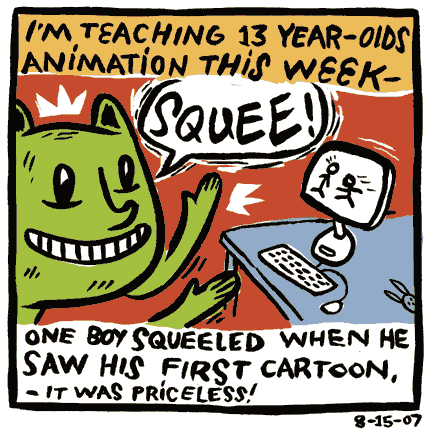
    1. My Life As A Bunny As I write this in a coffee shop, Max Estes is sitting at the neighboring table. His newly-launched daily blog (Wow! I can’t believe he’s so prolific!) is an absolute treat (example shown above). You may notice his style. He gave me permission to use a piece of his artwork to adorn the home page of this blog. I pray he wasn’t drawing me, but I’m too chicken to ask.
    2. Marty Feldmanize Me I’ve had the pleasure of knowing Augie for years. We first bonded over geek stuff, and the store for pet lovers he operates with his wife. And yes, we’re also professional colleagues. But I hope we’re friends first. Lately, his blog has shown me a new side to this complicated individual. Similar to the original Sienfeld show, I’d define this as a blog about nothing. I’ve enjoyed taking a break with it quite a bit.
    3. Bad Ass Birds The only blog in this list with a mildly vulgar title is also coincidentally the only one I would give a solid “G” rating, in terms of content and profanity. It amazes me how a mixture of made-up birds, odd reviews of even odder films, and semi-serious summaries of 1970s Dark Shadows TV episodes could add up to something so compelling. Man! As I look around, these bloggers are making me feel so boring!
    4. The Song In My Head Today This blog is lovingly written by a talented and passionate music reviewer (who also has excellent musical taste, in my humble opinion — she and I agree so often on her selections!). You’ll be challenged and entertained by Holly’s reviews. And God bless anyone who has on her blog an Elvis Costello Week!

    Could you think of a better time than now, during this sultry long weekend, to amble through some new and perfectly frivolous blogs? Go for it. Subscribe to the ones you like, and be sure to comment on them as you see fit. (Comments keep us bloggers from feeling like we’re wasting our breath!)

    And if any of your friends come to you and say, “I’m thinking of starting a blog,” tell them you know someone who has seen several of his friends — mostly non-tech types – take the plunge and revel in the world they found on the other side. Give your friend plenty of encouragement and watch what happens. It’s a blast for all involved.

  • Powerpoint to the people: A revolution in presentations

    On the last day before a holiday weekend, I thought I’d talk about something that’s important for us marketers but also fun. Or at least it should be. The topic of improving slideshow presentations has been covered wonderfully in the past, but there are some great new perspectives you should be checking out, to keep your Powerpoint decks in check.

    (With so many co-workers starting the holiday early today, one of the stalwart few who will be with me in the office today joked that he’d bring Mimosas. From that last riff you’d think he’d followed through on the threat!)

    Merlin Mann of 43 Folders gave a wonderful presentation to Google recently on better use of email. His 50 minute presentation (the video is below, and here’s a podcast of the talk) was as fun as it was practical. In response to inquiries, he shared his Powerpoint tips in a recent post. Although I should mention that he is the second person this week to let me know that Keynote has it over Powerpoint, if only because you can look at your speaking notes on your computer’s monitor while the audience sees the projected slide.

    In his tips on better slideshows, Merlin mentions Guy Kawasaki’s 10-20-30 Rule: “A PowerPoint presentation should have ten slides, last no more than twenty minutes, and contain no font smaller than thirty points.” This reminded me of another slideshow presentation form (I say form, just as poetry has its classic sonnet and haiku forms). I’m thinking of the form called pecha kucha.

    Pecha kucha was invented four years ago in Tokyo by Astrid Klein and Mark Dytham of Klein Dytham Architecture. They created it as a way to attract people to an event space they’d set up. They wanted a freeform presentation environment that wasn’t hackneyed. Sort of an un-poetry slam.

    Here are the rules for a Pecha Kucha night: A number of presenters (usually 14) each does a slideshow of exactly 20 images, each lasting exactly 20 seconds. That puts the total runtime at 6 minutes, 40 seconds. The topics of the presentation vary widely, but the presenters are primarily artists and designers. These events have spread, to take place in major cities around the world. I’m tempted to attend the next one in Chicago, in late September.

    According to an uncited entry in Wikipedia, this 20 slides, 20 seconds each form has been adopted in some corners of the business world. It allows for a brief, disciplined presentation of ideas, with questions withheld until the end and no room for meandering on the part of the speaker. It’s all in the service of avoiding “death by Powerpoint.” Those who know me well are aware that I dislike using Powerpoint, and try whenever possible to present with a simple MindManager mind map. Or just write out my ideas into a Word document (there, Microsoft, at least you get some of my loyalty!) and speak without visuals. It’s all in the worship of one of my business heros: Edward Tufte.

    For my friends reading this in the U.S., have a wonderful Labor Day Weekend, devoid of Powerpoint — unless you like that kind of thing!

  • Growth of out of home ads reflects our fragmented media consumption

    Physicists tell us the universe is ever-expanding, a concept that can make the mind reel. Advertisers trying to reach their target audience know this feeling well, as media alternatives continually fragment and multiply. One solution: Forget about media as we would ordinarily think about them and look to the places your market congregates as the medium itself.

    I’m only a recent convert to the power of out of home advertising, but that only seems to make me more of a zealot. Here are three examples worth filing away in your new media mental database:

    • Billboards that greet you by name — Tested last year and rolled out in the April of 2007, the Mini Cooper Motorby program is ingenious. Have owners register online, and receive a free key fob. When that key fob gets within 500 feet of a billboard, it triggers a personalized message. The billboard is 5 feet tall and 33 feet wide. My only questions: What are the results? And how are they translated to a true ROI?
    • Virtual billboards, Second Life-style — If an ad is on the side of a building, but that building is on Second Life, is that an interactive ad or out of home? A little of both, because it is far more interactive (try clicking through the side of a real building without getting injured or arrested), but has the same ambient quality of the real world. The biggest down-side: Ads are everywhere in Second Life.
    • Literally touch your consumers as they drink their coffee — Coffee cup sleeves have come of age. According to BriteVision, an industry leader in their production and distribution (they have their own ad network of coffee shops), the average consumer spends 49 minutes with their “Ad-Sleeve,” what an average recall of the ad at two-thirds (65%). The biggest up-side: Since many cafes offer WiFi, providing a URL can help measure effectiveness and reach an upscale segment of consumers. You can also include a phone number or short code for a mobile marketing play.

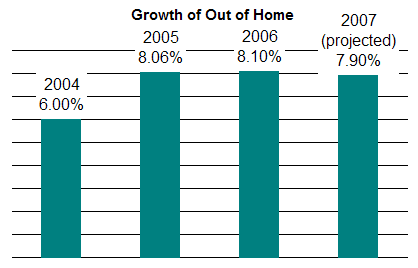
    The reach and creative potential with out of home are a couple of reasons it is growing when other media types are stagnant or shrinking. According to the OAAA, revenue for out-of-home advertising so far this year has increased by 7.9% (within a rounding error of the growth seen last year, and the year before). This projection for 2007 is based on spending in the first six months of the year. The graphic below shows prior growth.

    Growth of out of home this year is projected again at roughly 8 percent

    All of this is great news for brands that want to make a difference. There are many ways to truly involve consumers — some quite high tech, some that are extremely “out there,” and some that are frankly both. It all makes for an interesting ride with plenty to see and do.