Opinions are all my own

  • Andy Sernovitz provides disarmingly love-filled advice to a b-to-b crowd

    I’ve wanted to see Andy Sernovitz speak for several years. This Milwaukee-boy-made-good is the author of Word of Mouth Marketing: How Smart Companies Get People Talking. He’s a terrific dose of inspiration for any marketer facing the terrifying prospect of helping a brand “go viral.” Today he provided that inspiration — along with some excellent tactical ideas — to my city’s Business Marketing Association.

    Sernovitz’s presentation clearly had a consumer marketing origin, but he did an excellent job of reminding the business marketing group that we all go through the same decision stages in a considered purchase. Whether the person is a retiree buying his first recreational sailboat or a young design engineer considering parts suppliers, we’re human first. We’re swayed strongly by the opinions of others.

    We’re also moved by the creative imagination of smart marketing. Andy reminded us that we love what a brand does for us, or how it tickles our fancy.

    Ah, love. Who knew there would be such a strong tie-in with Valentine’s Day?

    Joking aside, here are two of his tips that are dead-on when it comes to marketing to business buyers:

    • White papers are still effective viral marketing tools
    • Email-a-colleague tools on your b-to-b web site are as well

    Andy also mentioned that it was the viral aspect of YouTube that has it valued so high compared to other video sharing sites. He counted 13 ways that YouTube helps people email or otherwise share its content with others.

    Online support of smart promotions can also help to get people talking. As a topical example, Andy mentioned this brilliant way that White Castle is getting people to talk about their restaurants on this day:

    A great ad, cited on Andy’s blog today

    Now there’s one more restaurant that you can’t get into tonight without a reservation!

  • CareerBuilder’s plans for grabbing and keeping Sunday’s Superbowl viewers

    Like millions of other Americans, I try to catch the Superbowl every year. But I’m a marketer, so my priorities are warped. With DVR remote in hand, I often time-delay the event by 45 minutes at the outset. This is so I can fast-forward through the often painfully one-sided game (and yes, Ron, your Pats will cream the Giants), and focus on the commercials. Laptop at the ready, I hop from one web address advertised to another, seeing the latest trends in corporate integrated marketing. Less strenuous than birding or trainspotting but just as geeky, I chalk the task up to research. But with this research, drinking pale ale is mandatory.

    This year CareerBuilder is whetting my thirst for — ahem — knowledge with teaser emails. As usual, they are using the spendy ad space to kick off their annual ad campaign. Something tells me there will be a cool viral microsite to go along with it, to keep the $3 million (which is the reported cost of one of this year’s 30-second Superbowl ad slots) working throughout the year. Here’s their email to me:

    CareerBuilder Email From Tuesday

    Notice that I turned off the graphics to help you focus on the content. Kudos to CareerBuilder for constructing an email that “looks good naked.”

    I’ll see you online, CareerBuilder!

  • PRISM, a bricks and mortar store analytics effort, takes its cue from e-stores

    It seems improbable that there was ever a time when skilled marketers didn’t use at least some traffic data to make improvements to their sites. The availability of this data, no matter how flawed, has been a chief impetus for the growth of web marketing as a discipline. The comparison was always with the dearth of similar data from bricks and mortar stores. Here are a few specifics:

    Stage of Purchase Web Metric Store Metric
    Initiation Unique Visits Foot Traffic Counts
    Consideration Page Views None Available
    Completion Transactional Data Transactional Data

    This list is over-simplified, but it makes a point. In the Consideration Stage — between the time when the door store swings open and the time the purchase is rung up — there is little to help the bricks and mortar marketer understand the motivation of the customer.

    By comparison, a web marketer has a full toolkit of metrics. There are page views to show visits to specific product pages and web site sections, exit pages to show when a consumer decides to leave without buying, and shopping cart abandonment metrics to show exactly when a consumer decided to stop his or her purchase.

    This stark difference is changing fast.

    PRISM (short for “Pioneering Research for an In-Store Metric”), is a Nielsen Media / In-store Marketing Institute co-production. Working with a consortium of retailers and consumer-goods manufacturers, the duo completed a test recently using sensors placed at key points in over 160 stores around the country. These sensors monitored the entrances and exits, as well as some store aisles, composing data sets and even heat maps of customer-traffic patterns.

    In a way that is uncannily similar to web analytics, the PRISM system combined these traffic data with transactional information. The end game is to achieve greater insight into consumer behavior.

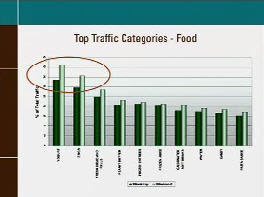
    A chart from the videoAs you can imagine, the potential for improving the in-store experience is huge. Just as web marketers have walked away with significant improvements to their sites through web analytics, these marketers are nearly giddy with new-found knowledge. At least, that’s the impression I’ve received by press accounts of PRISM. This piece in In-Store Marketing Institute’s site is characteristic of that excitement, particularly in this accompanying Flash and Quicktime video. (Warning: The video is all talking heads. Sadly, demonstrations of the system at work are being held closely under wraps.)
    Here is a typical insight, disclosed in the video by David Calhoun, CEO of the Nielsen Company:

    “In some food stores, the heaviest traffic flow is not through the carbonated beverage and snack aisles — which might be the conventional wisdom based on sales rates — but through the yogurt and eggs section of the store.”

    The chart above shows this (but not very well — it was captured from the video and only Calhoun’s narrative can identify the categories), with the two circled categories being the Yogurt and the Eggs sections.

    Since the advent of web analytics, physical world marketers have looked at us web marketers with envy. It appears their time to play next to us, in the sandbox of database marketing, is just around the corner.

  • Yes, you’ll like the music: The Smart Party system can read you like a playlist

    It’s tough to be a host. Will your guests like the snacks? Is there enough room to mingle, and proper ambiance to encourage conversation? And what about the music?

    This is no idle concern. In the days of special events that support your brand, your role as marketing technologist suddenly makes you responsible for enhancing the proceedings with the proper tunes. And musical tastes vary widely!

    Luckily, UCLA computer scientists have been on the task, and they’ve developed the Smart Party system. It polls the musical preferences of your guests by reading the playlists in their WiFi-enabled music devices.

    As excerpted below, a recent NewScientist item (subscription required), reports that this novel approach to “reading your audience” works by getting inside your guests’ purses and pockets:

    The [system] takes a poll of titles to work out the most popular genre and can also copy and play tracks from each device. It can then play music from the most popular overall music genre or tracks supplied by each party-goer in turn.

    Pretty cool stuff, although the article goes on to mention the obvious: digital rights management (DRM) may make this system a violation of copyrights.

    But I’m not as impressed with this innovation as with the direction that today’s innovators are taking. Before in this blog, I’ve posited that more than anything, portable marketing is about place. You’ll succeed as a marketer by enhancing experiences in a physical location at a particular time.

    News of the Smart Party system suggests that a lot of others are focusing their imaginations on making a place-based experience more personal, and ultimately more memorable.

  • Your web site’s messages should show a little humanity

    It’s simple. The reason for Apple’s spectacular success is that, although the human mind is capable of impressive calculation, what makes it uniquely human is its ability to dream.

    When they aren’t trying to parrot what Windows-based machines do, most Apple products promise a more fertile ground for right-brained thinking. Mostly these products succeed. And they do because they touch us in the heart at least as much as in the mind.

    Now think about your web site. Is it still behaving as if its users are more robot than human? Watch out, because your competitor’s sites might not. They may realize that the most buttoned-down web users haven’t forgotten to smile.

    Author and public speaker Daniel Pink made this point, but on a more global scale. His book from two years ago, A Whole New Mind contended that as workers in a new, Conceptual Age, we need to sharpen these six skills: design, storytelling, creative collaboration, empathy, play and rendering meaning — although he labeled them far more colorfully than I just did, which is why he is the famous business author and not me.

    Lately he’s been talking about using empathy in public messages. Once again, he was speaking more globally than messaging on web sites. But just review some of these examples and see if you aren’t inspired to breathe some warmth into your site’s content:

    Restaurant Sign:
    Don’t worry, this line moves really quickly.
    Movie Theater Electric Hand Dryers:
    We don’t like them either, but they are the most energy efficient and environmentally-friendly choice.
    Hong Kong Airport:
    Relax. Train comes every two minutes.

    These three have one thing in common. They respectfully ask us to take a breath and side with the human being who is delivering the bad news.

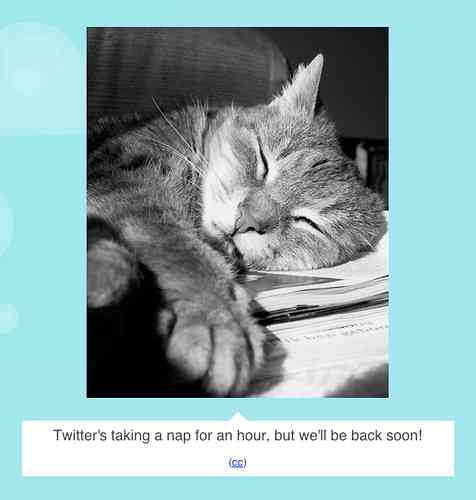
    How can this relate to your site? One of the most lighthearted set of web error messages come from the disruption-prone Twitter site. Although the originals were LOLcats, the latest batch — such as this one — take a more conventionally cutesy tack:

    A typical (and all too frequent!) Twitter error message

    Is this frivolous — therefore below consideration for your site?

    That depends. If your current error messages are pushing people over the brink, you’re losing business. There is nothing warm or cute about that business reality.