Opinions are all my own

  • How little do web users read? Even less than you think

    Before you struggle too hard and long over that golden prose you’ve drafted for your web site, consider this statistic, as cited on Jakob Nielsen’s USEIT.com site last week:

    On average, users [in the study discussed] will have time to read 28% of the words if they devote all of their time to reading. More realistically, users will read about 20% of the text on the average page.

    The takeaway: Write as though your reader has one foot out the door and the other on a banana peel. Get to the point and then move on!

  • Today Google does a cannonball into the social networking pool

    Three weeks ago, on a lark, I registered the domain name RumSocko.com. But until just now, I wasn’t entirely sure what I was going to do with it.

    Then, just moments ago, I learned that Google has entered the social network arena in a way that only a market behemoth can. Friend Connect will allow any site to have social network functionality. This tells me two things:

    1. Google sees an opportunity in social media marketing (SMM)
    2. It’s time for me to invite my friends and relatives to submit their favorite rum drinks

    Of course, only point #1 is of real relevance to my fellow marketing technologists. There has been plenty of talk lately about how social networks are still groping for a viable revenue model. I suspect Google will lead the way to the banquet.

    An example

    The only question will then be: Must other social networks resign themselves to the crumbs that Google leaves behind?

  • Why you’ll never find truly brilliant open source web design

    Malcolm Gladwell recently wrote about the nature of invention, and a society’s response to it. We revere scientists as heroes, for inventing solutions to our toughest problems. Yet Gladwell points out that these geniuses seem to be more vessels than virtuosos.

    The inspiration for a particular technology seems to arise “in the air,” to be picked up by the right inventive minds and made real. In many cases, such as the story of the invention of the telephone, there is more than one inventor. In addition to Alexander Graham Bell, there seems to be a parallel invention of the device by a fellow by the name of Elisha Gray. Why is he unknown? As often happens, the awarding of bragging rights turns into a race to the patent office.

    Science historians call this phenomenon “multiples.”

    The same creative insights seem to strike a number of inventors — often scattered across the globe — at the same time in history. Gladwell reminds us that the uncertainly of whom was the real originator makes our inclination to name a device after its “inventor” a dicey proposition at best:

    We think we’re pinning medals on heroes. In fact, we’re pinning tails on donkeys.

    This made me think of open source applications. Perhaps it’s fitting that we do not commonly know the single inventor of PHP technology — not because so many have built upon this foundation, but because the foundation itself was “in the air,” ready to be interpreted into code. I use PHP as an example, but any open source innovation will do to make my point.

    Few would argue with the genius behind PHP. So why don’t we see multiples of web design? Aren’t good designs of sites “in the air” as well?

    Singulars versus Multiples

    Gladwell provides a hint to an answer when he states, “[a historian’s observation] about scientific geniuses is clearly not true of artistic geniuses.” He goes on as follows:

    A work of artistic genius is singular … Shakespeare owned Hamlet because he created him, as none other before or since could. Alexander Graham Bell owned the telephone only because his patent application landed on the examiner’s desk a few hours before Gray’s.

    I find this distinction fascinating, because both types of genius are put into play in the creation of a great interactive experience. I love that one part of the process — the technology — uses the work of many to channel something that is clearly superior to others it replaces, yet is impossible to attribute to a single creator. Yet the part of the process that creates the most intimate parts of that application — the design — are invariably one person’s handiwork.

    That is the true genius of web design, and it explains why a digital world will never make a web designer less “singular” than, say, a great playwright or composer.

  • StumbleUpon gets to the crux of my problem

    Sometimes I regret finding so many things interesting.

    You see, I grew up in a part of the country that was extremely remote and sparsely populated, with little cultural diversity, in an era before cable, VCRs, and of course the internet. The majority of my teachers, bless them, were clearly there for the hunting and the summers off. In other words, intellectual stimulation was not a feature of my childhood.

    Home Sweet Home

    Years later, after some lucky breaks and the support and guidance of some extraordinary people, I find myself doing work that is rewarding and stimulating. Especially stimulating. The internet has given me the freedom to explore everything that intrigues me.

    All of this became apparent as I updated my StumbleUpon profile.

    It’s as though a genie had poofed out of a lamp and given me the ability to visit the best web sites available on any subject. And unlike the genie from One Thousand and One Nights, I’m given not three wishes but 127.

    There is the rub!

    And this is just the start

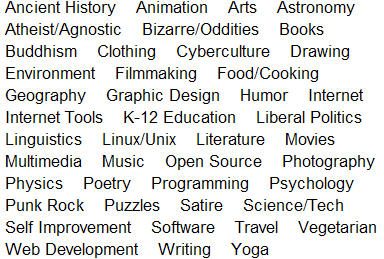
    I started with major interests, and realized that I’d checked more categories than I’d left blank. As I dug deeper into each, I was stopped at 127 interests, with the depths of many categories left unplumbed. The word cloud above shows the major selections only.

    My first bosses were a pair of brilliant advertising entrepreneurs. One had a degree in history, the other, journalism. Together they showed me the power a person grounded in the Humanities could have in the business world.

    They too were cultural omnivores.

    I thought of them this evening as I ticked off the many areas of study I wished I had an entire lifetime to explore.

    Tonight I might skip sleep. Again. I may just stay up and drink deeply from the well of StumbleUpon, a magical servant who feeds that little boy whose thirst for knowledge insists on being quenched.

  • Webby winners include new personal finance site

    Yesterday I described how Mint.com effectively used persuasion architecture modes of purchasing to acquire new users. Mint.comLater that day the site acquired its first Webby Award. Here’s a rundown from Mashable of other notable winners, including one that should have gotten Best Use of Snail Mail In Its Web Design: PostSecret.com.