Opinions are all my own

  • Guerilla (and gorilla!) marketing at its finest

    How much must a truly stellar promotion of a new business cost? If you’re a small, scrappy start-up willing to take a few risks, the answer is not much.

    Steve Fretzin and a few enterprising friends realized that their Chicago networking events were suffering from a lack of publicity. There was no calendar of Chicago-area events specifically for those seeking business networking.

    Instead of cursing the darkness, they lit a candle. They created NetworkingMonkey.com.

    Then they realized something else. NetworkingMonkey needed publicity even more than their events.

    So Fretzin and company found a sharp PR firm and embarked on an aggressive publicity campaign. He told me, “We wanted to make a statement to the city. So we hired 10 actors and sent them into the streets.”

    They didn’t leave unarmed. The came packing fruit.

    “We had them dressed up in gorilla suits, and we gave them crates and crates of bananas — each with a card that had our value statement and web address. We gave away 7,000 bananas.”

    If you have trouble imagining what that must have looked like, click on the video below. The event was well-documented, thanks to their PR partners, who wisely planned the event to coincide with a local television newscast’s “Dance-off Friday.”

    The value of this prime time television (and subsequent YouTube) exposure is hard to measure. But since the buy-in wasn’t much more than the purchase of a medium-sized plantation’s worth of bananas, I’d say the ROI of this clever publicity ploy was definitely huge.

    The Take-away:

    You don’t need a hefty promotional budget if you choose the right partners and use you imagination.

  • Cellulite couch shows the power of wit in branding

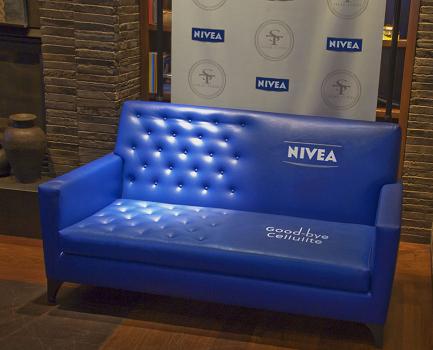
    Nivea was in South Beach for Miami Fashion Week and wanted to make an impression. They succeeded, with the help of New York agency TBWA\Chiat\Day [sic].

    To promote the Good-Bye Cellulite product line, Nivea fashioned these sofas.

    Brilliant.

  • Context matters with online B-to-B ads

    Testing in the online world has never become easier or more affordable. It’s therefore no surprise that many assumptions about online ads are being reconsidered. Today, Enquirio and Google announced the validation of one such tenet. It had been assumed, through common sense and improved response rates, that an ad displayed in the context of similar subject matter will do better than one with no relationship to content.

    What do we mean by contextual ad placement? The premise is that if I’m an executive who influences a decision to purchase construction equipment, and I see an ad as I review a construction industry portal site, I am more likely to recall the message — and the brand — than if I saw the same ad on an unrelated site.

    In research by Enquirio and commissioned by Google, this assumption was validated. The research methodology included randomized test subjects, given tasks related to the content of the sites they were reviewing. Some sites contained ads that were relevant, others contained the same ads but had no connection to those ads’ subject matter.

    Results were gathered in the form of questionnaire answers and aggregate eye scan heat maps of the sites being reviewed.

    Two key take-aways:

    • Through contextually relevant business-to-business (B-to-B) ads, purchasers are 52% more likely to associate your message with your brand
    • With contextually relevant B-to-B ads, it is 28% more likely that your brand “will make the cut” and be shortlisted.

    The Enquirio site has the whitepaper available for download.

  • Pecha Kucha Milwaukee stages another successful event

    Roughly 200 people attended Tuesday night’s Pecha Kucha Night, at Milwaukee’s Hi Hat Garage. I was one of them, and had the honor of being one of the presenters.

    If you don’t know what a pecha kucha is, you should find out. Here’s a post about the evening (pre-event) on the blog of the Milwaukee organizer, 800-CEO-Read. It includes links to help explain what it is and why you should care.

    This YouTube video of my presentation has just been posted:

    Special thanks to Jon, Kate and everyone at 800ceoread for making this event, and the follow-up videos, such a terrific success.

    You can see others from that night by reviewing this list on YouTube.

    The evening was an absolute blast. I’m definitely going back. If you’re in the Milwaukee area, I hope to see you there.

  • ChaCha on! Use free cell phone texts to settle bets and get smarter

    Yesterday, comments in a post about changing book readership levels proved that my assumptions are not a given. They may even be wrong. Unlike me, some think that rising book sales levels is proof that readership is actually growing.

    I’m of the opinion that gross book sales are an unreliable measure.

    For instance, the only two publishing break-out stories of the past decade are the successes of Scholastic Publishing, which has the Harry Potter series, and Wiley Publishing, which has the For Dummies series. I’m over-simplifying, but one could say that unless you’re a child, or a “dummy,” your consumption of books isn’t growing year-to-date.

    Or is it?

    A few minutes ago, after reading a comment in my post by Matt Davis, I decided to reach out to an “impartial” third party. Here is the comment that spurred me on:

    Your link claims an increase in book sales versus the previous year. Couple this with the “1 in 4 Americans Read No Books” stat, and my conclusion is that passionate readers are numerous. It’s the passive or non-interested reader that is fading away. Am I wrong?

    I don’t know, Matt. Not anymore!

    So I used a service on my cell phone that I’ve been meaning to try for some time. Think of it as a library Ready Reference service, but via text messaging. And, at least for now, it’s free. (Standard texting costs in your cell phone plan apply, of course!)

    I’m speaking of ChaCha. Reading reports about it intrigued me. I love the idea of settling bets quickly and (hopefully) conclusively. And hey, I can certainly stand to get smarter on stuff.

    So I just texted this to the ChaCha short code (242242):

    Are more people reading books today versus in the past, or less?

    Four minutes later, this is what was texted back to me:

    Before the internet and TV and other electronics, people read more books. But now the number have went down a lot [sic]. ChaCha! http://search.chacha.com/u/j02abxvf

    On the surface this answer looks good (poor grammar notwithstanding). But if you click on the source link, you have to ask yourself about the quality of the information this answer was based on.

    My take-away: Who knows who is right? But for a fun way to settle a question, I like this quick and free service. It might even help with Trivial Pursuit.

    ChaCha on!