Opinions are all my own

  • What was sorely missing from yesterday’s iPad unveiling was … Graffiti?!?

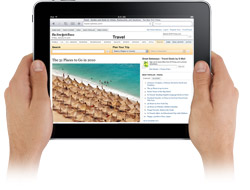
    The iPad, unveiled WednesdayYesterday’s unveiling of the Apple tablet, which we now know is called the iPad, showed a device with a larger surface than the iPhone / iPod Touch. It allows for a better reading and video experience and provides improved ways to do things like manage emails and photographs. Largely unaddressed with this release is a far more important question: How will this multi-touch make me  better at thinking and creating?

    Rocking the PDA old skool with Palm’s Graffiti

    Return with me for a moment to a simpler time, before smartphones got “smart.”

    It was a time when the handheld device du jour was a Personal Digital Assistant (PDA). In the 1990’s, Palm released their Pilot PDA. These Treos, sans cell phone required a stylus for text entry. There was no QWERTY keyboard, and not even a cell phone number pad.

    The user needed to learn a type of stylus script called Graffiti to get text into the thing. Some people got good enough to write with something close to the speed of traditional longhand. Personally, as a lefty, I found it more comfortable to use Graffiti than to write in longhand. I didn’t have to think about the angle of the paper in relation to my contorted left hand. Smearing ink wasn’t an issue.

    This was many people’s introduction to a computer user interface beyond the keyboard. There was a lot wrong with it, though. Styluses are a pain to use. And many Palm users found Graffiti so difficult to use that they simply called up a hunt-and-peck keyboard. Here’s a YouTube demo of it in use.

    For me the golden promise of multi-touch monitors is not the ability to flick through photo galleries or zoom into a map — as cool as those functions are. Ever since the first mass market multi-touch keyboard was made available with the invention of the iPhone, I was waiting for a faster way to record thoughts.

    I was hoping yesterday to learn of a gestural script — a Graffiti without the stylus.

    What’s so wrong with QWERTY keyboards?

    Whether displayed on an iPhone, an iPod Touch, or now the iPad — old-fashioned keyboards simply don’t free the user to quickly jot something down and get back to work.
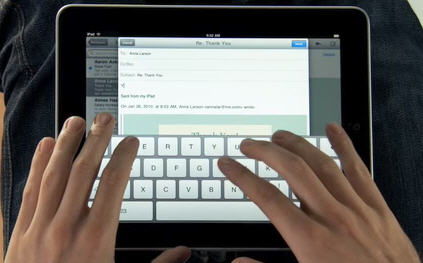
    Instead, these devices force users to leave the fluid, intuitive work of (let’s face it!) grown-up finger painting. The appearance of the QWERTY keyboard sends them marching back indoors like a recess bell. Ugh! The taps of fingers on keys — even ultra-modern keys, projected on slick glass iPad surface — still evoke the drudgery of an oppressive cubicle farm.

    I know this sounds a little glib, but think about it. Our speed of productive output are in many ways limited by our office supplies. Give someone a soul-crushing keyboard to think with and you’ll be producing something constrained by that medium. If their work soars, it’s in spite of the keyboard, not aided by it. In 2003, Jeff Han demonstrated to cheers the full effect of a multi-touch experience. I predicted then that this technology will quickly change the very nature of our work experience.

    Apple knows this.

    There have been accounts of Apple applying for and receiving patents on what would be the building blocks of a new gestural interface. New Scientist recently recounted the patents Apple has applied for to tap into “touch or hover” and “gesture dictionary.” That day may arrive with a new version of the iPad. It cannot come soon enough.

    Related post:

  • Jeff Han’s demonstration of multi-touch screens
  • Thriving in a hashtag economy

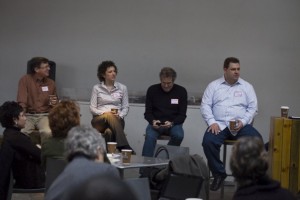
    Kudos to photographer Matt Mason for providing these photos. Click to see the gallery

    A question about using social media arose this morning — one that I only had time to half-answer. I was on a panel at a Milwaukee Social Media Breakfast (#SMBmke). The question (to paraphrase): “I don’t sell a sexy product. I’m a business that sells to other businesses something that they need. But they don’t necessarily blog about it or tweet about it. Can social media support my goal of lead generation?” I said yes. Below is the second half of my answer.

    I did mention The Long Tail. Click through that link to learn what that is. And if you do, think about that link. Jeff Jarvis coined the phrase link economy. Chris Anderson coined the phrase the long tail. I propose a new coinage: the hashtag economy.

    The long tail is the book, and the concept, about how niche markets find what they need in a world this isn’t hindered by the economics of brick-and-mortar. There are no carrying costs associated with iTunes offering one more song that just happens to be obscure. Their inventory is limited only by digital storage costs and the bandwidth necessary to deliver the song when someone buys it.

    The link economy uses this free, or nearly free, paradigm. It cost me nothing to create the link that pointed readers to an explanation of The Long Tail. The link led to Wikipedia. There again, the power of almost-free. This crowd-sourced encyclopedia saw the most minuscule of incremental costs to provide you with that definition.

    The upshot is this. Since we are rewarded nearly every time we click on a link, we do it more often. That generates something that very often can be monetized: Significant volumes of traffic.

    Smart businesses — such as the publishers of Wired Magazine and Anderson’s book — leverage this link economy to sell more books. And they leverage The Long Tail Phenomenon in the very sale of a book about the long tail; Anderson’s book might never have become a best-seller if it hadn’t been offered in a virtual bookstore like Amazon first. His readers might have simply been just too darned “niche” to persuade bricks-and-mortar book stores to stock it in their shelves.

    Scott Baitinger, co-owner of Streetza Pizza, and I were talking about niche marketing earlier this week. I complimented him on his use of Twitter Hashtags to find a narrow group and to market to them. That narrow group is @FitMKE. Scott has been peddling his pizzas to this group by tweeting to them with the #FitMKE hashtag.

    Analog broadcast channels (those based on radio / television wave frequencies) are valuable enough that they are regulated by the government. There are rules about what businesses must do to earn their right to be there (e.g., public service announcements and public-oriented programming). Things that are scarce have value, and these channels are no exception. A recent auction of analog broadcast channels garnered bids in the many millions of dollars.

    Twitter handles are not limited by the spectrum of a radio or television broadcast frequency. If I auctioned off my Twitter handle, I would get zero bids. Why? Everyone who knows anything about Twitter knows you can create accounts limited only by the nearly infinite combinations of letters and numbers.

    This makes Twitter a spectrum of a nearly infinite number of nearly-free channels. It draws lots of people because it is so cheap and teeming with variety. It uses both the long tail and the link economy.

    Increasingly, Twitter is also spawning communities of likeminded people around hashtags. One example of #SMBmke. Another, ironically, is #MKElikemind (another breakfast group — here’s the info on my blog). Scott, and @StreetzPizza, found #fitMKE to be a channel to narrow-cast his offer of healthy pizzas (and also indulgent pizzas, since — hey — you have to be getting fit to enjoy life, don’t you?).

    The Hashtag Economy is one way smart marketers are finding their niche audience within the cacauphony of other channels. They’re tuning in, conversing, and doing business there.

    Here’s a challenge, especially for my friends (old and new) who attended this morning’s breakfast: What hashtag conversations have you been a part of? And how have they improved your life and work? More important: What business relationships have formed from them?

    Related posts:

    Also mentioned:

    Photo credit: Matt Mason, photographer

  • Milwaukee wants to know: Should you hire a social media expert?

    Originally scheduled for December, the Social Media Breakfast panel discussion, Social Media Guru: Snake Oil Salesman or Expert?, will take place on Thursday, January 21, at The Moct. I’ll be one of the four panelists. The other panelists, and other details, are as follows (this information was originally posted last month):

    Matthew Olson @_Signalfire_ – Owner and Creative Director of Signalfire, LLC

    Sue Spaight @SueSpaight – VP of Account Management and Digital Strategy at Meyer & Wallis

    Kim Nielson @Knmu – Communications Project Manager at University School of Milwaukee

    Here are the details:

    January 21, 2010 – 7:30 am to 9:30 am

    The Moct – 240 E. Pittsburgh Ave., Milwaukee, Wisconsin

    WiFi and Light Breakfast Provided

    Twitter Hashtag: #SMBMke

    It promises to be a spirited discussion on a timely topic. I look forward to seeing you there!

  • Brought exclusively to Milwaukee and Madison: Improve how you measure your site’s ROI

    Start the new year right by resolving to better track the return on investment (ROI) of your web site. I’ve been hard at work with Milwaukee’s C2, planning my upcoming digital ROI workshops in Milwaukee and Madison. Here is the information as it is posted on the C2 site:

    These half-day seminars are designed to expand your understanding and broaden your capabilities and confidence. You’ll work smarter, faster, stronger!

    Each 3-hour seminar will be offered in Milwaukee and Madison.

    Please click the date to register

    Digital Content Development and Delivery That Maximizes ROI

    Presented by Jeff Larche, Digital Solid

    Measurement, benchmarking, comparative analysis and revision of content to best generate desired results can be a complex series of steps, each with its own challenges.  Jeff will show participants best practices for workflow management around digital content development and delivery that will maximize your return on your investment of time and resources.

    Milwaukee: Tuesday, March 9

    Madison: Tuesday, March 23

    Realizing Results Demands Real Measurement: AIDA

    Presented by Jeff Larche, Digital Solid

    Jeff takes a deep dive into web page analytics to show participants specific measurement tools/methodologies designed to measure the sales cycle effectiveness of each page using metrics around AIDA: Attention, Interest, Decision and Action.

    Milwaukee: Tuesday, April 13

    Madison: Tuesday, April 27

    These workshops are unique in the area and are reasonably priced, so they should fill up fast. I suggest you register right away.

    They should also be a lot of fun. I hope to see you there!

  • Ambient awareness is to humans what coconut shells are to an octopus

    Octopus using shells as toolsEleven months  to the day after David Pogue of the New York Times posted on being a newbie in the “Twitterverse,” I think his piece is still one of the best introductions to the platform. Here’s a sample:

    I’ll admit that, for the longest time, I was exasperated by the Twitter hype. Like the world needs ANOTHER ego-massaging, social-networking time drain? Between e-mail and blogs and Web sites and Facebook and chat and text messages, who on earth has the bandwidth to keep interrupting the day to visit a Web site and type in, “I’m now having lunch”? And to read the same stuff being broadcast by a hundred other people?

    Then my eyes were opened. A few months ago, I was one of 12 judges for a MacArthur grant program in Chicago. As we looked over one particular application, someone asked, “Hasn’t this project been tried before?”

    Everyone looked blankly at each other.

    Then the guy sitting next to me typed into the Twitter box. He posed the question to his followers. Within 30 seconds, two people replied, via Twitter, that it had been done before. And they provided links.

    The fellow judge had just harnessed the wisdom of his followers in real time. No e-mail, chat, Web page, phone call or FedEx package could have achieved the same thing.

    I was reminded of this again over lunch yesterday, when I was chatting with a couple of really smart tech types. My lunch companions were very Pogue-like in their misgivings about Twitter. One was even leery of Facebook. Both made points that sounded familiar to me.

    I acknowledged that when Twitter first came out, I was the same way. This post from 30 months ago is an example of my ambivalence toward Twitter. I have since seen it work as a valuable way to connect and learn, for both me and many of my clients. Some business has come out of it as well.

    I’m sold on Twitter. Besotted in fact. (See for yourself, at @TheLarch)

    But its success could be fleeting. Twitter is white hot right now, but flash fires often burn out just as quickly.

    Maybe I should revise my oath of undying love. Instead, how’s this? I’m sold on the emerging social dance called ambient awareness, a concept explained eloquently in this Clive Thompson article.

    Pack up your coconuts and see the world

    Ambient awareness is bigger than Twitter, and even bigger than Facebook (now at 350 million users worldwide). It’s like the coconut shells in the arms of an octopus. For those who didn’t see that story, here’s the gist: Biologists diving off the coasts of Indonesia have discovered a species of octopus that has evolved to use a novel tool. Scientific American describes the discovery:

    The octopuses were found to occupy empty seashells, discarded coconut shell halves or manmade objects, and on several dives, the researchers saw them carrying coconut shell halves below their body and swimming away with them.

    Sometimes, an octopus would carry two shell halves and then put them together to form a shelter, the scientists said…

    “Using tools is something we think is very special about humans, but it also exists in other animal groups we’ve never considered before, a low life form, a relative of a snail. These octopuses, they’re not simple animals.”

    I learned about that story through — what else? — Twitter. This platform, and the ambient awareness it harnesses, is literally a new tool for helping those who put it to use. It helps us work, play and generally be the social creatures that we are.