Category: Web Marketing

New ways to create and measure sites so they improve their ability to bring your best customers closer and attact other individuals just like them

  • Viral campaigns more frequently relying on pre-existing buzz

    Legend has it that in 1936, Lana Turner was playing hooky from Hollywood High School when she was discovered by a film studio executive. She was sipping soda in a local drugstore. Almost immediately, Turner became a star. Social media sites such as YouTube are becoming today’s soda fountain. For example, take the lastest “discovery” (last month there was Nick Haley).

    Musician and University of Minnesota grad student Adam Bahner became a minor internet sensation. Bahner, who records under the name Tay Zonday, wrote and posted a music video that had novelty and a simple but catchy melody going for it. Here is his video on YouTube.

    Next, he is contacted by video production company True Entertainment. Their assignment was to promote a new soda flavor from Dr. Pepper. The director’s vision was to take “Zonday’s” song, add a boatload of production values, and come up with an online video that would get attention and go viral. Very viral. As of this writing, the video has been up on YouTube for exactly one week, and has been viewed there 1,234,763 times. Here it is.

    One of the first lines of the song is “This is the web, and it’s going to murder your TV.” True enough. And it has already made modern Lana Turner stories more sudden, more fleeting, and decidedly digital.

  • In praise of short URLs and one innovative provider

    Like everything else, short URLs follow the rules of supply and demand. My first internet business, in the mid-1990’s, had a four-character dot-com domain name. Back then this was good but not extraordinary. Now the dot-com space is so crowded that many start-ups look like they were named by dipping a spoon into alphabet soup. Luckily there are short URL services — most famously ShortURL.com. [I was thinking of TinyURL.com, the clear winner of the two in terms of Alexa’s Daily Reach metric.]
    These businesses take the sting out of a rangy line of URL characters, while helping to avoid truncation (in emails) and misspellings (when speaking the address over the phone).

    As a market leader, TinyURL offers a ton of features. Maybe too many. An upstart I’ve just learned about (thank you Steve Purkiss of ProjectStars) will give this status quo provider a run for its money. For this month’s One Positive Day, consider what URLao.com is doing right.

    I love URLao’s simple, clean, Web 2.0 interface. They get you started quickly and pull you in with simple explanations of their best features. Here is the language they use for them:

    Private Redirect
    Ensure your privacy by requiring users to enter this password before being taken to the destination.
    Enable Cloaking
    This option hides your target URL — when users visit your link, they will only see your shortened URL in the address bar of the browser.
    Preview Target
    Give your users confidence by allowing them to preview the location of the redirect. On visiting your link, the user will be shown the location of the redirect and be asked to click the link or to confirm they wish to visit the destination site.

    Notice the number of features is short. Just three. It’s a wise move for an upstart player in this category … promise a simpler yet improved experience.
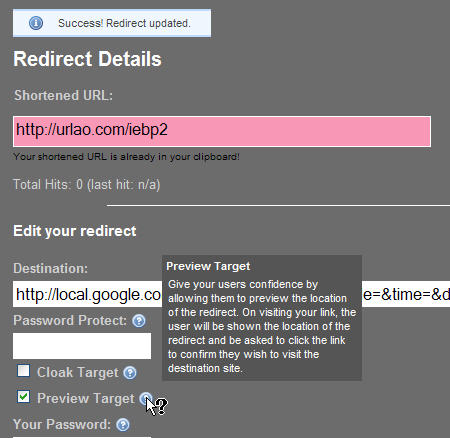
    Short URL Example (using URLao.com)

    Notice the benefits-heavy descriptions. This is even smarter. I used the last of these features when I created this short, clear URL to go to a Google Maps location of our parent company (and the home of ec-connection): www.URLao.com/FindNS. It’s a shortened version of this ungainly URL:

    http://local.google.com/maps?f=q&hl=en&geocode=&time=&date=&ttype=&q=nelson+ schmidt,+milwaukee,+wi&ie=UTF8&ll=43.043614,-87.899938&spn=0.009158,0.021114 &z=15&iwloc=A&om=1

    There are other features you should investigate, such as tracking each short URL’s use. I’ve often wondered how I could easily track how many people in a short list of email recipients actually click through to the links I’ve provided. This gives me that power, while ensuring that none of the URLs are broken in the process of opening, replying or forwarding the email.

    As with so many other start-ups, this one offers its services for free. That means you definitely do not want to use it for mission-critical work, or anything where online security is an issue. But for quick, smart creation and monitoring of customized URLs, I have yet to find a service better than this one.

  • The power of nuance and why words really do matter on the web

    When redesigning a site for a client, our team works hard to get sign-off on improving content quality — especially the language used. Getting this level of influence is often a challenge. Large sites usually have many content “owners.” In our experience, few of these domain experts are also experts in optimizing online content, either for readers or search engines. These folks can underestimate the importance of nuance to the success of their content.

    Frankly, I don’t blame them.

    Until the advent of the Content Interest Index, there really hasn’t been a way for content managers to gauge success. The best they had were more global, site-wide metrics.

    NOTE: This Tools + Tips post on GrokDotCom provides an excellent run-down of some existing engagement metrics for overall site performance.

    In other words, in the well-worn words of Tom Peters, “You can’t manage what you don’t measure.” Without measurements showing the effect that content quality has on readers, many domain experts overlook the power they wield.

    This is unfortunate. I’ve seen small content changes make impressive differences in response. Here is a quote from the web site of Thom Pharmakis that sums it up well:

    I own a decades-old Italian car that is so highly strung, the valve clearances need to be checked every 3,100 miles … just .001 inch out-of-tolerance will cause a discernible lag in performance. Selling copy is that sensitive. Every word, every paragraph space, the placement of every comma or ellipsis or dash is meticulously considered. Little alterations have drastic effects. Which makes the difference between blistering performance … and sitting stranded by the side of the road.

    Here, here.

    Another Way by Thom Pharmakis

    As a side note, it takes more than a phenomenally gifted writer to score a bulls-eye on the web. Thom’s statement is displayed on his site as nothing but a graphic (shown above, and found on his site). That means his wonderful metaphor is impossible for search engines to read and index.

    Even when your audience is non-human — and is in this case a search engine robot — it’s not so much what you say but how you say it!

  • Cheers to the barnacle app: a useful new entry in the Web 2.0 lexicon

    Last week I reported on a fun little social lubricant called Foamee. It is a third party trifle completely reliant (at least as of this writing) on Twitter. The objective: If you’re a member of Twitter, you pledge to buy someone a beer. Foamee keeps tabs on these declarations.

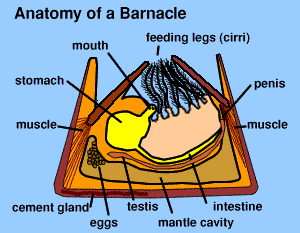
    Anatomy of a Barnacle AppAs I pointed out in my post, this application is part of a larger trend. Namely, that of launching a shoestring site that is financially independent of a larger site, but completely dependent on it for survival. It’s an interesting paradox, and all but cries out for a new piece of jargon. You know, something to toss out casually during your next new media PowerPoint presentation.

    Enter Joshua Porter of Bokardo Design. In his blog, Joshua dubbed this type of site a barnacle app. I think the term has legs (and the graphic above backs me up on this — at least, a barnacle has “feeding legs”).

    Do you agree? Is this a term worthy of surviving past its inevitable 15 minutes of fame in Wired‘s Jargon Watch listing (a recent example)?

    Also: What is your favorite barnacle app, and why?

  • Add the latest JCMC to your towering reading pile

    We’ve all got far more to read than time to read it, right? So you’re going to hate me for telling you this, but if you care about communication and technology, you should be tracking the Journal of Computer-Mediated Communication. Especially this latest issue, whose “special theme” is social network sites.

    Of particular relevance to marketing technologists are these articles:

    • Social Network Sites: Definition, History, and Scholarship
      danah m. boyd and Nicole B. Ellison
      This introduction describes features of social network sites (SNSs), proposes a comprehensive definition, presents a history of their development, reviews existing SNS scholarship, and introduces the articles in this special theme section.
    • Social Network Profiles as Taste Performances
      Hugo Liu
      A social network profile’s lists of interests can function as an expressive arena for taste performance. Based on a semiotic approach, different types of taste statements are identified and further investigated through a statistical analysis of 127,477 profiles collected from MySpace.
    • Whose Space? Differences Among Users and Non-Users of Social Network Sites
      Eszter Hargittai
      Are there systematic differences between people who use social network sites and those who stay away? Based on data from a survey administered to young adults, this article identifies demographic predictors of SNS usage, with particular focus on Facebook, MySpace, Xanga, and Friendster.
    • Mobile Social Networks and Social Practice: A Case Study of Dodgeball
      Lee Humphreys
      Dodgeball is a mobile social network system that seeks to facilitate social coordination among friends in urban public spaces. This study reports on the norms of Dodgeball use, proposing that exchanging messages through Dodgeball can lead to social molecularization, whereby active members experience and move through the city in a collective manner.
    • Publicly Private and Privately Public: Social Networking on YouTube
      Patricia Lange
      Based on a one-year ethnographic project, this article analyzes how YouTube participants developed and maintained social networks by manipulating physical and interpretive access to videos. The analysis identifies varying degrees of “publicness” in video sharing, depending on the nature of the video content and how much personal information is revealed.

    Juicy stuff. Enjoy!