Category: Web Marketing

New ways to create and measure sites so they improve their ability to bring your best customers closer and attact other individuals just like them

  • B-to-B Viral Marketing Case: Powerboat sales as a window to our current economic squall

    Let’s say you’re a company that mines data in a quiet niche — one not known for analytic vigor. You’ve been doing it for years and do it wonderfully. For clients who appreciate your chops, you’re a godsend. But these clients are exceptional in the traditional retail business sector you serve.

    How, how do you spread the word about your super-segmented lists and dead-on business intelligence services? Intuition says you find something to “go viral” around. But that requires some degree of topical relevance, if not outright sensationalism. How do you enliven something as dry as, say, boat purchase behavior (pun intended), to give it the life necessary to grab headlines?

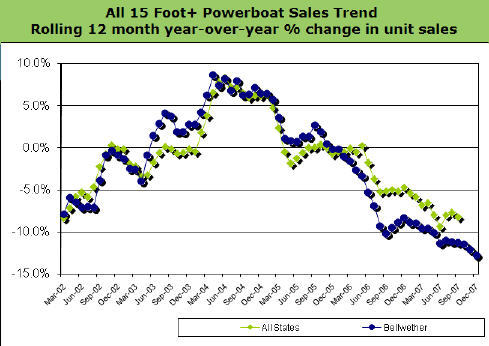
    The answer is what Info-Link does. They periodically publish one of the more pedestrian metrics they track: Quarterly sales in bellwether states. Below is their latest Bellwether Report, available on their site and distributed via a simple but effective opt-in email:

    Info-Link Bellwether Report

    You can explore various sales statistics by quarter (use the pull-down). Yes, the news is depressing. But it’s undeniably informative. And share-able. What information can your business repackage in such a way that people will want to share it?

  • Looking for ways to promote your cause? Look no further than this Conversation Bum Rush

    As marketing technologists, we are like entomologists in a thriving new ecosystem. Everywhere you look there are new species of creatures flitting about, evolving — it seems — right before our eyes. They may use similar techniques for survival and reproduction, but the combinations employed vary slightly from one to the next, and by observing the most successful species, you can learn much about surviving yourself in this teeming Web 2.0 forest.

    Now don your pith helmets, and behold the authors of a book on social media. You will not encounter a more highly adaptive critter. How do they thrive?

    Well, you wouldn’t expect them to typically run ads in the New York Times, or on the sides of cabs, for that matter. To promote the latest edition of their book, they are practicing what they preach. And they will succeed.

    Watch and learn.

    Join the Age of Conversation Bum Rush on March 29thOn March 29, join a social media movement (and help a good cause) by purchasing the latest Age of Conversation. And for an excellent blueprint for promoting the book, read Chris Wilson’s blog entry on the campaign (by way of David Berkowitz). The tactics Chris outlines are how the most successful social media “creatures” are surviving in this thrilling — and dangerous — new media jungle.

    Watch and learn.

    And, come the end of March, buy the book!

  • WhoIsSick.org: A mash-up that proves misery loves company

    Musical genius Tom Waits once quipped, “Everybody I like is either dead or not feeling well.” This week I took comfort in these words as I was in the throes of a terrible cold. Everyone I knew, it seemed, was either sick or succumbing. As often happens, this got me wondering how widespread the virus really was.

    In the past I’ve been frustrated. Maps of everyday pandemics aren’t easily come by. But today I got an emailed link to an interesting new Google mash-up. The link was sent to me by friend and lighting designer extraordinaire Noele Stollmack (who has been begging me to mention her in my blog for months*). A bit of an amateur epidemiologist herself, she confessed in her email that WhoIsSick.org is the “first social networking site that has piqued my interest.”

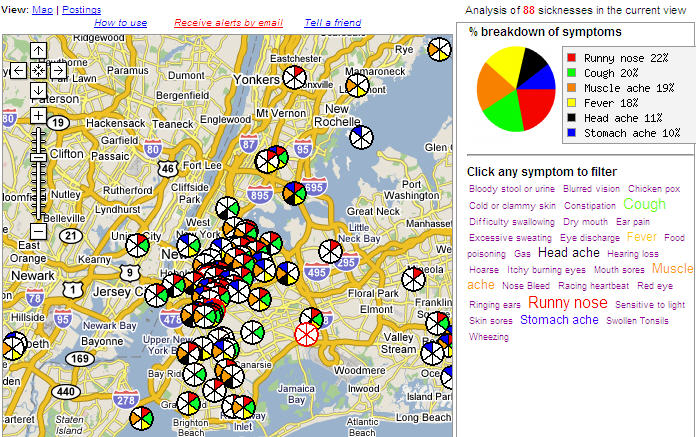
    Click on this image for an expanded view of the sick people in NYC in the last 60 daysNoele is actually jumping the gun a bit. It may become a social network someday, but for now it’s a promising database / mapping application showing the spread and concentration of collections of symptoms. Participation is still quite low, but I like the concept. The image at the right shows a tag cloud of the symptoms reported in the Manhattan area. If you click on the image you’ll get an expanded view that shows the NYC Google Map with the distribution of these symptoms.

    How are you feeling? If the answer is not well, go to WhoIsSick and type in your ZIP code. You’ll see who else is sick in your area, and have a chance to add your malady to the mix.

    Try it. It might make you feel a little better.


    *Actually, Noele Stollmack finds blogs “too personal and self-indulgent” to waste her time with, which is reason enough for me to create this Google bomb that ranks high when anyone searches on the phrase noele stollmack. 🙂 Back atcha, Noele!

  • Follow-through is crucial to higher search conversion rates

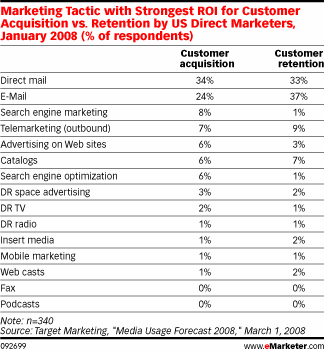
    Yesterday I sent a results report to a client for a pay-per-click (PPC) search  lead generation campaign that my team managed. It showed a performance that was five times higher, in terms of cost-per-lead, than a traditional direct mail campaign. That’s pretty cool. But as I sent the report, I was reminded of this recent report from eMarketer:

    eMarketer summary of favored direct response media

    It shows how a majority of marketers favor direct mail for lead generation versus search marketing. Scott Brinker was rightly puzzled by this, in a recent post. I agree with Scott that a chief reason for this strong preference for direct mail over search engine marketing (34% versus 8%), when it comes to customer acquisition, is the difficulty many marketers face in getting search prospects to convert.

    Indeed, if the lead acquisition campaign my team was leading was instead a customer acquisition campaign, the results would likely have been closer to a dead heat with direct mail in terms of ROI.

    But what does that mean? Just that we’re not trying hard enough. As marketers, I feel we cannot allow so many opportunities for conversion to click away from landing pages. There are many tested techniques for improving conversions (new offers, testimonials, guarantees, Web 2.0 landing page design). There are also spectacular new tools to do multivariate testing of these techniques.

    Let’s take direct mail for what it should be. It is (usually) the customer acquisition benchmark. Now let’s shift more resources online, but apply them where it really counts: To create campaigns that actually surpass the mail in delivering a strong ROI.

  • Vibrant reading list sites suggest there is hope for book publishing

    In his long career, Si Newhouse has shown shrewd business acumen. In the 1990’s, when many said it couldn’t be done, he pulled off an impressive turn-around of New Yorker magazine. This was accomplished in part by hiring Tina Brown, whom Michael Kinsley has called “The very best magazine editor alive.” At the time she had done a similar remake of another Conde Nast property and money-loser, Vanity Fair.*

    While Newhouse was working his magic on these magazines, he was also busy in book publishing. But here he was selling off, not rehabbing.

    He sold Random House, his company’s huge and respected book publishing unit. The financial calculus was unmistakable: With a few notable exceptions — such as Wiley Publishing (the folks behind the brilliant For Dummies series) — the business model of book publishing cannot generate profit margins that more modern media such as films are commanding. With the rising cost of printing and shipping, this will likely remain the case until e-books such as the Amazon Kindle become easier and more affordable.

    So what do you do if you’re a Si Newhouse wannabe? What if you wish to make your reputation and fortune in books?

    The leaders of two enterprising companies have decided to ignore the headaches of production and focus instead on bringing readers together. Although the viability of these two businesses will continue to be in question, they have survived their crucial first year. GoodReads.com was a year old in January, while Shelfari.com will mark its first anniversary in a week.

    As anyone who has ever joined a reading club knows, in spite of the reclusive nature of reading, book lovers can be a surprisingly social breed of bird. Like so many distinctive tail feathers, they flash their lists of favorite books and authors as a way to bond.

    Reading lists, and the opinions associated with them, can become an obsession. Take recording artist Art Garfunkel. His web site includes a reading list, in chronological order, of every book he has read in the last 40 years. The list tops 1,000 of some of the most respected books in literature (“I avoid fluff,” Garfunkel recently told a reporter).

    Art Garfunkel has a habit and he has it bad

    Is the urge to list online an act of ego, OCD, or intellectual outreach? Or a little of all three?

    The founders of GoodReads would tell you that Garfunkel is merely trying to display his tail feathers on a more world-wide strutting ground. And they’d point out he is not alone in this instinct to share his list online. GoodReads currently sports over 300,000 members. On average, only one in five online community members is truly active. But those who are active on GoodReads are extremely so.

    The site reports that more than one out of a hundred members (3,708) have taken the time to review J. D. Salinger’s Catcher In the Rye. (This number is extrordinary for such an “old” book. Slightly fewer people – 3,641 – reviewed the first Rowling book, Harry Potter and the Sorcerer’s Stone.) Below is a comparison of the two sites in terms of Page Views, according to Alexa.com. (Click to expand the thumbnail below.)

    Click to expand GoodReads vs Shelfari, in estimated page views

    It’s ironic that social networks built upon a moribund business model may soon become future sweethearts of venture capitalists. Whether this is so will depend on the speed with which the internet becomes as effective an e-book delivery system as it is virtual reading club.


    * At the New Yorker she introduced such innovations as the following:

    • Short articles, so they could be mostly read in one sitting
    • An edgier aesthetic, guided by Pulitzer-winning graphic novelist Art Spiegelman and a slew of new editors
    • Actual photography in the editorial space. (I’m not kidding. What’s more, some of these photos were– Gasp! – in color)