Category: Web Marketing

New ways to create and measure sites so they improve their ability to bring your best customers closer and attact other individuals just like them

  • Is “click here” the web equivilent of an ugly red sticker?

    A background in direct response can warp a person for life. Just ask a typical ad agency creative director. In a past agency, where I started out as the lone voice in all things direct marketing, I seriously think the creatives wanted to have me committed. I was reminded of that time in my career when I read this post in Copyblogger:

    Many years ago, an advertising agency in my neighborhood hired me to consult on a direct mail project for one of the biggest nonprofit organizations in the country. One glance at the client’s test results revealed that the successful mail pieces featured big red stickers, the kind you often see on magazine subscription offers.

    So one of my recommendations was to use a sticker in the new direct mail piece. From the expression on the designer’s face, you would have thought I had just relieved myself on the conference room carpet. He crinkled his nose in disgust and informed me that the agency “didn’t do stickers. They’re tacky.”

    Needless to say the red sticker mailing, running as a control, continued to out-perform more attractive test packages. The ugly and unsophisticated won out, in terms of effectiveness, over the attractive and more contemporary.

    Click here graphicI was thinking of this while participating in a discussion recently on the pros and cons of using “Click here” as an inducement.

    Our team’s stance is simple and non-negotiable: The practice is bad form. They’re in good company. Jacob Nielsen, the Moses of usability best practices, carved his own Ten Commandments of web design on a virtual stone tablet, and #2 included “Don’t use ‘click here’ or other non-descriptive link text.”

    Built into this commandment is the crux of his reasoning. If you employ link text that is not descriptive, you’ve wasting valuable words. But is this waste always sinful?

    Effective Versus Efficient

    “Wasteful” can be considered the antonym of “efficient.” And who doesn’t want to be efficient? Well, the answer is me — sometimes. That is, sometimes there are strategic reasons for a little “waste.” Stephen Covey is quick to point out in his book that it’s not called Seven Habits of Highly Efficient People. No, Covey chose the word “effective” for the title for a good reason.

    If your web users are not particularly web-savvy, you may have to go back to “Web 1.0” in your copy and presentation. And that may mean slapping some “red stickers,” in the form of hackneyed hyperlink instructions over your web design. Only testing can tell you for sure.

    The exception is if you are asking your user to make a commitment. In the case of “buy it now,” etc., you should still never use “click here.” To do otherwise would simply be too inefficient to be optimally effective.
  • Of social media, exploding churches and imploding airlines

    In Hawaii, Aloha can mean both hello and good bye, but for Aloha Airlines recently, it meant only bankruptcy. Likewise for ATA, Skybus, Skyway, and most recently Frontier. For those holding useless tickets, the news spelled delays, hassles and lost money. Naturally, the public outcry was covered by television news and various bloggers. But for my news, I didn’t have to go farther than Twitter. Using keyword search, I could tune into the griping and gnashing of teeth in real time. Twitter gave me “News I can use,” and I didn’t even have to look at a newscaster haircut.

    Twitter also reported something that local news simply cannot: Are any of my friends directly affected? The answer was No, to the airline implosions, but two Twittering friends were delayed by the American Airlines wiring harness problems.

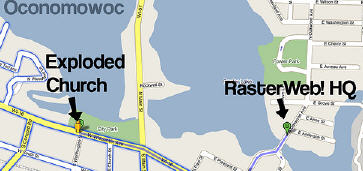
    Map showing church

    Another colleague inadvertently acted as Breaking News reporter, when he reassured his Twitter audience that his office is a safe distance from the “exploded church.” Here is what raster reported on the day that a hundred-year-old church in his city blew up due to a leaking gas line:

    don’t worry about us, we are not that close to the church that exploded: map

    As you can see from the map he supplied, raster did a great job of showing why he was unharmed, but also, what had just happened. That night, when I watched the local news, I was already well aware of what happened.

    What Twitter will evolve into is anyone’s guess. But where it is right now is a place I could never have imagined: Squarely between me and local journalism.

  • Making things up as you go, and why I love my job

    When I speak to groups of college students, I can’t help sounding a little frenetic. Concepts and cases spill out of my mouth, and I never fail to leave the classroom elated. Just as surely, a few audience members appear — as they file out — to be feeling the same way. (It could simply be because I stopped yammering!)

    I try to wrap up each presentation, whether it’s on database marketing, or web marketing, or new media, with a story from my childhood. A topic that fascinated me was the advent of television. I would read the memoirs of TV pioneers. (My favorite was Dick Cavett’s. He continues to spin great yarns in his blog. A notable recent blog was on his encounters with William F Buckley, Jr., on the screen and off.)

    Back when Cavett was a struggling comedy writer, he suddenly found himself replacing Jack Parr on the fledgling Tonight Show, which topped the ratings in its time slot as the first nationally-broadcast talk show. The rest is history. It is also history steeped in the possibilities of a humming, glowing box that was new to households everywhere.

    I tell the students how fortunate they are to be born in a time when other revolutionary technologies are emerging (which, together, become a sort of digital connectedness). They, and I, are part of a exciting adventure. This came to mind as I read this, by MediaPost’s Search Insider columnist Gord Hotchkiss (registration required):

    We’re building a new world up as we go. More correctly, a new world is emerging organically from the efforts and thoughts of millions of people. It’s a world defined in an ethereal middle space, a world of mind-spawned musings and accomplishments, shared and propelled one packet at a time. We’re not discovering anything, we’re building something entirely new. At any given moment, hundreds of millions of us are making it up as we go along. It’s a Darwinian experiment on a grand, grand scale.

    Can you describe to me a better job than being a part of that?

  • Financial services marketers lean heavily on direct response and email tactics

    A new report by the Direct Marketing Association reveals that marketers in the financial services sector are relying heavily on direct marketing and email, and showing an impressive ROI for these tactics. Here are two particularly impressive findings from this research of U.S. banks and credit institutions:

    • They invested $13.4 billion in direct marketing advertising, which produced $178.8 billion in sales, or $13.34 returned for every dollar spent
    • Growth in email marketing within financial services companies is expected to be the greatest of all media types used in the next four years, for a compound annual growth of 22.5%

    The report also showed a very small reduction in print advertising over the next four years.

    What can account for this? Aside from the arguably better overall effectiveness of these media, they are also tactics more suitable to centralized control. As financial institutions continue to consolidate, these tactics become even more appealing.

  • Online personas are an impossible vacation

    Maybe it’s because I’ve just returned from some time away from the office — and the blog. For whatever reason, a post from earlier this year by Jared Spool reminded me of Spalding Gray’s comedic novel/memoir Impossible Vacation. Spool insists that an online persona is not a document. He contends that it is far more alive — a corpus of research and hands-on interaction. His key point: “Personas are to persona descriptions as vacations are to souvenir picture albums.”

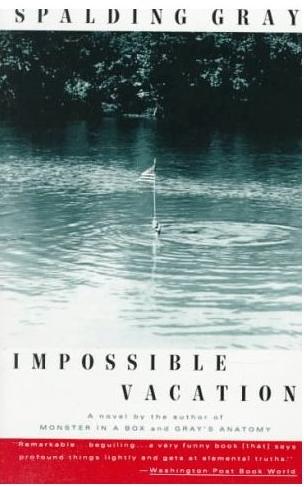
    Impossible Vacation

    Of course he is right. Stating as much is akin to other applause-getters, such as “Hitler was a bad man.” But he goes on to deliver the goods. Spool, of User Interface Engineering, provides excellent examples and resources that can help marketing technologists in the pursuit of that “vacation” experience. For instance, Spool sites this slideshow presentation by Todd Zaki Warfel of Messagefirst. Todd’s list of common persona mistakes includes not using them throughout the design process — something I feel is key to making personas come alive.

    The late Spalding Gray was a monologist best known for acutely personal one-man shows. His novel, Impossible Vacation, was similarly self-referential. The protagonist struggles through a sequence of sometimes perverse journeys, never able to — well, you can guess. Building personas is equally unending. Every new dataset and customer encounter should enhance a deepening understanding of user needs and motivations.

    The personas you build should be revisited and revised frequently. How else do you share any new-found user understanding? The objective is to “grok” your various user types, to use Robert Heinlein’s coinage. Heinlein defined grokking this way:

    Grok means to understand so thoroughly that the observer becomes a part of the observed—to merge, blend, intermarry, lose identity in group experience.

    Impossible? Yes. But by every degree of striving, user interface design becomes more useful to the people who matter most.