Category: Web Marketing

New ways to create and measure sites so they improve their ability to bring your best customers closer and attact other individuals just like them

  • 99% of Amherst College’s first-year students pass on a land line

    Recently Peter Schilling, Amherst College’s director of IT, posted interesting findings about his students technology preferences. Amherst is hardly a typical U.S. institution of higher learning. Located in western Massachusetts, Amherst is regarded one of the nation’s very best liberal arts colleges. However, Schilling’s findings do show the direction in which our college students are using technology and consuming media.

    Some of the points Schilling made have to do with how quicky technology is being adopted, and how quickly old technology is being sloughed off. For instance, the number of first-year applicants applying online has jumped from 33% to 89% in just five years.

    On the other hand, of the entire enrolled class of 2012, only five of the 438 first-years students (1.1%) registered a telephone land line. The portability of cell phones has clearly won hearts and minds. Similarly, notebook computers abound. Only 14 students of the class (4.3%) registered a desktop computer for use on the school network.

    Here are other findings from the 30-point list that Schilling posted (these are direct quotes. I know point #5 is vague):

    1. Students in the class of 2012 who registered computers, IPhones, game consoles, etc. on the campus network by the end of the day on August 24th, the day they moved into their dorm rooms: 370 students registered 443 devices.
    2. The number of individual film titles in the College’s digital video streaming collection: 1,260.
    3. The number of times these films were watched last year: 20,662.
    4. Number that brought iPhones/iTouches: 93.
    5. Likelihood that a student with an iPhone/iTouch is in the class of 2012: approximately 1 in 2.
  • Web design turned on its side

    We in the web design business often talk about what users see above the fold. The assumption is that people may not be compelled enough to browse down. But there are certain situations where the most suitable “browse” direction is sideways and not down. TheHorizontalWay.com is a collection of sites that turn our preconceptions on their ears. Of particular note among the collection is Interview Magazine, which uses the orientation for both novelty and to avert long load times.

    The only downside of this approach that I can think of — aside from being slightly disorienting — is the mobile edition of a site would be difficult to maintain, since mobile pages are more traditionally vertical.

    Can you think of other potential programs with a horizontal design?

  • This weekend don’t miss BarCamp Milwaukee!

    Stewart Brand, co-founder of the Whole Earth Catalog, computing innovator, and community organizer, is purported to be the first to pronounce, “Information wants to be free.” Although I’ve not heard his name dropped in discussions with BarCamp Milwaukee organizers, it definitely fits. Here’s how OnMilwaukee characterizes this freeform information mash-up:

    BarCampMilwaukee3 is a technology based forum; running sessions all day Saturday and Sunday covering topics from specific programming applications to the role of the Internet today.

    BarCamp’s run nationwide; each city specifying the format and content of the event to suit the needs and wants of the local tech class.

    “There are several conferences in cities like Chicago, San Francisco and New York. BarCamp is a spoof on FooCamp, an event hosted by O’Reilly Media that is truly expensive,” BarCamp organizer Pete Prodoehl explains.

    I attended (and was a presenter at) last year’s event, and I found it incredibly stimulating. You’re surrounded by interesting topics presented by enthusiastic and knowledgeable speakers. The only problem I had at BarCampMKE2 was deciding which topic to choose from in a given time slot.

    It’s a good problem to have, and a strong reason to add BarCampMKE3 to your weekend plans. You’ll be glad you did.

  • Data sharing site sifts through the substance of current events

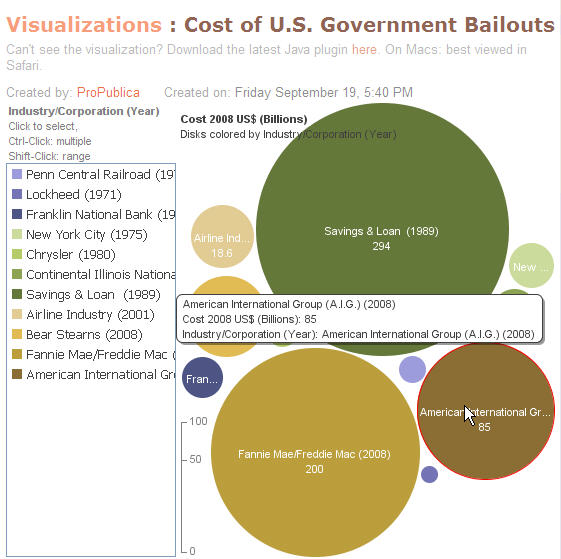
    Social networks have sprung up around unexpected applications. One of the most useful, especially in the uncertainty of the last few weeks, is Many-Eyes.com, which is a social data visualization site. The premise is simple: People upload complex datasets that they feel they, and others, would like to analyze. The site then allows them to use some novel visualization tools.

    Some of the best charts are available for public exploration, with no registration necessary. Here is one from the site’s home page today, dissecting the magnitude, in dollars, of various bailouts in recent history:

    Click to go to Many-eyes.com

    Other charts allow you to dig through data in unexpected ways. This word tree helps those interested in the substance of Katie Couric’s interview of vice presidential candidate Sarah Palin to take in Palin’s answers sentence-by-sentence, starting with key words:

    Click to go to Many-eyes.com

    The datasets cover the gamut, from the mundane, to the crucial, to the sublime (example of this last type: All of song writer Leonard Cohen’s lyrics). Visit the site to see your world in a new way.

  • Wii ad on YouTube literally thinks outside the box

    As anyone who is reading the headlines will agree, this has been a harrowing week. Here’s something to put a smile on your face, first passed along to me by David Berkowitz. Watch this YouTube ad for a Wii game all the way through. You’ll agree its creators really did think outside the box.

    Check out with Wii ad

    Like David, I had to run it several times. I laughed in amazement each time.

    Enjoy, and Happy Friday.