Category: Web Marketing

New ways to create and measure sites so they improve their ability to bring your best customers closer and attact other individuals just like them

  • Give your site a marketing checkup with Web Grader

    No system for measuring the marketing power of a site is perfect, but one of the more comprehensive I’ve come across lately is WebSiteGrader.com.

    This system takes your web address, looks over the site, and reports back on features such as the following:

    • How optimized your site is for search engines
    • How well you’re placed with major directories
    • Your currrent Google Pagerank and Alexa rank
    • The quantity of inbound links
    • Much more!

    Web Site GraderIt even evaluates the reading level of the site, to make sure you’re not turning people off with your language. As a point of reference, this blog got a Secondary / High School rating.

    The end of the report is a single score out of 100 possible points. Is spite of some obvious gaffes, such as no listing in DMOZ, this site got a 94. That means out of a sampling of 100 randomly selected sites, DigitalSolid’s marketing power is better than 93 of them. As of today, the process is free. Give it a try. In five minutes you’ll have a thorough web site marketing “check-up,” and concise recommendations on how to improve your score. Do you have any other favorite marketing power evaluation systems? Let me know.

  • Google gets out the vote on Adwords dashboard

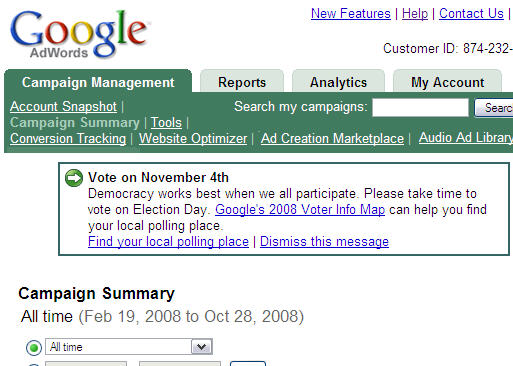
    If you didn’t know there was an election tomorrow (yeah, right!), Google wishes to remind you. Amidst typical alerts on its Adwords dashboard to adjust your bids or review your budgets, they’ve posted the following:

    Google gets out the vote

    This has to be a first for the company — and for that matter any ad network — to provide a civic-minded nudge along with its business notices.

    Consider yourself duly alerted. (And yes: Please do vote!)

  • Nearly 3 out of every 5 web users prefer sites with peer-written reviews

    This morning I spoke to the annual conference of the Wisconsin Innkeepers Association in Madison, about social networks and the hospitality business. There was a lot to cover, but rating sites figured prominently. A key question: How much do they matter in purchase behavior? My sources say quite a bit.

    According to research done by MarketingSherpa and Prospectiv (Online Shopping and Email Relationships, January 2007), “the majority of consumers we surveyed prefer sites with peer-written product reviews: 58% [nearly three out of five] ‘strongly’ or ‘somewhat’ prefer sites that include reviews, while only 14% don’t trust them.”

    Here is one example that the MarketingSherpa post cited:

    After PETCO added reviews online…

    • Top-rated products were converting at a 49% higher clip
    • Shoppers using the ratings section of the site for navigation spent 63% more than shoppers using other navigation column hotlinks
    • Shoppers who read reviews and shopped via ratings navigational hotlinks had an average order size 40% higher than the average shopper.

    Few hotels use peer reviews right on their sites, but certainly everyone has seen the reviews on Expedia and Travelocity, as well as the many social rates sites such as TripAdvisor.

    Transcript

    Below is a very loose transcript of my talk from this morning supporting this assertion, with hyperlinked references.

    That’s a lot of exposure to praise — and criticism — for your hotel. What’s more, even those who don’t overtly go to these sites may stumble upon them thanks to search engines. As I mentioned in this blog before, even Baby Boomers aren’t immune to the influence of user generated content.

    There was a time when a hotel site could be an island unto itself. Now it is swept into consumer conversations regardless of an owner’s willingness to participate. The Web 2.0 world is nothing if not inextricably networked. What’s more, this access is becoming increasingly mobile. A new generation is accessing their wired world on their cell phones. What will it mean when even the most spontaneous booking decisions can be influenced by the opinions of others who are equally connected?

    A good example is Yelp.com. I had a very positive experience staying at the new Iron Horse Hotel in Milwaukee. Afterward I wanted to share my praise. My first choice was to post on TripAdvisor. But there were already many rave reviews there. Yelp, however, hadn’t recorded a single opinion. My post was the first. It could also be more influential than all of the TripAdvisor raves, because of Yelp’s rebust mobile experience.

    Social networks are a force that cannot be ignored. Behind this force is a compelling human need for community. As I discussed in June, my self-proclaimed Online Community Month, the erosion of face-to-face networks described in Bowling Alone has created a vacuum. It’s one being filled by digital communities — for better or worse.

    Regardless of their utility in building cohesive social units, their power to make or break businesses is undeniable.

    The newest (in relative terms) addition to online community-builders is Twitter. As I’ve noted, Twitter sends flotsam and jetsam our way — and we marketers should take notice.

    Travel businesses such as Carnival Cruises are using Twitter to support their brand. So far, they are using it to promote their travel specials, and the occasional contests (such as breaking the record for the world’s largest beach ball), to the few hundred Twitter users who have chosen to follow. However, they are in turn following many news organizations and sites, and are likely using direct messaging and search engine traction to get their messages out well beyond the walls of Twitter. Here’s a typical message of Carnival Cruises on Twitter, shown in the context of my own Twitter feed.

    The take-away: Get active in social media. Nearly ten years ago, a book came out called The Cluetrain Manifesto. Its key argument was that online marketing wasn’t about traditional, broadcasted, “interuptive” advertising. It was about conversations. The last decade has shown how prophetic these words were.

    If you are ready to become more involved, as a Wisconsin “innkeeper” (or any business person responsible for a brand), start by getting involved in social sites such as Twitter and Facebook — as a way to get your feet wet.

    Also, do some reading. You can’t go wrong with the book Groundswell by Charlene Li and Josh Bernoff of Forrester Research.

    Don’t be afraid. And have fun.

  • What it takes to go viral

    The very thought of an online effort going viral seems like the ultimate triumph: The ROI on a successful viral campaign is huge. Take a fast, meteoric ride on the exponential pass-along curve and you’re looking at the marketing equivalent of striking it rich on a single lottery ticket. So why doesn’t it happen more often?

    I see at least two factors standing in the way of an existing brand actually lighting the fuse: Relinquishing control and a sincere willingness to lighten up.

    Control

    It takes a huge leap to create something and set it free. In a nutshell, that’s the dilemma of using social networks to further a brand — the potential for chaos. Once in the hands of the social graph, a concept can take on a life of its own. And with independent life comes the chance of betrayal.

    No one wants to see their viral effort hijacked and distorted into mockery. Unfortunately, it’s this very tension that make viral efforts so fun to watch.

    Humor

    E.B. White wrote the following:

    Humor can be dissected as a frog can, but the thing dies in the process and the innards are discouraging to any but the pure scientific mind.

     
    It’s a pity, then, that something as ephemeral as humor is at the heart of a successful viral effort. But it’s true, and in the hands of a committee-driven brand team, a funny concept all too easily becomes so many frog innards. Humor is that fragile.

    It was actor and director Sir Donald Wolfit who was reputed to have said on his deathbed, as a parting reassurance, “Dying is easy. Comedy is hard!”

    So are concepts that succeed in going viral.

    This post was inspired by one that I received on Friday that is an unqualified success. I received a get-out-the-vote email from a friend in the form of a personalized video. It got the point across and also elicited several heartly laughs. Try it yourself on a friend (of the right political inclinations — it’s from MoveOn.org).

    I’d also like to challenge readers: Do you know of any viral efforts that do not, to some extent, involve humor?

  • Cure for online ad doldrums: Unleash the artists and drive transactions

    This post by David Koretz, in last Thursday’s Online Publishing Insider (registration required), put it well:

    According to IDC, the average user spends 32.7 hours each week on the Internet, and only 16.4 hours watching TV. So while Internet usage is double that of television, [online ad spending] lags dramatically. In 2008, Internet advertising revenue will only be one fifth the size of television advertising, a third as big as newspaper advertising, and only half of magazine advertising, according to a recent Carat report.

    So what does he recommend? Among his prescriptions:

    Unleash the artists: As a technology guy, it pains me to say this, but we need more artists in this industry. We need more creative folks dreaming up ad formats that create a memorable user experience and drive consumer action. We need to create new ad formats that leverage the interactivity advantage of the Web.

    Most importantly … we need the type of ads that get talked about around the watercooler Monday morning.

    And from new formats comes the obvious next step:

    Drive transactions: The Web is the best platform for getting consumers from awareness to transaction the world has ever seen, yet few advertisers leverage the Web as a transaction platform.

    Great advice all around.

    Why hasn’t this advice been heeded so far? Mostly it has to do with playing it safe. Being bold means taking risks. In the recent past, marketers have been rewarded for following the path of least resistance.

    Like It Or Not, It’s A New Era

    But times have quite suddenly changed. The title of Koretz’s piece is Stop Blaming The Economy. His point being that the recent economic downturn could become an easy excuse for underperformance.

    Along with Koretz, I suggest that this downturn should turn up the heat on innovation. For this reason (and possibly, for this reason only) this more competitive marketing environment is something that I am looking forward to.