Joshua Porter recently shared an excellent presentation on leveraging cognitive biases in the design of social networking sites. I’ve followed Joshua’s blog for years, and his thoughts on this subject reinforce my loyalty. You should know that I’ll vehemently defend the time I spend reading his stuff, even if you try to persuade me that I could be reading other, similar blogs. This die-hard loyalty is itself an example of something called a cognitive bias. It shows the Ownership Effect, one of the biases — or heuristics — that secretly influence our decisions and actions.
Heuristics are mental shortcuts. Unknowingly, our brain processes information through filters. These filters add more weight to some facts and less to others. Should real facts be scarce, heuristics can sometimes fill in the blanks.
Are cognitive biases good or bad?
The virtue of gut-based judgments is a subject of heated debate. Some think rational decisions are the best. They point to addiction and racial prejudice as two consequences of unchecked cognitive biases. Others, most famously Malcolm Gladwell, feel that heuristics have more value than they get credit for. His book Blink is full of examples of the gut overruling the brain and proving itself more accurate.
Regardless of your take on the phenomenon, as marketers we can only benefit by getting to know cognitive biases, especially in good web interface design. Lucky us: In the process we can learn a little more of how our own minds make judgments.
But be forewarned. It’s not pretty.
A bias that is particularly interesting is Loss Aversion. If I approached a random sample of people and offered them money based on the outcome of a coin toss, the wagers that they accept and refuse are far from rational. If I said I’d pay $1.25 if they win the coin toss, and the cost of the bet is a dollar, a person’s rational brain would do the math and say “Go for it.” In a fair bet, the win far outweighs the loss.
However, most pass on this offer. They refuse the likely ROI of 25%.
In fact, when the stakes are changed and other amounts are tested, it turns out that the majority of participates will hold onto their dollars until the reward increases to $2.00!
This is not rational. Even when haggling is eliminated (defined as holding out until you get the best possible offer), the majority of people walk away from making a likely profit.
Why do they do this? Because the value of not losing is twice as great as the value of winning. In a 50-50 wager, the value of losing $1.00 is equal to that of gaining $2.00. An absurd 100% ROI is the usual tipping point.
Could loss aversion be inherited from our cave-dwelling days?
Where does this reflex to avoid loss come from? Work by researcher Keith Chen with capuchin monkeys suggests that loss aversion may be innate in humans — and indeed, in other more primitive primates. In his research (purchase of white paper required — otherwise, here’s my blog entry on the topic), he sees exactly the same loss aversion in monkeys that are taught to use tokens in exchange for food as others have observed in humans playing identical games. And I mean exactly, as in: If you just looked at the numbers, you couldn’t tell human response from monkey response.
It really makes you think.
Joshua Porter gave the example of using loss aversion to get people to register on a site, with offers of “Never lose another password!” or “Don’t miss out on opportunities to save!” If the cost of loss is presented as half as great as the cost of preventing a loss, you will likely generate a simple conversion.
Paradoxically, the fear of loss is also seen in gambling. As soon as you sit down at the poker table, your more primal, reptile brain wants to ensure others do not get your chips. Even if you have a weak hand, you might try to bluff your way to victory. Even in the face of almost certain loss. To casinos, the cognitive bias of loss aversion is definitely something good.
Swoopo goads bidders in a chase for merchandise
I’ve observed this phenomenon in a truly scary “auction site.” Swoopo.com offers merchandise that you can bid on. But these aren’t true eBay-like auctions, because your bid is lost whether you win the prize or not. Everything from software to flat-screen TVs are presented with starting prices in the teens. Then participants throw their cash at the merchandise, hoping to be the last person to place their money down before the timer ends the contest.
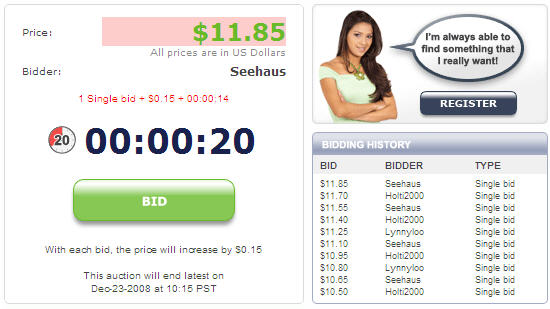
The site’s designers have cleverly avoid gambling laws through a technicality. Their site is a “game of skill.” It is arguable that it takes skill to be the last to bid, and thus take home a prize.
But this contest is more like a carnival game of topple-the-milk-bottles. Every bid bumps up the cost of the item, but also adds seconds to the countdown clock. Yes, it’s a game of skill. But like those who have pitted their wits against a carnival game, there are far more who walk away penniless than victorious. And since there are no sweepstakes laws requiring full disclosure, you enter the game unsure of your odds of winning — even with practice.
So what force brings people back to bid again and again? And what causes bidders to pursue an item so vigorously in the face of disappointing odds?
One reason certainly has to be the thrill of the chase — the determination not to let others get the item you feel rightly entitled to claim. After all, you’ve already committed real dollars to trying to win the item! This is classic loss aversion.
Go to the site and see for yourself. Watch the bidding, which has a level of supposed transparency. You can see your opponents bid against you in real time. To watch is both thrilling and deeply chilling.
Spending time on Swoopo.com is like watching the id in pitched battle with the super ego. On this site, due to excellent interface design, the id is the only sure winner.
