Category: Web Marketing

New ways to create and measure sites so they improve their ability to bring your best customers closer and attact other individuals just like them

  • Planning an event? Use online marketing as your hamburger helper

    Once the event is over and the hall is cleaned up, the marketing and PR value of that event doesn’t have to fade. Chris Brogan wrote about how social media and internet marketing can act as hamburger helper for the event. It’s an apt metaphor for these two reasons:

    1. It’s inexpensive to use online marketing
    2. It stretches everything!

    Chris’s post describes how online social network tools can improve event outcomes by helping with all five of its phases:

    • Awareness
    • Attention
    • Engagement
    • Execution
    • Extension

    Are social media efforts the meat? No way. But they can be used throughout to maximize effectiveness.

  • Most “social media terrorists” just want to be acknowledged by a brand

    When I give presentations about social media, a frequent question is, “What can we do when we see someone kicking up a fuss online?” I assure them that it is identical to any other customer service complaint. Most people with a beef want the problem fixed, but they also — short of that — want to be heard. Really heard.

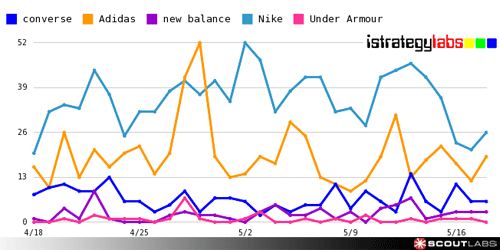
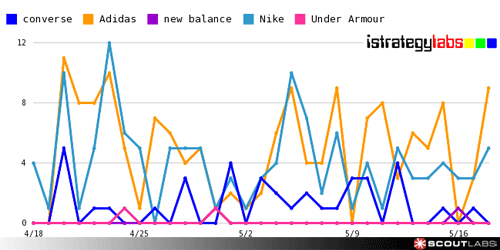
    Further evidence comes from iStrategyLabs’ post about monitoring positive and negative comments. They write the following:

    We’ve found that 80% of the time we can easily turn a brand terrorist into a brand evangelist just by letting them know that they’ve been heard, or by directing them to a resource they’re looking for (you could call this customer service).

    The other 15% of the time we need to talk internally with our team to see what can be done with more complex issues and the last 5% ends up being something client side teams need to handle directly (i.e. reaching out from senior leadership, or product features need to be changed etc.).

    It’s a good post, and further validation for a technique that I’ve seen used countless times to good results. Here, by the way, is how iStrategyLabs measures share-of-voice, both for positive and negative comments:

  • Beware of confusing a social network’s weak mojo with Gladwell’s powerful Mavens

    Is someone who blabs about a brand on Facebook or another social network site any more valuable to a retailer than the passive “fan” of that product? And if yes, what is that new value? This was discussed at an Email Insider Summit earlier this week. It’s an important question. But as panelists used the format to think aloud, they began confusing two phenomena. One is the real-but-weak power of social network influence. The other is the strong-but-possibly-nonexistent “Gladwellian” Maven.

    Malcolm Gladwell’s The Tipping Point talked about Mavens as hubs of influence. These folks are strong connections in a social ecosystem. As mavens on this subject or that, their opinion means much in persuading others. Gladwell based much of his book on the research by Duncan J. Watts, described in his book Six Degrees of Separation: The Science of a Connected Age.
    This research, which was itself predicated on Stanley Milgram’s small world experiment, suggested that strong ties do most of the work in spreading a message.

    The only catch: When the actual pathways were traced in Watts’ experiment, he found that only 5% of the work was actually done by these supposed hubs. He finally concluded that messages can be spread nearly as efficiently without hubs (i.e., Gladwell’s Mavens), and in fact, these myriad weak connections are the key to a social network’s real power to influence.

    Can I Endorse Some Tupperware?

    The marketers on the panel at the Summit should have kept this in mind. If MediaPost reported their collective thoughts correctly, they were crowded together on thin ice indeed. According to the MediaPost account (free registeration required), “They agree that a person who simply visits a ‘fan’ page and is a static follower is of minimal value. But people who can be tagged as influencers — who forward information to friends or other contacts that result in transactions — have tremendous value.”

    When I first read this, my thought was, “Sure, of course people who refer other people to a brand and get them to buy are valuable.” But it sounds like the power of a pass-along is being highly overvalued. Continuing from this account of the discussion:

    Email marketers are working hard on algorithms to quantify the worth of those influencers operating via social media outlets. Tim Schigel of ShareThis.com, who spoke on a panel at the MediaPost Email Insider Summit on Wednesday, said: “We’ll see a better understanding of that (soon) … the industry is trying to figure it out.”

    Also on the panel was Craig Swerdloff, CEO of LeadSpend, who said the value of a social-media influencer should be “another variable that you put into your algorithm to determine the lifetime value of a customer.”

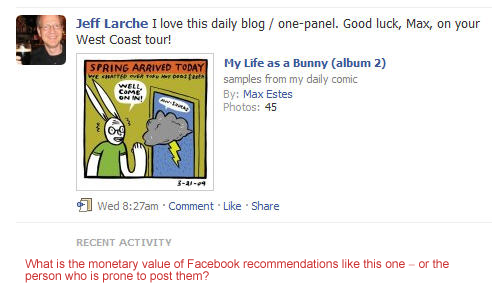
    What is that amount? A back-of-the-envelope calculation could be as follows: If a Netflix customer is worth $9 alone, but that person has 500 Facebook friends, and is able to drive even 1% of them (5) to make a purchase, that individual’s value could be as high as $54.

    Yow! That $54 would confer my full value in Netflix’ eyes to everyone else who also becomes a Netflix subscriber. I see the following flaws with even approaching such a calculation:

    1. Lifetime value is a predictive number. It’s a break-even cost of finding someone else to replace me if I should stop using Netflix. That value was probably calculated over a year’s worth of use of the service — probably more. Could these five friends each be as loyal from Day One? And if we waited a year, would I be able to cough up five more Facebook friends who join the service?
    2. How can my friends’ association with me — or even their consideration of an endorsement I send their way — be given credit for their conversion into customers? Are they not Facebook friends of other people who are fans or active ambassadors for the brand? I would guess that they are. And if so, do I get full credit just because I messaged these five about the service? What about the force of these weak connections? Are these many mutual friends who are fans worth nothing?

    The value equation being discussed certainly works if I was actively recruiting and selling for a pyramid marketing business (example: “How’d you like to host a Tupperware party and keep half the profits?”) But for something as passive as “You should consider this product,” it would be hard to value an active Maven much higher than the passive fan.

    Maybe not any higher at all.

    In a world where many weak connections can trump a few strong ones, a better value equation may be an aggregate of all passive fans — where they are also Mavens or not.
  • Communities have laws; Facebook is no exception

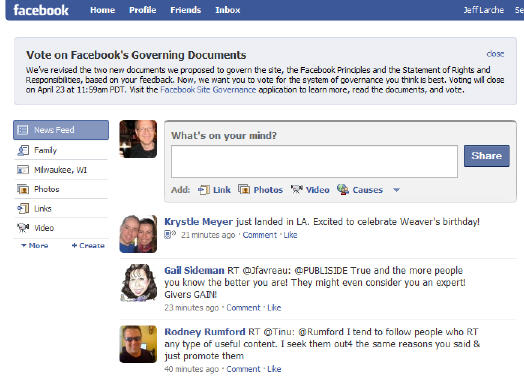
    Do you find this as interesting as I do? Look at the box at the top of this screen capture, from Facebook:

    communities_have_laws

    Sometimes we forget that Facebook is more of a community than some physical neighborhoods. Folks know each other (on Facebook, most everything is only viewable by ordained “Friends”), and people care about how they are perceived by the rest of the neighborhood. As various outcries attest, this is a community whose residents truly care. Remember the brouhaha a couple of years ago over Facebook launching its News Feed, to inform every friend of a person’s activities — including the posting of relationship break-ups, social snubs, and embarrassing photographs?

    For those who can’t make it out, this notice on Facebook this evening reads as follows:

    Vote on Facebook’s Governing Documents

    We’ve revised the two new documents we proposed to govern the site, the Facebook Principles and the Statement of Rights and Responsibilities, based on your feedback. Now, we want you to vote for the system of governance you think is best. Voting will close on April 23 at 11:59am PDT. Visit the Facebook Site Governance application to learn more, read the documents, and vote.

    Would you expect anything less than elections and referendums within this sprawling community?

    (And just how sprawling, you ask? Consider Manhattan. It has tens of millions of residents, yet its boroughs can be counted on exactly one hand. Conversely, the boroughs of Facebook are themselves in the millions — although there is much overlap*.)

    *Each person’s Friends list could be considered itself a borough. Think of the overlap between people in their Friends lists as the boundaries between boroughs.

  • Why my heart sank when my blogroll tanked

    A couple of weeks ago I installed some new widgets in the sidebar of this site. They are adding the value I’d hoped for, but a conflict with this new version of WordPress killed my blogroll.

    What surprised me is how saddened I was to no longer display links to my favorite resources. Jeff Jarvis says that in our new link economy, do what you do best and link to the rest. He expands on this idea in the exceptional book What Would Google Dowwgd?

    Hyper-aware of my limitations as a teacher, my blogroll became for me a strictly necessary appendage to this blog.

    It has returned triumphant.

    Much of my attempts at teaching boil down to this: Urging clients to get involved first-hand in Web 2.0 activities, such as blogging, reviewing (note the link to my review of What Would Google Do, in the social site Goodreads.com) and putting a well-customized RSS reader to the test on a regular basis. Only then will they “get it,” and know where our world is headed (at a pace that is accelerating).

    … And only then will they appreciate the pain of a blogroll on the fritz.