Category: Productivity

  • The Intelligent Enterprise: A Book Review

    The Intelligent Enterprise: A Book Review

    I’ve been blogging here for nearly 20 years (don’t go digging — I’ve learned a lot about writing and MarTech since my tech consulting infancy), yet I’ve never before posted a book review. And with this precedent comes a major disclaimer: Vincent Yates and Jason Goth, the authors, are leaders within my employer, the global consultancy Credera. So this could smell of log rolling, or worse. But I’ve always posted what I sincerely thought at the time. Conversely, I’m not stupid. If they had conceived a truly ugly baby I may be whispering that opinion to my colleagues, but certainly not posting it here. What follows are the objective reasons you should buy and read this book. It’s both excellent and timely.


    Enterprise leaders are hungry for information on how they can adopt artificial intelligence (AI). They are also, if they’ve earned their positions in the C-suite, allergic to glowing citations of easy success. I’ve read lesser business books that suffer from something called survivorship bias — the tendency to elevate success stories while diminishing the more frequent failures. David Ogilvy put it well when he talked about the need for perseverance, but especially also caution, when running a business. He was reported to have said, “The road to success is dotted with many tempting parking spaces—and strewn with the bodies of pioneers.”

    The authors address this head-on, by describing attempts at investing in AI that failed to take into account all the elements needed for success. One example: I was thrilled to see a section about the need to incorporate design thinking. Nothing kills a new technology more surely than workers who are overlooked in its design and roll-out, who then quietly circument or sabotage that investment.

    I also found it refreshing that they mentioned Gartner’s hype cycle, where inflated expectations by an enterprise inevitably lead to a trough of disillusionment. 

    Practical Advice for Avoiding Regret

    I should mention, since I focus on MarTech on this blog site, that the most successful implementations of AI aren’t related to marketing at all, unless you count customer service in that category. In my own experience, and within the pages of the book, it’s primarily the many back office processes that AI can profitably automate. These aren’t necessarily the most sexy applications. But they tend to make the greatest impact on an enterprise’s bottom line. 

    Speaking of the bottom line, I loved the list of the many often unanticipated costs of owning and operating an AI solution. Headlines everywhere talk about the easy path to positive ROI (see above: survivorship bias), but data hygiene, ongoing model improvements and smart governance — to name just three — come with ongoing costs that need to be considered up front. 

    AI is not set-and-forget.

    Speaking of governance, I loved seeing the section on AI safety. The book talks about how AI is basically “a brain in a jar” (ick), but with this power comes risks of unintended consequences. Guardrails are essential. I recently wrote in my personal blog how important this is overall, especially at a nation state level.

    I need to also call out the clarity of the writing. This book excels at bringing a blindingly complicated technology within the grasp of the enterprise leader. It was an actual pleasure to read.

    One Small Quibble

    It’s a truly small knock on the book, but the quote that begins it, one in praise of learning from the wisdom of others via books — ostensibly by Socrates — is most certainly a fabrication, like the many howlers attributed to Albert Einstein or Ghandi. A quick search for the origin of the quote using Copilot (thank you, AI) indicated there is zero evidence of this sentiment in the writings of Plato, Xenophon, or other contemporaries of his. What’s more, although he certainly valued learning from others, he preferred the Socratic method (speaking of log rolling!). 

    In fact, Plato wrote that Socrates thought writing things down instead of memorizing them led to a lazy or weakened mind, particularly in terms of memory and genuine understanding. As a relatively new technology, he was suspicious of writing.

    “Employ your time in improving yourself by other men’s writings, so that you shall come easily by what others have labored hard for.” — Almost certainly not Socrates

    Like I said, a small quibble. As a leader, you will “improve yourself greatly” by reading it and taking heed of its advice. Unlike that fallacious quote, The Intelligent Enterprise is the opposite of AI slop.


  • Why I love Adobe’s Content Supply Chain solution (and you should too!)

    Why I love Adobe’s Content Supply Chain solution (and you should too!)

    I’ve loved Adobe Workfront for many years, and even posted here four years ago with this news: Adobe to buy Workfront: A big win for marketing throughput. As a primarily customer data wonk, you might be surprised that I’ve fawned over this workflow tool. But data is data. And these two experiences from early in my career helped me understand the value of democratized data to accelerate sluggish production processes:

    1. While working at my very first marketing firm I used a then-new technique to boost the pace of print production by 20%
    2. A short time later I helped my brother, who founded and led a precision machined parts factory, to completely rethink how products are produced, greatly improving revenue and profits.

    The technique that unlocked these improvements was the same for both. It was a workflow optimization approach called the Theory of Constraints, as described in the worldwide best selling business book, The Goal.

    My older brother, Brian, was a brilliant business operator. He has sadly passed away, but not before telling me that The Goal was “The best business book I’ve ever read.” That’s extremely high praise, if you talk to anyone who worked with him.

    Join Me At Adobe Summit

    In keeping with a theme I started with my last post here, Going to Adobe Summit? Here’s one reason I’d love to connect with you there, I’ve co-written an eBook that resurrects the thinking of a business leader whose lessons may be overlooked by modern marketers. That would be a shame.

    In this eBook, I examine the innovations of The Goal‘s author, Eliyahu M. Goldratt, through the lens of solving the vexing challenge of Content Supply Chain. It turns out the data coming out of Adobe Workfront is perfect for using the Theory of Constraints to identify and fix workflow bottlenecks.

    I invite you to see for yourself. You can download this free eBook here.

    And if you’re attending Adobe Summit, seek me out. I’d love to talk about this important digital marketing tool and the concept that can turbocharge it.

  • Adobe to buy Workfront: A big win for marketing throughput

    Adobe to buy Workfront: A big win for marketing throughput

    Workflow management is often an afterthought. That’s a big mistake, especially when it comes to marketing execution. The late Eliyahu M. Goldratt told us this in his books from nearly forty years ago, starting with The Goal, and especially its follow-up ten years later, It’s Not Luck.

    Those books are ancient business history, yet this proven competitive advantage continues to go ignored by most enterprises. I know. I’ve seen it in my many years of digital marketing consulting. But things are starting to change. What’s more, I consider Adobe’s announced plan to purchase Workfront as a sign that this progress is accelerating.

    Let’s face it: Workflow management isn’t sexy. But following the adage of You can’t manage what you don’t measure, the pace of executing your marketing strategy can stall if you aren’t identifying and fixing constraints in the pipeline. That’s where Workfront shines. But first, a little more about how we got here.

    The Theory of Constraints

    Goldratt initially created his Theory of Constraints (TOC) because Western manufacturers were quickly losing ground to the Japanese makers of cars, televisions, and much else. At the time he maintained that improved throughput was a secret weapon for the modern manufacturer … and marketer. (He looked at several categories of workflow in his books, and devoted It’s Not Luck to marketing effectiveness.)

    Speed-to-market — what Goldratt called throughput — reduces inventories, stabilizes costs, and helps a brand prevail over less-nimble competitors. Out of Goldratt’s work (along with others of his ilk) came entire categories of TOC-driven productivity, most notably modern logistics.

    Let’s look at a common marketing example:

    It’s a competitive no-no to take many weeks between conceiving a campaign and its execution, using a tool like (in this example) Adobe Campaign. But constructing campaigns in Campaign is hard work! There are so many skilled hands that must touch the work product, in sequence or in parallel — doing everything from copy writing and photography to graphic design, data science, coding and quality assurance (QA) testing.

    Non-waterfall approaches to the work, particularly Agile, are, to use a phrase that is the title of another of Goldratt’s books: Necessary but Not Sufficient. Agile in this context is no panacea.

    Achieving Spreadsheet and Email Escape Velocity

    In order to move the work efficiently, you need to get everyone out of the tyranny of email threads and shared Excel spreadsheets. Managing projects of this complexity must be handled by a platform, with automated hand-offs and reporting.

    I can hear some of you now: “We’re good. We have Jira to do that!” or “We have [the Microsoft Jira clone] Azure DevOps [ADO].”

    Yeah, no.

    Marketing involves more than technologists. It demands creatives, plus many layers of stakeholders. These folks haven’t the patience to learn the language and interconnections of those development and bug-fixing tools.

    Workfront is the industry leader in providing a marketer-friendly solution. I’ve seen it in action. It can track campaigns, A/B tests, tagging, insight generation and much more. It does something else that would have warmed Mr. Goldratt’s heart.

    Finding and Fixing Bottlenecks

    You’ll recall that the “C” in TOC stands for constraints. And a constraint is just a fancy word for a workflow bottleneck. These are the slowest stages in the path leading to a successfully delivered project. Typically, Goldratt observed, you can only see one of them at a time. That’s because if you observe work piling up at a particular step, the system upstream slows, making other, upstream bottlenecks undetectable.

    Thus the 5-step cycle that he described in his books, and is shown at the top of this post.

    Another clarification: By “exploiting” constraints, Goldratt had simply meant opening up the log jam. In manufacturing, (and frankly, also in marketing project management), that can mean things like this:

    • Doing as much QA as possible before the constraint
    • Hiring a second resource
    • Adding a second or faster machine used to do the work

    Once you’ve cleared one logjam, it’s guaranteed that will expose another. That’s just life in project workflow management.

    You can do none of the work I describe unless you have the reporting necessary to see the bottlenecks. And if you’re using manual reporting today, just realize that won’t scale as capacity increases.

    These productivity reports are where Workfront really shines. Marketing projects managed this way move through the system more smoothly and create an environment conducive to other improvements, e.g., unanticipated process innovations.

    You cannot manage what you do not measure, indeed.

    Managing Inputs and Outputs from Adobe Platforms

    All of this is why I’m so pleased that a major digital experience company has decided to buy Workfront. Arguably every platform in the Adobe Experience Cloud has inputs and outputs that must be managed by many types of roles. By eventually providing a workflow management tool to knit together this work, the value of Adobe’s cloud will grow.

    As a process guy, I’m loving this development. But let me know what you think. I’ve turned off comments, but I have an extremely “googleable” name. You can find me on social media and let me know your thoughts.

  • MindJet adds Gantt charting to its mind mapping software

    I’ve been an advocate of mind mapping for years, and have recently talked about my preference for using MindJet.com’s mind mapping product, MindManager. I even demonstrated its power, while leading a discussion about rich digital media, at an UnGeeked Conference in May. I find the system a huge time-saver. Now MindJet has upgraded their software to include a valuable way to share project roles, deadlines and milestones: Gantt charting.

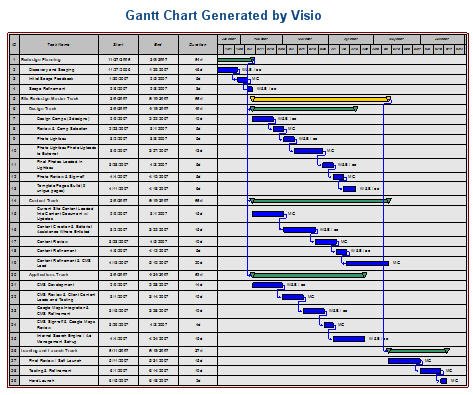
    Since the 1990s I’ve appreciated the ability of Gantt charts to bring teams to agreement on project roles and deadlines. It’s an equally valuable way to show clients how any delay in supplying crucial content or sign-offs can push web launch dates out. Below is an example:

    The detail is intentionally too small to make out, because I’ve used live client details. From left to right, this chart shows the task name, and start date, end date, and duration in days. After that is the chart itself. Milestones are the green bars. Every task within that milestone must be completed before the milestone is reached and the next milestone and task set begins.

    My web development team would “own” some of the tasks, and the client would own others. At a glance, everyone knew what they needed to do and when. They also knew the effects on the project as a whole if they missed their deadline. Great stuff.

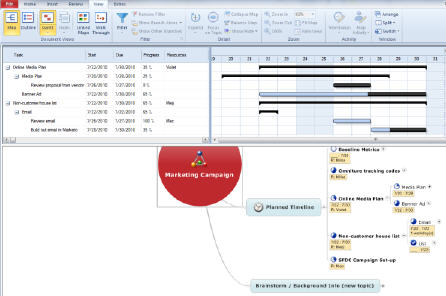
    Now, the just-released MindManager 9 includes this feature. Below shows a simple Gantt chart, from MindJet’s introductory video:

    Needless to say I’m eager to give the Gantt charting a test spin. What’s especially exciting is it takes the collaborative strengths of building a mind map as a team and fairly quickly converts that shared map into a full-blown project plan.

  • The time wasn’t right for Google Wave

    One of the first adding machines was created in the mid-1600s. It took another two centuries before they were common in the workplace. Did adding up figures suddenly become more difficult or error-prone after two centuries? What exactly about numbers changed in the late 1800’s to make this new technology so suddenly appealing?

    Of course the answer is that it was us who changed, not the fundamentals of math. To say we changed slowly is an understatement — in spite of the major economic improvements and workplace enhancements that came from their adoption.

    It’s hard to imaging myself being one of those poor office clerks who added figures in his head all day, back in the so-called Age of Enlightenment. What I can be pretty sure of is this: A machine that does adding for you must have initially seemed far-fetched; even comical. How on earth could a machine do the work of the human brain? There must be some sort of catch.

    Of course you know where I’m going with this.

    Many writers of obituaries for the soon-to-be-euthanized Google Wave have said it was a slick solution lacking a problem. It therefore died of neglect.

    I agree that it lacked a critical mass of users, but I disagree with the “lack of problem” assertion. Google Wave did real work, and it did it in a way that was flawed but thrilling for the vast potential it represented. At least, it thrilled me.

    Ever since the mid-1990s, when I read the book of a very young Michael Schrage, No More Teams!: Mastering the Dynamics of Creative Collaboration, I realized that there were many barriers to good workplace collaboration. Chief among them was technology. Especially back then, personal computers were isolating machines. They forced us to relate with a small screen and a single keyword.

    One of his observations was that before we could take the next incremental leap in teamwork, we needed a revolution in the technology that supports us. Of course he was right, but his pronouncement overlooked another barrier: We might be handed the technology we need to collaborate in a networked age and its environment so unfamiliar that it is almost universally rejected.

    A year ago I predicted that we would be working within something like Google Wave “in two years.” I seem to have missed in that number by a factoring error of 10 — maybe even 100.

    That would put adoption of the Wave at 200 years from now. In the meantime, I guess we all continue to add up columns by hand and grouse about our dreary workaday lives.