Author: Jeff Larche

  • Serving SUPERVALU customers one niche at a time

    I really like the direction that Kevin Hillstrom’s One Positive Day blogging concept is taking. While I used the occasion this month to share a favorite work tool, Kevin was inviting many of his social networking and database colleagues to speculate on how to improve the online presence of SUPERVALU, a grocery and pharmaceutical retail and supply chain company.

    I’ve had the luxury of a week since that July 1 post to think about my response. I started with the question of corporate mission. There are many ways to drive consumers to your site, such as an online version of the old “Green Stamps” promotion, but as Kevin states at the end of his post, you ultimately have to show something beyond raw page views. You have to add to the stores’ bottom lines, either by saving money by automating something that is now labor-intensive, or generating greater sales totals, or both.

    In the comments, Ron Shevlin and another contributor mentioned how helpful it would be to create an aisle-by-aisle shopping list of items. I can understand the logistical challenge of this, since every store floor plan seems to be at least a little different, something exacerbated by the thousands of new products introduced (and pulled!) every year. This last point was made another contributor to the dialog — 10-year food business veteran Harry Joiner.

    A Store-generated Shopping List

    I had even wondered if something could be done with a mobile-enabled service. For instance, from your cell phone, you call or text a list to a SUPERVALU short code. Then, either through voice recognition (in the case of a voice call) or standard database look-up, you get back a list in your email box, ordered in the walking pattern of the store and complete with related specials and exclusive couponing.

    Perhaps something could even be done with a WiFi-enabled version of this voice-activated shopping list device. This device would take your family’s accumulated voice lists of groceries, digitize the list into text using its native voice-recognition system, and — after it is sent via a wireless internet connection to SUPERVALU computers — the device receives and prints the final list with coupons.

    This certainly would align itself with SUPERVALU’s Mission  Statement: “To serve our customers better than anyone else … provide our customers with value through our products and services, committing ourselves to providing the quality, variety and convenience they expect.” The mission statement goes on to talk about building strong communities surrounding its stores, which is the other theme of how to help this web site become a greater contributor to the store’s success.

    Harry Joiner mentioned creating Ning-like online communities surrounding each of the most significant lifestyle and demographic categories. He gave some examples of how other product marketers have succeeded with this tactic.

    A few community examples for SUPERVALU that spring to mind are the following: Young, growing families, single adults looking for tips on cooking for one (and perhaps even place-based events specifically for singles), and of course cooking enthusiasts.

    Some value-creating tactics could be things like product-related cooking demonstrations or give-aways, or tie-ins with non-profits that the SUPERVALU business supports through its foundation. Only online community members would be privy to them, of course. One thing is clear. These communities would need to find a great deal of value on the sites.

    Many companies have tried to build a critical mass among their “wired niches.” Most have failed.

    And speaking of long tale strategies, here’s one that my friend Steve Ward had cooked up well over 10 years ago, and I think still has promise: An online database of all nutritional information for every product on the shelves (or as many as possible)!

    Those who are striving to reduce their sodium or fat consumption, or improve their nutrient intake, could create shopping lists that tell them the exact nutritional values of what they eat.

    Would this, or any of the above ideas, fundamentally change the way SUPERVALU returns shareholder value? No. Would it help the company fulfill its mission? Absolutely. But like so many online endeavors, this would be accomplished slowly and at a significant investment, one niche at a time.

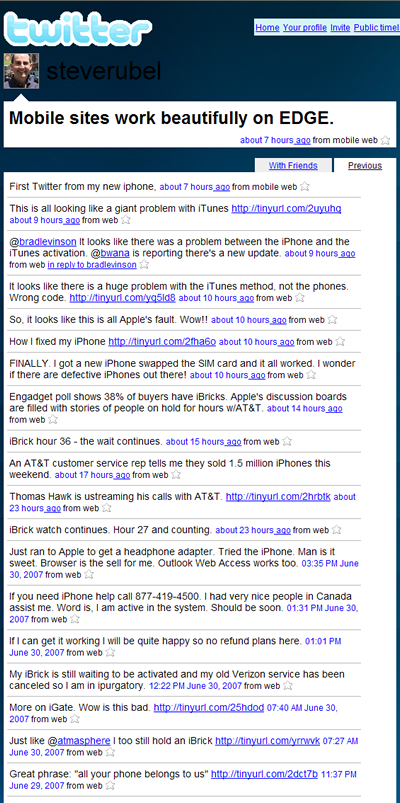
  • Steve Rubel finds a novel way to report on iPhone launch

    If you’re covering the launch of a mobile device, and it’s as revolutionary as the Apple iPhone, how do you post in a way that’s novel and immediate? If you’re Steve Rubel of Edelman, and write the influential blog Micro Persuasion, you blog from a mobile device. All while standing in line for the gizmo it is destined to be replaced by.

    Here is Rubel’s Twitter feed over that period. For those not familiar, the top posts are the most recent. You can review even by clicking the “More” link I’ve provided.

    I’m sorry there aren’t live links (I grabbed these as graphics off the posts Sunday night), but if you’d like to find the originals they should be available for a while at Steve Rubel’s Twitter Home Page.

    (more…)

  • Thinking in mapped networks, with connections real and implied

    More than a year ago I started telling trusted friends and colleagues about a great piece of software. Half-joking, I would lean forward and confide that this is one secret too valuable for me to blog about. The digital equivalent of a performance-enhancing drug, it was something I’d prefer not to leak to competitors. That is, until today. In the spirit of openness, and timed to coincide with my friend Kevin Hillstrom’s One Positive Day campaign for blogging civility, I am ready to spill the beans.

    Thinking With Both Sides of the Brain

    Ever since my college days I had wondered if there was a smarter way to organize my thoughts. Common note-taking techniques didn’t seem to cut it. Looking around, I wasn’t optimistic. Certainly the first personal computers, with their DOS-like lists, hierarchies and sequences, were of no help.

    Then I found the books of British “pop psychology” author Tony Buzan. In a Madison, Wisconsin used bookstore, I discovered the first: a copy of his 1974 Use Both Sides of Your Brain, where he talked about something called mind mapping.

    Buzan wrote that standard outlines require scanning from left-to-right, top-to-bottom. This causes the brain to work harder to make the interconnections between concepts.

    Back then Buzan couldn’t have envisioned the modern solution to this dilemma, which is to boil lists down to a point where they lose much of their potential meaning and utility. Or conversely, the author will stretch out the information across a blinding sheaf of slides and spray of “bullets.”

    I’m referring to Powerpoint of course, a product that Edward Tufte, author of The Visual Display of Quantitative Information and other classics, so eloquently lambastes in this essay.

    Our brains are built to survey information as it is seen in the physical world, making associations through placement, space, distance and color. The more complex the subject, the greater our brain resists tidy categorizations and rankings.

    Thinking In Mapped Networks

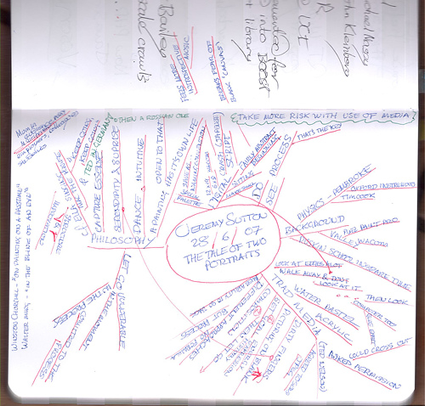
    Enter the mind map. The illustration below shows a hand-drawn example. It’s one Buzan that would have been proud to call his own.

    An example of a hand-drawn mind map

    To the person who drew it, there is more meaning here than could be crammed into a dozen pages of lists.You can instinctively see how these maps help with lateral associations while still allowing for more formal hierarchies and sequences. As you might expect, some maps are never really completed by their owners. They are continually refined. New insights and perspectives leap off the page with every rereading. This is a good thing, because it shows how concepts can grow and deepen over time.

    That was Buzan’s point, and luckily, many modern software developers have listened.

    An advantage of the computer-based mind mapping tools is they are easier to share with others (you can even port some softwares’ output to other programs, including … Powerpoint!). Annotation features also help. They add explanation that is needed when you’re showing your map to others — or just trying to remember what the heck you meant when you drew it!

    The best mapping tools can even be used as collaborative brainstorming aids. I’ve checked out several over the years, and the best by far is the award-winning Mind Manager. Visit MindJet.com to see for yourself.

    Put bluntly, it could change the way you think.

  • Dracula vs. Frankenstein: The latest in the battle between Facebook and MySpace

    The Frankenstein’s monster of the Universal Studios film was hideous. A product of an unholy experiment, it was gruesomely assembled, yet through a miracle of science walked the earth, wrecking havoc. Count Dracula, from the same studio at about the same time, was mysterious and elegant. This monster’s seductive powers were finely focused. Dracula came from a remote, distant land. And, like the heretofore Mary Shelley invention, wrecked his own considerable share of havoc. Guess which is MySpace and which is Facebook?

    Dracula vs. Frankenstein: According to IMDB, a really bad movieAnd if you’re wondering who is winning the battle of Dracula vs. Frankenstein, well, it’s too early to tell. They are definitely using their differing powers differently, and with equal aplomb.

    It was exactly a month ago when Facebook announced it would open its platform to outside developers. This online social network certainly regards no site more of a competitor than MySpace. The move to a great extent was to blunt the loss of users over to that site.

    It’s an important strategy. Facebook has only a quarter of the members as MySpace (28 million versus MySpace’s 108 million). How do you argue with that that kind of success? Or compete against these kind of numbers? If you’re Facebook, the answer is you reverse course.

    In their game-changing move, Facebook chose to swing open the doors to their platform to all manner of third-party widgets and software. This Slate article explains how these applications individually amount to little, but cumulatively they can spell a huge advantage (thanks, Bryn, for the link):

    None of the nearly 900 (and counting) programs released so far are particularly life-changing—among the most popular add-ons are a “Graffiti” program (downloaded by more than 3.3 million people as of this writing) that lets you doodle other people’s profiles and an “Honesty Box” that lets your friends say, anonymously, what they really think of you. Collectively, though, these programs are hugely significant. If the site figures out a smart way to deploy these mini applications, it will be more than just a social network. Facebook will turn into a do-everything site with the potential to devour the whole Internet.

    Good move, Facebook. That had to smart. What would you do in response if you’re MySpace — a site that has been, after all, the anti-Facebook? MySpace has always been open to all comers, fertile soil for application developers — including YouTube videos, which are embedded in MySpace profiles by the millions.

    So what do you do? You selectively compete against the very products you’ve allowed to thrive in your garden. Starting with YouTube, itself a threat. This week we learn that MySpace has improved their own embedded video product: MySpace TV.

    The clearest damage that could come of this is to YouTube. And it’s a good thing, because YouTube is developing its own social network chops. But the move also shows a different approach to getting and keeping users: Don’t rely on others to produce your most popular applications. Instead, provide them yourself, so you can get traffic to both your own social media site and the site that feeds it.

    Mind you, MySpace TV is no copy-cat of YouTube. Instead of trying to engage YouTube at its sweet spot — user-generated videos — MySpace TV focuses on professionally produced videos. Very smart.

    It’s a characteristic move from a company that has so far behaved surprisingly shrewdly. Even a patchwork Frankenstein’s monster can display uncanny survival instincts.

    To see an excellent face-off between Facebook and Myspace features, check out this recent evaluation of the two by our friends at Mashable.

  • Internet Radio royalties need to be more fairly assessed

    I’m a regular listener to Milwaukee’s latest public radio format, 88Nine Radio Milwaukee. It’s a terrific FM station with many “degrees of connection,” so to speak, to the web and new media. First, they have a great site. They also have a high-quality, 128k internet streaming signal — one that I use frequently through iTunes. They even have a member of their on-air talent who co-produces his own extraordinary podcast. That would be Sam Van Hallgren, who is co-star with Adam Kempenaar of the best film buff podcast out there, Filmspotting.

    Today you won’t be able to sample 88Nine’s streaming signal. That’s because they, along with other web stations, are protesting a fee increase for use of licensed music. This increase is huge, and threatens to put most of their ilk out of business. I’ll let LaCrecia Thomson, RadioMilwaukee’s new Listener Relations Director, explain:

    On Tuesday, June 26th, RadioMilwaukee will join other Internet radio providers in a “Day of Silence” for net radio. Internet radio is in immediate danger of being silenced permanently through new, government-imposed royalty rates that are so high they will shut down most webcasters and could force RadioMilwaukee to severely limit our stream.

    BE HEARD.  Preserve the diversity of service web radio provides and the voices it inspires.  Without action, your listening choices will be limited.  Support net radio and RadioMilwaukee.  Wisconsin’s U.S. Representatives Gwen Moore and Tammy Baldwin have already sponsored the Internet Radio Equality Act.  Let senators Herbert Kohl (202.224.5653) and Russ Feingold (202.224.5323) know you want a diversity of entertainment options.

    All I can add is if you have a favorite streaming radio station, check it out today. It will likely be silent as well. I’m sure their site will point you to the appropriate lawmakers who can help ensure that the silence doesn’t continue indefinitely.