Author: Jeff Larche

  • Need to reach B2B buyers? Ignore social media at your peril

    Business-to-business (B2B) marketing executives may comfort themselves that they don’t have to think about social media because, “That’s for consumer products.” That excuse has just been exploded by Forrester Research. Although no one should storm into an uncharted jungle unprepared, Forrester advises that B2B marketers had better start donning their pith helmets and sharpening their machetes.

    In research findings released last month, Forrester reports the following:

    If you’re a B2B marketer and you’re not using social technologies in your marketing, it means you’re late. … [Although there are some strong b2b companies doing well in the social media space], a lot of the blogs, communities, and other social outreach from business to business companies is less than mature, to say the least.

    This is your chance to stand out. Take this report and show it to your boss to convince her that it’s time to get started.

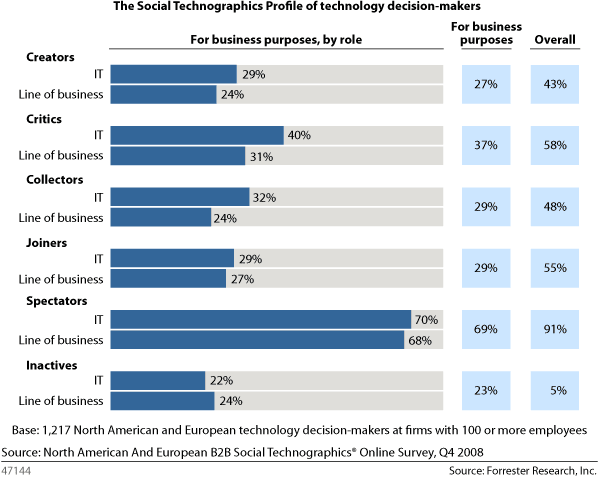
    This chart shows the Technographics of the B2B buyers they investigated. Although they are an admittedly “plugged-in” audience (they are technology buyers for the most part), Forrester discovered that 91% of the group were Spectators, the highest percentage they’ve ever witnessed in a Social Technographics Profile.
    b2b_social_participation_sm

    Even the overall Creators (i.e., bloggers, forum posters, etc.) and Critics (those who use social media to rate products and post reviews) are quite high, at 43% and 58%.

    The Takeaway

    The way businesses buy is changing fast, and in the direction of ignoring the marketer altogether. Instead, they’re talking amongst themselves, in conversations that B2B marketers should ignore at their peril.
  • Social Media 101: Get your feet wet with Facebook

    This morning I was part of a panel discussion, talking to the Greater Milwaukee Committee’s Insider Breakfast, held at The University Club. The topic was social media. One of the questions from the audience was (to paraphrase), “I know of MySpace, Facebook, LinkedIn, Twitter, etc., but the only one I am a member of is LinkedIn — and I barely know how to use that. How do I prioritize as I get my feet wet in them?” Panelists had varying opinions, but I opted for a one-word answer: Facebook.

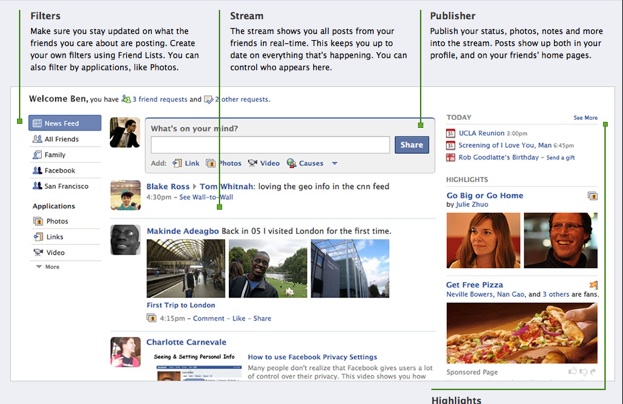
    Facebook announce this week it's becoming more like Twitter. Click to via a larger graphic

    Start with Facebook, I advised.

    Others, notably GMC president Julia Taylor (whose Twitter presence is @JHTaylor) and Cd Vann (@ThatWoman_SOHO), “participating visionary” of SOHO|biztube.com, disagreed. They leaned more toward Twitter as a place to start. As much as I enjoy Twitter, and find it invaluable in my consulting business, I rarely suggest a client start there as a way to understand the experience. Here are my reasons:

    4 Reasons Why Facebook Is A Better Set of Training Wheels

    1. Twitter is too scary — Three weeks ago NY Times tech columnist David Pogue finally dipped his own toe into the waters of Twitter. Pogue began the column by saying, “I’m supposed to be on top of what’s new in tech, but there’s just too much, too fast; it’s like drinking from a fire hose. I can only imagine how hopeless a task it must be for everyone else.” This was his apology for being a “geek” and not being willing to face the ugly, 140-character beast that is Twitter. I feel for him. But more importantly, I feel for the clients who have to learn the arcane nomenclature of “re-tweets,” hash-tags and Twitter agents. When the panel discussion was over, I confided to Mary McCormick of the Rotary Club of Milwaukee that mere mention of Twitter causes most of my clients to go into spasms. I wouldn’t knowlingly wish that on anyone!
    2. Twitter is too amorphous — The same quality that makes Twitter so popular also makes it a little too much like a multi-faceted, super-charged desktop application (think Excel) that is daunting specifically because it is so versatile. I find myself using Twitter for a lot of things, and this versatility can lead to early abandonment and disappointment (read the book The Paradox of Choice: Why More Is Less for how this veritable banquet we face can be psychologically overwhelming).
    3. Facebook lowers the chance of a “crappy first experience”Robert Scoble wrote that there is a barrier we’re facing today. It’s a “new digital divide.” The divide is between the folks who can swim easily in the social network pool and the “normal” people who refuse to or are afraid to dive in. Scoble writes that when these normal people get into a social network, “they enter a pretty lame environment since there are no friends … The first experience is a real crappy experience, since there’s no input. And it’s all about input from other users.” Facebook is more helpful than Twitter, and it’s easier to find a group of folks you can immediately “friend.” They can help you, and reduce the crap risk significantly.
    4. Facebook is becoming more like Twitter by the week — Just this week Facebook announced new changes to their interface. They make this social networking site, which already has a version of “tweets” in their mini-feed feature, even more like its competitor for user attention and participation.

    I think all of us on the panel would agree that if you are a business leader, you need to start personally leaping the chasm — the digital divide — to get a feel for the new communication medium. You need to give social media a try. If you choose Facebook, I’m here. If it’s Twitter, I’ll see you there too, at @TheLarch!

  • Designing an application around consumer behavior

    A recent post on Experience Matters offered a great example of how you can design a user experience around an existing need. Their example is YouTube:

    1. Consumer Need: The ability to share themselves with potentially millions of others through site and sound.
    2. Augment Behavior to include Brand: In the case of YouTube … perhaps the best use of this network was not for a brand to spread its own content, but help consumers share their own. After all, the initial consumer need identified above was the desire for consumers to share themselves with the masses. Wouldn’t it make more sense to empower them in continuing this behavior rather than competing against them? If successful, this takes the process full circle and makes the brand-infused behavior become part of the original consumer need.
    3. Why is this behavior occurring?: YouTube made video distribution easier (on a mass scale) than ever before. It didn’t require hosting a server or website, or being isolated to sending your large files across flaky channels. From a content consumer perspective, YouTube and sites like it offer the depth and variety that professional producers simply cannot match. The quality (for now) of the content is obviously not comparable but consumers are willing to look past it because the content is original, very controllable, and often more personal.
    4. Consumer Behavior: Millions of people are uploading their thoughts, talents, and parodies onto a video sharing network. Even more millions of people are watching those videos (the majority of which are user generated, not professional).

    They call this reverse engineering. But really, it’s simply finding a need and filling it in a unique and viral way. Major online successes are the clearest examples to describe this process because their imprint is so deep and the applications are so new and different from the status quo. Here’s another example:

    The Birth of Amazon

    Jeff Bezos set out to make an e-commerce site. Period. He reverse-engineered from a fundamental desire to buy something in your underwear (so to speak) and not to buy books. It turns out that books simply met the right criteria for ease of warehousing and shipping. Also, books were searchable in a vast and accurate — but, before Amazon, difficult to access — database.

    The success of both of these examples is obvious. Len Kendall of Experience Matters defines success this way:When a brand can improve or change a consumer’s behavior so it still satisfies their initial needs.”

    He goes on to say that a really big success is when a brand can radically change consumer behavior in a way that makes it virtually inseparable from the initial need.

    The Killer App For Your Brand

    What is the fundamental need that your audience wants to fill? How can you satisfy that need with your brand and some unique technology?

    As an experiment, I tried this reverse engineering exercise with a brand that seems the very antithesis of high-tech. Next week I’ll reveal the brand and the solution.

  • Try a soft-sell approach to your commitment-shy past customers

    What is the value of a web visit that ends without an action? Sure, if that visit ends in a sale, or some other action, the answer is easy. But what about the person who “snacks” on your content but leaves without a conversion? Today data mining expert Kevin Hillstrom makes a case for testing a less strident reaction to an abandoned shopping cart visit. At the very least, he advises testing against a control group when you send discount offer emails to these not-ready-to-purchase past customers.

    In the post he suggests the following:

    Click for a larger versionConstruct a value model in your transactional records using the following “dummy variables”:

    • Shopping Cart Abandoned 1 Month Ago
    • Shopping Cart Abandoned 2 Months Ago
    • Shopping Cart Abandoned 3 Months Ago
    • Website Visit, No Shopping Cart, No Purchase, 1 Month Ago
    • Website Visit, No Shopping Cart, No Purchase, 2 Months Ago
    • Website Visit, No Shopping Cart, No Purchase, 3 Months Ago

    When you do this, Hillstrom contends that what many find is this:

    Unconverted website visits and abandoned shopping carts are not the end of the world! In fact, these activities tend to increase future customer value, as illustrated in the graph above (months four and twelve in the graph).

    Hillstrom likens future value, as measured by non-sale visits, as “sort of like a heartbeat … each additional purchase (months six and eighteen in the graph) results in a shot of adrenaline, causing the heart to beat.

    “Each unconverted website visit or abandoned shopping cart results in a mini-jolt, as evidenced in many statistical models.” Indeed, he writes, “We view the activity as part of a relationship.”

    The take-away from those trying to derive value from any type of site is obvious: Build into your value model a way to watch unique visitors over time, and match “non-committal” behaviors that accompany purchases (or subscriptions, or whatever your call-to-action is) to a dollar amount.

    And also: When you see folks abandon a conversion funnel, stay calm!

    Another tip is consider measuring two specific signs of interest using my Content Interest Index. You can see a seven-minute YouTube video describing what it is, and its value, by visiting this post about the Index.


    Note: The link above was to a blog post called Jeff’s First Pecha Kucha. This is a way of presenting slide show content in a prescribed format that is brief and often quite fun. If you are in the Milwaukee area, don’t miss this evening’s Pecha Kucha Milwaukee at the Sugar Maple. It should be a lot of fun!

  • Winning by the numbers: In praise of Moneyball and data analytics

    moneyball-book-coverFive years ago the book Moneyball was going around the office of respond360, which is the CRM arm of BVK. The book fueled my love affair with data-driven marketing. In reviewing the book this morning, I realize how relevant its lessons have become in our economic downturn.

    Wikipedia describes the account of the Oakland A’s unprecedented success on a shoestring budget this way:

    Statistics such as stolen bases, runs batted in, and batting average, typically used to gauge players, are relics of a 19th-century view of the game and the statistics that were available at the time.

    The book argues that the Oakland A’s front office took advantage of more empirical gauges of player performance to field a team that could compete successfully against richer competitors in Major League Baseball.

    Rigorous statistical analysis had demonstrated that on base percentage and slugging percentage are better indicators of offensive success, and the A’s became convinced that these qualities were cheaper to obtain on the open market than more historically valued qualities such as speed and contact. These observations often flew in the face of conventional baseball wisdom and the beliefs of many baseball scouts and executives.

    By re-evaluating the strategies that produce wins on the field, the 2002 Athletics, with approximately $41 million in salary, are competitive with larger market teams … who spend over $100 million in payroll. Because of the team’s smaller revenues, Oakland is forced to find players undervalued by the market, and their system for finding value in undervalued players has proven itself thus far.

    I found the book inspiring then, and I find it even more exciting today. In spite of my general lack of enthusiasm for the sport of baseball, I found it the best business book of 2003.

    Reading Digital Tea Leaves

    The author argues that most teams still rely on the black art of talent scouting. Wizened, tobacco-spewing scouts  watch a young athletes play and proclaim him either unfit or “slugger material.” Does this sound like the seat-of-the-pants metrics that marketing has traditionally used to evaluate markets, products and campaigns?

    Back when I read it, I was thrilled to imagine new ways to read a different sort of tea leaves — namely, the ones found in market and customer databases. What I’ve learned since is that once you start looking at data in a new way, you can find breakthrough insights.

    You really can.

    Although I don’t think he’s a marketer, here’s what “Ryan,” in his GoodReads review of the book, wrote:

    Awesome – story of how the Oakland A’s built a great baseball team on one of the league’s smallest budgets by using innovative statistical analysis to identify undervalued players. I think that’s pretty neat.

    I couldn’t have put it better. Pretty neat indeed.