Author: Jeff Larche

  • Digital picture frame can help pet owners share their love

    This afternoon I had the privilege of speaking to the American Animal Hospital Association about, among other things, mobile marketing. I look forward to resuming the conversations tomorrow.

    Tomorrow I will also be posting an entry with many of the links and updates I’d promised. But for now, I wanted to present for your critique a gee-whiz idea I posed to the group. I hope you can help me with your comments.

    Please consider this: What if there was a way to use the viral marketing power of a Facebook widget to help your best customers talk about your practice.

    The idea uses something I’ve blogged about before: widgets. Ad Age contributor Bob Garfield has postulated, and I agreed in this post, that widgets can be for healthcare marketers the new refrigerator magnet. Well, how about for veterinary practices?

    A prototype image is near the bottom of this post, but the essence has more to do with functional design than actual appearances. It occurred to me that pet owners are almost as quick to flash you their latest pet pics as they are photos of kids and grandkids. One friend (a team member from my ec-connection days) even has a Facebook profile page for his lovely Dora:
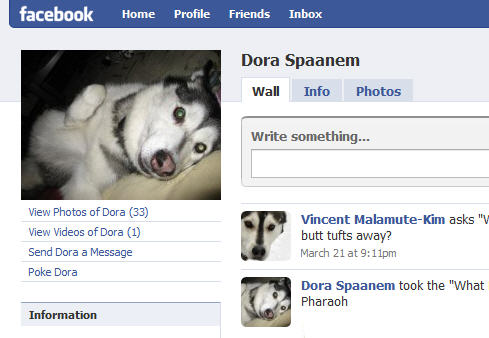
    The Lovely Dora

    This spawned in my mind the Digital Pet Parade. It’s a digital picture frame, of sorts, that you would install and configure on your Facebook profile. Using this widget, you can display pet photos that you’ve already loaded in the Photos section of your site. The picture frame (a prototype shown below*) does these things that a mere photo collection cannot:

    A logo on the digital picture frame would link to the sponsor's practice site
    A logo on the digital picture frame would link to the sponsor's practice site
    1. Rotates your photos with a frequent “refresh” rate that you would set — or simply shows a new one from your collection daily
    2. Includes the photos of your friends on Facebook as well — or at least those who also have the picture frame showing their photos (and their picture frame would show your photos if they opt to allow this)
    3. Allows for picture comments, from you and you friends (not shown)
    4. Is equally functional on iPhone web browsers, as well as other many other higher-end smartphones.

    This afternoon I got a chance to chat with a lot of practice managers and veterinarians about using the power of social networks to help their best customers become their ambassadors. But I still wonder if this way particular way of empowering customers has real potential.

    Hot … or NOT?

    Here’s the big question: Has this simple widget added more complexity than is needed?

    From a marketing perspective, it’s a glamorized way to show you’re a “fan” of the practice, by using their branded widget. I frankly like the subtly of this. And yes, in this way it resides on your profile page the way a magnet would hold up papers and whatnot on the door of your fridge.

    But will your customers be eager enough to agree to install one more application on their Facebook profile? You tell me!

    I’ve met a lot of people today and asked them to respond. Let’s keep the discussion going!


    *NOTE: Digital Pet Parade prototype was designed by the lovely and talented designer and art director Heather Prickett Bolyard.

  • 7 Types of Backlinks For Better Search Ranking

    In the internet before Google, Yahoo was the leading search engine. To be more precise, Yahoo was a web directory. That’s an important distinction, because it meant ranking high in Yahoo (back then) required a single editor’s effort. Yahoo editors approved or overrode recommendations for how sites might be categorized in their directory. This was kludgy, imprecise, and definitely not scalable for a fast-expanding web.

    Google changed everything. Their search spiders scour the web and look at how peer sites link back to yours. It’s overly simplified, but for the most part, here is the equation if you want high Google placement for your site:

    Number of Peer Site Backlinks multipied by The Authority of Those Referring Sites equals The Magnitude of Your Chances of Ranking High in Search Engine Results

    In today’s Google-dominated search environment, backlinks are king.

    7 ways to boost backlinks to your site

    Most search engines have followed Google’s lead, and to at least some extent take into account the quantity and quality of sites linking back to you. Here are seven types of backlinks for you to pursue:

    1. Vendor Sites — If you use specialized supplies in the course of your business (anything from custom mailing labels to MRI devices), talk to your vendor about linking back to your site. And don’t hesitate to suggest specific keywords to use when pointing back to you (more on that at the bottom of this post).
    2. Organization Sites — Any site from the Chamber of Commerce to the Better Business Bureau can be a referring site for you. Make sure you’re listed there and listed properly. These geographically-specific sites are especially important for businesses that are in some why land-locked in their marketing. These local sites help search engines rank you in regional searches. (Example: Last time I checked, this site ranks #2 in Google for “milwaukee marketing technology analytics”)
    3. Community or Non-profit Sites — Are you involved in any charitable work, or do you support local or national causes? Talk to their sites’ managers about being acknowledged with a link. Also, it’s good marketing to tell the world about the ways your business is helping to make the world a better place! It certainly can’t hurt to provide a page of your own, called something like “XYZ Gives Back,” where you show a little gratitude and link back to them.
    4. Press Release Services — Services such as PRWeb help spread news about your site throughout the web. If these electronic press releases are properly worded (again, think about key words people search on!), they can do much to send you both business and boost your search rankings.
    5. Blogging and Twitter Strategies — Done poorly, backlinks from blogs and micro-blogs (such as Twitter) can come back and bite you. But done sincerely, you can share information about your business to audiences who care. And many of these types of backlinks carry considerable search engine mojo. Check out this famous four-minute video for a primer on how an interconnected web of social links helps make for a better online experience.
    6. Reputable Directory Listings — There are a few reputable directories out there you should consider submitting your site to. Yahoo stills has its directory. The DMOZ Open Directory Project is also worth trying (although its editors are volunteers, and I’m unsure how successful new entrants have been in getting listed). You definitely can get into The Best of the Web, however, and should. Industry-specific directories can also turn out to be a good source for reputable backlinks.
    7. Comments on Social Sites — Join the social network conversation, and be sure to include your web address in your comments (comment forms all have a field you can fill out for this purpuse). Be helpful and courteous. Do not self-promote. Follow this advice and you will find that your site will receive some direct clicks from the comments. A handful of curious readers will inevitably investigate the source behind the contribution. But more importantly, some search engines appear to consider these types of backlinks in their algorithm.

    One Last Backlink Tip

    I mentioned in #1 above to not hesitate to suggest that backlinks be hyperlinks with the key words you care most about. Instead of having the link mention your business name, consider having it mention the line of products you’re known for — in the language your prospects typically use when they are searching for a source. But be careful about spreading the same phrase to all backlink sources.

    The reason is search engines are vigilant about sniffing out marketers trying to game their system. One way is looking for identically-worded backlinks … especially those that spring up nearly at the same time. These can flag your backlinks as potentially coming from a “link farm.”

    That said, all of the tips above are “white hat methods” of helping people find what you have to sell. In a way, these backlinks are nothing more than good, electronic word-of-mouth advertising.

  • Large and diverse group made inaugural likemind a valuable meet-up

    If you missed this morning’s first-ever Milwaukee likemind, you missed some great conversation and excellent coffee. Thank you Greg Batiansila for being the first to document and post a glimpse of some of the festivities. Here it is:

    At least one other person had a video camera, so there will likely be other videos circulating. Want to try spotting them? Check out the buzz surrounding the event on Twitter, where they will undoubtedly be posted. Just search for the MKElikemind hash-tag (#MKElikemind).

    Mark Your Calendar For the April 17th likemind

    I received at least a dozen emails and direct messages from colleagues who couldn’t attend, and hoped to attend the next one. I’ll bet my co-organizer, Chris Moander, did as well.

    That means the April 17 likemind will be just as varied and interesting as this first meet-up. So mark your calendar!

    Kudos To Bucketworks

    I need to give a special thank-you to the providers of the absolutely perfect setting for this type of event. Bucketworks, you’re the best!

  • Wearable computer hints at ways we might live digitally

    Every year the TED conference introduces new and provocative ideas, many of which soon become commonplace. Two years ago, Jeff Han’s demonstration of multi-touch screens presaged the Microsoft Surface, and the first mass-produced multi-touch cell phone: the iPhone. These multi-touch screens are many things, but unencumbered is not an adjective that comes to mind.

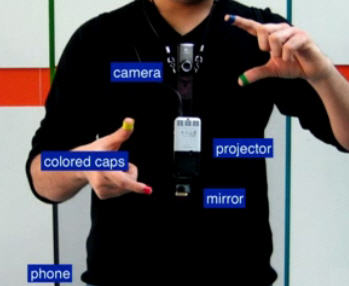
    Even the iPhone requires you to hold a cell phone, which is a barrier for a lot of real-world applications. MIT Media Lab’s Pattie Maes explained the challenge at the latest TED conference. She said that, for instance, “If you are in the toilet tissue aisle of your supermarket, you don’t take out your cell phone, open a browser and go to a web site when you want to know which is the most ecologically sound toilet tissue to buy.” She and Pranav Mistry, also of MIT’s lab, have devised a potential solution to accessing this type of rich information in the real world. They call call this sort of computer interface their Sixth Sense. Here is the video of the computer demo.

    The demonstration had the audience on their feet, cheering.

    Here are three things I love about this concept, as crude as it currently is:

    1. It’s cheap, light and small
    2. It can very quickly become cheaper, lighter and smaller
    3. With video recognition, the need for colored finger-markers will be unnecessary (so will logging in, since it will recognize its owner’s unique fingertips from anyone else’s)

    Wearable computers have been talked about for decades, but this is the first user interface that is starting to make sense to me.

    When Jeff Han’s concept of multi-touch computer interfaces was presented two years ago, my blog post was effusive about the possibilites. Someday we might be able to work standing up — more prone to both creativity and collaboration (please excuse the obscure pun). The biggest barrier to this future was that darned wall-sized screen. With the Sixth Sense device, any white wall becomes a screen — and an inviting whiteboard for one or more knowledge workers to play in.

    Do you agree that this crazy contraption has a lot of possibilities?

  • Pepsico cashes in on Twitter by reporting from its birthplace

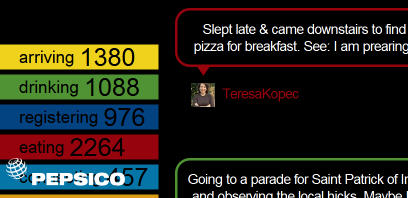
    sxsw_twitter
    Sample from the app's home page

    Okay, so Austin isn’t really the “birthplace” of Twitter, but it was at the South-by-Southwest (SXSW) tech conference two years ago that Twitter was introduced to the technorati in a big way.

    I recall reading blogger and anthropologist danah boyd’s posts about her frustration with the system (she had set her cell phone to receive every tweet from her hundreds-strong network — in real time). She later that year mused about its uses in a public conversation that first persuaded me to tinker with Twitter.

    Now it’s two years later, and time again for SXSW to light up Austin. But this year Twitter, and social media in general, are far more mainstream. Pepsico is cashing in. Check out this tool for reporting on tech tweets from Texas!