Author: Jeff Larche

  • World Cup win was also a triumph for Edward Tufte

    The U.S. just won a pivotal game in the World Cup, and it was a squeaker. I “watched” it while working, using an amazing new data visualization app on the New York Times website. One tab in particular reminded me of the teachings of data visualization guru Edward Tufte. It showed an easy-to-read display of key game statistics, updated every 15 seconds:
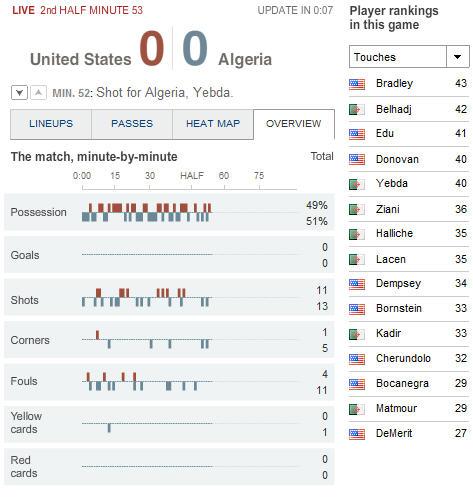
    The right column had a pull-down that allows users to see vital statistics about each player. The number of touches in the game, by player, is shown above. Others include fouls, cards, and of course goals (a list of exactly zero players at this point in the game!)

    No, I’m not such a data wonk that I could feel like I’ve experienced the action by watching this view. But the other tabs at least gave me a hint at the action I was missing away from the television screen. Check these out, keeping in mind that you can see the latest action, and review the action that took place earlier, in a type of choppy animation, using the timeline player at the bottom of the app:
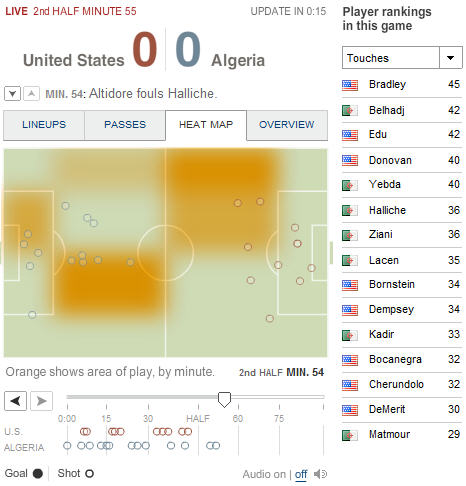
    And here’s another:
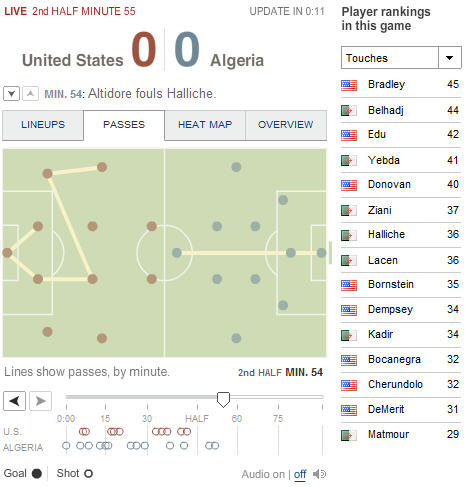
    Notice, at the very bottom of the graphic, the audio toggle. I chose to keep the app in the background, with the audio turned on. Throughout the game, the app was silent (thank goodness it didn’t pipe the vuvuzela noise through my computer speakers!) That is, the app was silent until that U.S. goal in added time. That’s when I heard a three-second burst of cheers. It was a cue for me to check the app and receive the thrilling news.

    Edward Tufte believes the future vitality of business — and perhaps even of our species — hinges on how well we can communicate complex information quickly and intuitively. The Times has adopted many of his favorite techniques, particularly in the Finance and Sports sections. For example, those little sparklines you can find there were first made popular by Tufte.

    This latest real time tracking of the complex game of world football (a.k.a. soccer) is a demonstration of how far we’ve come with data visualization, and an exciting taste of the future. Gooooaaaaallllll!

  • Thoughts on Likemind: Guerrilla Marketing was easier back when it was harder

    Guerrilla marketing, a concept coined by Jay Conrad Levinson and made popular during a simpler pre-Internet age, was never as easy as it sounded. The Internet’s arrival as a marketing tool didn’t make guerrilla marketing less relevant. It did heap on potentially detrimental distractions.

    I was reminded of this when Jon Mueller announced the topic of his presentation, set for this Friday morning at Milwaukee’s June Likemind meet-up. The title is DIY: The Fine Line Between Building and Killing an Idea. Jon acknowledges that modern technology grants us unprecedented power to launch an idea or market a business. In some ways it’s a Utopia to the Jay Conrad Levinson of that long series of guerrilla marketing books. Each explored a different facet using guerrilla warfare tactics to out-compete bigger and better financed competitors.

    Jon’s talk will describe how technology has not made do-it-yourself (DIY) marketing necessarily more surefire. He’ll explore how digital marketing provides “distraction, an assumption of promise (if I use this, the result will be this), and a diminished true interaction between people.” In other words, the very technology that can be a DIY heaven can also be a marketer’s undoing.

    Since Jon is general manager of the business book giant 800ceoread.com, I’m expecting him to be citing business books like the Guerrilla Marketing series — but also more recent books on the perils of the Internet age.

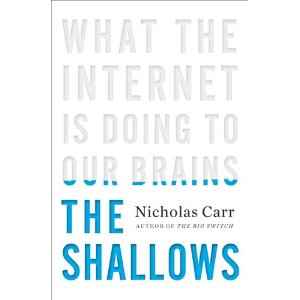
    Most notably, I’m expecting him to touch upon the new book by Nicolas Carr, The Shallows: What the Internet Is Doing To Our Brains, which just came out, and

    It contends that the web is changing how we think and make decisions — and not for the better. I hope you join Jon at the event. Here are the details. It’s free of charge, at 7 AM on Friday. It also may be outdoors, weather permitting!

    Finally, I’d like to brag about a one-degree-of-separation moment I had a few days ago. I met a co-author of two of the Guerrilla Marketing books. Al Lautenslager (a.k.a., @GMarketingGuy) is based in Appleton, Wisconsin. It was interesting to chat with someone who is keeping Levinson’s ideas current, as is evidenced by a smartly done and decidedly DIY marketing website. I hope we keep in touch, Al!

  • A steak-scented billboard: Who ever sausage a thing?

    This What’s In Store post reported on a billboard that not only visually evokes a juicy steak — it smells like one. Here’s an excerpt:

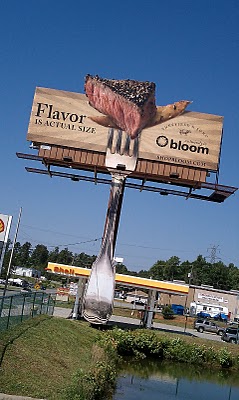
    A billboard that smells as enticing as it looksCommuters [on a North Carolina highway] may find a new aroma commingling with exhaust fumes: The smell of grilled steak, coming from a billboard designed to entice shoppers by appealing to a sense other than sight … It pairs the smell with a big visual, showing a giant piece of steak and a French fry on a giant fork.

    The post goes on to say that this is one of the first of its kind in the country. I was reminded by a friend this morning that the technique has definitely been enhanced by modern chemistry (by ScentAir of Charlotte, NC), but this tactic at least dates back to Wisconsin’s own Wienermobile.

    For those who don’t remember it, this vehicle promoted Oscar Meyer wieners for decades, and often used the smell of cooking hotdogs to help build an audience.

    … As if the vehicle’s design alone wouldn’t do the trick!

    Can readers find an earlier example of out-of-home “whiff-appeal” to help sell a product?

  • Online surveys as brand awareness Trojan horses

    Another offline marketing tactic goes online. For years, some face-to-face or phone surveys during election seasons have been used to start or intensify voter opinion. Most of us have heard of these tactics, but if you haven’t, here’s an example:

    “Hello, I’m doing research on the local senatorial race. Here’s our survey question for you: If you learned that Senator Jones, who is up for reelection, regularly terrified kittens, how would that influence your vote? And here’s our follow up question: What if you learned he was even meaner to cute little puppies?”

    Click to view the ad in contextOther surveys of this ilk are less nefarious, but they do have this in common: They claim to do one thing while accomplishing another. Think of them as Trojan horses, carrying awareness instead of seeking to measure it.

    I thought of this technique when I saw this online ad — er — I mean, survey.

    I have to say, it’s kind of brilliant.

  • Voice recognition was done first and best by humans

    Back in 2008 I theorized that it would be just a few years before voice commands revolutionized marketing and commerce. Not necessarily for everyone, mind you, but most significantly for people who wouldn’t dream of using a keyboard, or even a smartphone!

    My post, Leaping the chasm to a plugged-in construction site, predicted that voice recognition isn’t that far away, and is the only way that many professionals would benefit from the utility of digital networking and cloud computing — ranging from the “safety glasses and hard hats set,” to offshore oil technicians (were you listening BP?), and even to surgeons.

    One Million Years BC was a very cheesy movie about life before history. Original voice was mostly simple words and grunts. Heavy breathing was also involved -- at least, I'm imagining, by certain audience members.
    In the beginning, even before we had a written language with which to record history, our original form of communication was voice. The problem with voice, however, was that once the words were spoken, they were gone forever. HarQen was launched at a time of technology convergence, when original voice can be turned into an asset.

    That was as an outsider in the digital voice space. After spending time “inside,” with my friends and co-workers at HarQen, I’m realizing that voice recognition isn’t the only way to make a big difference with these types of phone users. I’ve discovered that you can derive value simply from people talking into their phones and having these snippets turned into sharable assets.

    In other words, I hadn’t considered original voice. Original voice can be thought of as voice “captured, stored and shared,” pretty much as-is.

    HarQen believes The Original Voice Matters. I recently talked about their view, of how voice is the “original rich media,” at Ungeeked Elite. Here’s a post from last week, on the VoiceScreener blog, that helps to explain why the best voice recognition software still resides between our ears — and how HarQen is using voice asset management to give clients an impressive competitive advantage.

    So I was wrong. But I’m even more excited now than I was then. I cannot wait to see what happens when voice asset management is commonly adopted. Although it might not be powered directly by voice recognition, there may be a plugged-in construction site after all, using speech in the way it was used in the days when the only construction sites were in barely habitable caves!