Author: Jeff Larche

  • Is Second Life real estate another bubble ready to burst?

    Chris Anderson, author of The Long Tail, recently posted his reservations about the commercial potential of Linden Lab’s metaverse, Second Life. (Check out the many comments, by the way. I praise him for his willingness to stir a hornet’s nest.) The main reason for Anderson’s pessimism: Lack of traffic to the virtual storefronts and office spaces. Chris Anderson’s Avatar on Second LifeDoes this mean we should all forget the Second Life “land rush” ever happened? I don’t think so.

    Yesterday I heard Steve Ennen, VP, Digital Business Strategies at American Business Media, speak at an online marketing summit. He pointed out that we should look at the potential for marketers in a “Third Life, Fourth Life or even Fifth Life.” I would agree. Especially if the next platform can be one that doesn’t require special plug-ins or players. Online, experiential marketing is here to stay. And a whole generation is growing up having spent a significant portion of their young lives on gaming platforms very similar to Second Life.

    In the future, favorite online communities may well become these consumers’ first lives.

    You’ll find more information on Second Life in this and associated entries.

  • Networks are personalizing our sense of place after depersonalizing time

    There was yet another piece in the New York Times last week about the disintermediation of established businesses as a result of our new, networked world. In this case, it was about how new map mash-ups are growing in popularity, to the chagrin of many professional cartographers. Here’s an excerpt:

    With the help of simple tools introduced by Internet companies recently, millions of people are trying their hand at cartography, drawing on digital maps and annotating them with text, images, sound and videos.

    In the process, they are reshaping the world of map-making and collectively creating a new kind of atlas that is likely to be both richer and messier than any other.

    They are also turning the Web into a medium where maps will play a more central role in how information is organized and found.

    Initially, I thought this article was further proof that networks automatically disintermediate. It’s just their nature. They cut out that faceless “middleman,” whether this “man” is a travel agent, a realtor, or — in the case of Wikipedia — a traditional encyclopedia editor. But then I heard a story that showed me how networks can cut both ways.
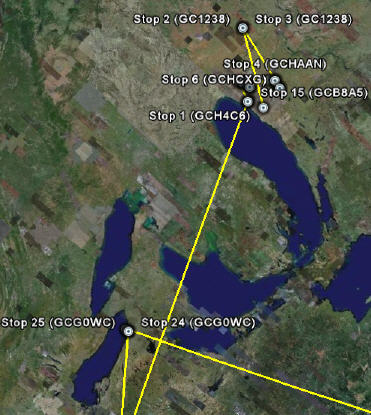
    This shows a the path through the Midwest of a TravelBug (think Geocaching)

    But first, a word about how place, as defined as our physical world, has always been subjective — that mash-ups are simply expressing this reality in another demonstration of The Long Tail. The above example from Google Earth is the path that a friend’s Travel Bug (lovingly named Tatoo Bug) took as it passed through Midwestern geocaches. This portion was the first leg in a worldwide, 15,951-mile trip that he and other enthusiasts continue to follow on the dedicated Geocaching site.

    Just as blogging has shown what happens when you remove the high cost of entry to publishing, these new rich, personalized maps are what you get when you hand mapping tools to the masses. Think about what maps have been in recent history. And I define recent history as the time since researching and printing maps was only available to the chosen few.

    When I was a child, living in the hinterlands of the Upper Peninsula of Michigan (also known at “The U.P.”), I was surrounded by towns that were too small for most maps to even acknowledge.

    To cartographers, they didn’t exist. The commercial effects were devastating. 

    Smack in the middle of a breathtakingly beautiful part of the country, with much to offer visitors, these tiny hamlets withered on the vine because tourists drove right past. These towns were achingly close to the tourist dollars they needed to survive. In some cases they were separated from major U.P. roads by nothing more than a stand of pine trees. So close and yet so far away.

    That is all changing.

    I’m a rock climbing enthusiast. The last time I climbed at Devil’s Lake, a spectacular set of quartzite climbing faces, I and my fellow climbers found the right place to set our gear based on an old, dog-eared book. The book was far from current, but it was the best we had. I’m expecting, within the year, to make my selection based on one or more Google Map mash-ups, enhanced with Flickr.com photos and user-generated raves, rants and warnings. My guide book will stay on the shelf, more a relic than reference.

    And who knows? Maybe, armed with more personal — and personalized — knowledge of the area around Devil’s Lake, I’ll discover an ideal place to eat. One that I didn’t even know existed. A new perspective will reveal a physical world I didn’t realize was right there all the time.

    Networks Can Intermediate Too

    Is it inevitable that a networked world eliminates the middleman, shifting from an objective, imposed experience to a more subjective one? I thought so.

    But on the same day that I read that Times article, I heard a wonderful NPR podcast. It was one of a series of programs called RadioLab, and this episode was about time. The program reminded me that there was an era in this county when small communities like my hometown had a very personal — and personalized — view of time. Up until about 200 years ago, these places had no official “time.” Noon was simply when the sun was directly overhead. You set your watch to that moment, and that was good enough.

    Back then you could walk into a room and ask for the time, and get as many different answers as there were people answering. Some would even, quite sincerely, answer with something like “It’s nearly time for me to harvest the corn.” Because what was time, after all, but something you experienced subjectively?

    One day that all changed, and everyone followed the same timeclock.

    And the intermediary that created this change? None other than a network: The railroad.

    With much at stake for both the train and the towns along its path, someone had to agree to exactly when the 12:07 train would pull up to the stop. The network wiped away all personal “maps” of time and replaced them with one that was objective and unyielding.

    All of this is a reminder to me that two of the most agree-upon truths — Time and Space — which keep us moored to this harbor called Reality, are more open to interpretation that we would care to admit.

    We all know that retail’s mantra and battle cry is Location, Location, Location. But the spread of map mash-ups helps us realize that what makes a location good is in the eye of the beholder. Take it from me: If what you want is a really good smelt fry, I know a place in Rapid River, Michigan that is worth seeking out.

  • Confirmation page growing in email marketing importance

    A recent Direct Marketing Association study describes the growing popularity of super-simple subscription processes — sometimes just asking for an email address. But even more noteworthy is the clever twist of nailing down details within the confirmation page.

    In a way this is just a semantic trick. Instead of the subscription process being a two-page “ordeal,” with Page Two saying something like: “Almost done! Now tell us what you’d like to receive in our eNewsletter,” the second page says, “Thanks for subscribing. Your first issue will arrive shortly. Now, if you tell us in the form below what content would be most welcome, we’ll be about to customize those messages precisely to your tastes.”

    Such a simple change. And such a big improvement in conversion rates! Privacy assurances and transparency about how often the emails will arrive are also key to raising subscription conversion rates, according to the study.

    Other findings, as described in Chad White’s blog about the report, are as follows:

    • Only 3% of major online retailers use a double opt-in subscription process.
    • Only 92% [sic] of retailers have an email sign-up form or link on their homepage.
    • More than 43% of retailers allow customers to sign up for email with one click from their homepage.
    • The subscriber’s name (31%) and zip code (18%) were the two most often required pieces of information.

    What are you doing to improve your eNewsletter’s subscription process?

  • If there is ever a Web 3.0 Mount Rushmore, Blaise Aguera y Arcas’ face will be next to Jeff Han’s

    Let there be no doubt. The past year has given us a clear glimpse of Web 3.0 and how we will experience it. First Jefferson Han gave us the multi-touch interface to this new multi-dimensional world. Now Blaise Aguera y Arcas gives us the information architecture behind that glass rectangle. Blaise Aguera y Arcas is an architect at Microsoft Live Labs, and in this breathtaking video he shows what Ethan Zuckerman called, after this TED2007 (technology, entertainment, design) presentation, “Perhaps the most amazing demo I’ve seen this year.” You be the judge.

    A demo of Photosynth

  • A magical feat worthy of Hogwarts: Harry Potter book materializes via text message incantation

    I read somewhere that Italy has more pet dogs than it does children. That is a bad thing in a country — a sign of negative population growth. However, I tell you very selfishly that this ratio — more dogs than kids — is an excellent thing in a high rise. Take mine for example. The elevators and lobby are teeming with canines, usually on the business end of leashes held by a slack-skinned residents such as myself.

    So how do you account for the fact that the mail room of our building today was full of USPS notices of the arrival of the same parcel: The last in the Harry Potter book series? Obviously I’m not the only “kid at heart.”

    But this kid has a decidedly geeky side. I pre-ordered mine three months ago using nothing but the keypad of my cell phone. As I stated then, in my account of ordering the book, the service that made this miracle of commerce possible is a harbinger of things to come.

    Here were the steps I used to order my copy of this juvenile horse-choker:

    I registered (just once) at the ShopText site. I provided the usual: My name and shipping address, and my credit card information. I also gave them my email address and cell phone number. That’s when the real wizardry began.

    I received a receipt via email and SMS (i.e., cell phone text message). It included my short password, something needed to avoid ordering fraud

    Then, all I had to do was send a text to ShopText’s “short code,” which is a 5- or 6-digit cell phone number that communicates with an SMS server. I placed the keyword in the message body, “Potter,” as instructed in the print ad that offered this ordering option.

    I received a confirmation on pricing, which also requested the security password. Once received, the system sent my cell phone — and my email Inbox — a receipt for the purchase. Poof! Within three minutes I had scratched my itch and bought this last of the Harry Potter series.

    And that’s the point.

    If SMS ordering catches on at all, it will be because of the ease with which spontaneous purchases can be made before having time to think something like, “Heck, I can always go to the bookstore.”

    This is a system that deserves to succeed, and it probably will, considering what big, pampered kids I and my fellow boomers have become.