Author: Jeff Larche

  • Magazines learn Web 2.0 tricks

    Five months after the American Society of Magazine Editors presented a National Magazine Award for general excellence to National Geographic and The New Yorker, it is what these publications are doing off the printed page that impresses me.

    Three Ways Print Magazines Are Making Daring Online Plays

    While retaining impressively high editorial standards, The New Yorker has found ways to leverage this content in ways that should attract a different breed of reader — or at least a newer generation.

    The image below is a screen capture of a featured political cartoonist at work, creating a caricature for a story. Included on the same page are links to feeds for editorial content unique to the medium — podcasts and blogs.

    (The magazine also publishs all print content online. I love how I can pass along by email a copy of an article I’ve read in the print edition of The New Yorker. Example: The South Korean film The Host (original title: Gwoemul) was one of my favorite films of last year, but few in my circle of friends and acquaintances knew about it. Anthony Lane, the bright and Wodehousean film reviewer for the magazine, described this film wonderfully in this New Yorker review. I’ve probably emailed that review to a dozen people, mostly because I find The Host brilliant, but also because Anthony Lane is such a persuasive salesman for the film.)

    Another 2008 editorial award-winner, National Geographic, presents its stunning photography in a format that invites sharing. In fact, I had originally seen these photos (sampled below) in the print edition. Fellow blogger Lembit Kivisik had reminded me of them in a post on his Twitter feed. He commented to me that “I think about subscribing to the mag after visiting their site. Maybe I finally will now.”

    And that’s the point, I think. Many of these magazines are flashing a little ankle, as it were, on the calculation that people will want an analog version of what they see digitally. (And who can argue that — unlike the online versions — the lush photographs and maps in National Geographic’s print edition are something to prize … to linger over and visit revisit often?)
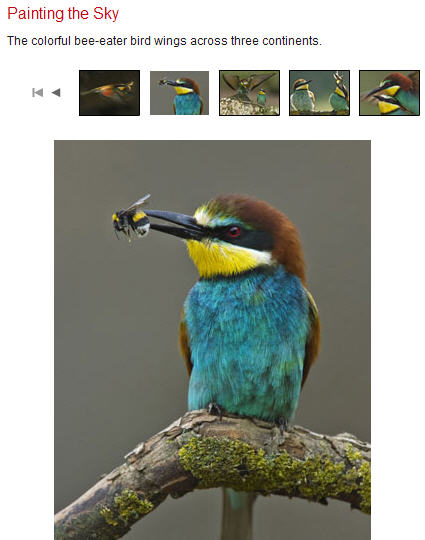
    Jozsef Szentpeteri's cool photos of colorful, bee-eating birds

    And then there are the magazines using podcasts in a big way. My latest print Economist is a weekly treat (it’s sad, I know), but time being scarce, I appreciate their new service, Talking Issues. It allows print subscribers to download the latest issues as dozens of well-categorized and labeled podcasts. You get every word of their print edition. Now I get to “read” The Economist the way I would a spoken word book during my long commute into work.

    Download the entire magazine in spoken word. Approximately 150 Mb per issue!

    Do you have favorite examples of magazines making new media plays for our time and subscription dollars?
  • Does Disney know they’re being hijacked by Twitter spam?

    Disney’s brand police are notoriously tough and vigilant. When they find a business using their name or images improperly, they take swift action. So I’m wondering how long it will take Disney to discover that some new arrivals to Twitter are pointing people to their web site under fault pretenses. In other cases, the same business (it appears) is inducing people to click on Disney-related Tweets, only to arrive at what appears to be a Google Adwords micro-site, or a site for an Orlando vacation package retailer.

    It all started four days ago when, in quick succession, I discovered several new followers to my Twitter feed. I’m still not sure why I was chosen, since the newer of these entries are following only a handful of others. Unlike most new followers to my Twitter posts, these folks seemed to have no connection to my professional or personal interests. (Full disclosure: I’ve only visited a Disney property once, and that was this summer. The high point was learning to dance The Macarena. Fuller disclosure: I still do The Macarena quite badly.)

    Suspicious New Twitter Followers

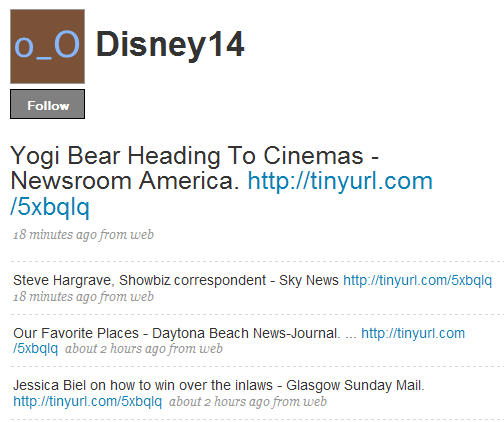
    One of my new followers that day, Disney14, has — as the web site linked to its profile — this official Disney site: http://disney.videos.go.com. The URL contains a source code (CMJT), and a source ID number, both suggesting that the business behind Disney14 is part of an affiliate program Disney uses to get traffic to its video store. But traffic from this source arrives without knowledge that they’re clicking on a link to a Disney video merchant.

    It appears from the text of these Tweets that the business behind them wants to show up on search results for the keywords used. Here are the most recent examples from yesterday (below this graphic is a text version, with the hypertext links preserved):

    Click to visit Disney14 on Twitter

    Here are the live links. Don’t worry, clicking on them won’t add to any SEO mojo. All of the links below, as in Twitter, have rel=”no follow” attributes that tell search engine spiders to ignore the links:

    Within minutes of acquiring Disney14 as a follower, I also found destdisney on my list. This profile is associated with no web site, but every post lists the same Google Adwords micro-site trap, which itself uses the Disney brand in its domain name. Here are posts from yesterday:

    Click to visit the destdisney Twitter profile

    A third Twitter profile, sjohn1019, points every post (latest: “Safelite AutoGlass Contribution Grants Local Child’s Wish – MarketWatch“) to an Orlando vacation site. The site linked off of this Twitter profile is http://www.automaticwealthmaker.com, a “make money with Google Adwords” lead generation site. Which, incidentally, seems to have been cyber-vadalized by a hacker who changed “wealth-maker” to “wealth-taker.” Ah, the messy world of sleezy internet hucksters!

    What do you make of all this? And how long will it take Disney to issue a cease and desist order against whomever is behind this Twitter spamming? Watch with me, won’t you?

  • 99% of Amherst College’s first-year students pass on a land line

    Recently Peter Schilling, Amherst College’s director of IT, posted interesting findings about his students technology preferences. Amherst is hardly a typical U.S. institution of higher learning. Located in western Massachusetts, Amherst is regarded one of the nation’s very best liberal arts colleges. However, Schilling’s findings do show the direction in which our college students are using technology and consuming media.

    Some of the points Schilling made have to do with how quicky technology is being adopted, and how quickly old technology is being sloughed off. For instance, the number of first-year applicants applying online has jumped from 33% to 89% in just five years.

    On the other hand, of the entire enrolled class of 2012, only five of the 438 first-years students (1.1%) registered a telephone land line. The portability of cell phones has clearly won hearts and minds. Similarly, notebook computers abound. Only 14 students of the class (4.3%) registered a desktop computer for use on the school network.

    Here are other findings from the 30-point list that Schilling posted (these are direct quotes. I know point #5 is vague):

    1. Students in the class of 2012 who registered computers, IPhones, game consoles, etc. on the campus network by the end of the day on August 24th, the day they moved into their dorm rooms: 370 students registered 443 devices.
    2. The number of individual film titles in the College’s digital video streaming collection: 1,260.
    3. The number of times these films were watched last year: 20,662.
    4. Number that brought iPhones/iTouches: 93.
    5. Likelihood that a student with an iPhone/iTouch is in the class of 2012: approximately 1 in 2.
  • Web design turned on its side

    We in the web design business often talk about what users see above the fold. The assumption is that people may not be compelled enough to browse down. But there are certain situations where the most suitable “browse” direction is sideways and not down. TheHorizontalWay.com is a collection of sites that turn our preconceptions on their ears. Of particular note among the collection is Interview Magazine, which uses the orientation for both novelty and to avert long load times.

    The only downside of this approach that I can think of — aside from being slightly disorienting — is the mobile edition of a site would be difficult to maintain, since mobile pages are more traditionally vertical.

    Can you think of other potential programs with a horizontal design?

  • This weekend don’t miss BarCamp Milwaukee!

    Stewart Brand, co-founder of the Whole Earth Catalog, computing innovator, and community organizer, is purported to be the first to pronounce, “Information wants to be free.” Although I’ve not heard his name dropped in discussions with BarCamp Milwaukee organizers, it definitely fits. Here’s how OnMilwaukee characterizes this freeform information mash-up:

    BarCampMilwaukee3 is a technology based forum; running sessions all day Saturday and Sunday covering topics from specific programming applications to the role of the Internet today.

    BarCamp’s run nationwide; each city specifying the format and content of the event to suit the needs and wants of the local tech class.

    “There are several conferences in cities like Chicago, San Francisco and New York. BarCamp is a spoof on FooCamp, an event hosted by O’Reilly Media that is truly expensive,” BarCamp organizer Pete Prodoehl explains.

    I attended (and was a presenter at) last year’s event, and I found it incredibly stimulating. You’re surrounded by interesting topics presented by enthusiastic and knowledgeable speakers. The only problem I had at BarCampMKE2 was deciding which topic to choose from in a given time slot.

    It’s a good problem to have, and a strong reason to add BarCampMKE3 to your weekend plans. You’ll be glad you did.