Author: Jeff Larche

  • What it takes to go viral

    The very thought of an online effort going viral seems like the ultimate triumph: The ROI on a successful viral campaign is huge. Take a fast, meteoric ride on the exponential pass-along curve and you’re looking at the marketing equivalent of striking it rich on a single lottery ticket. So why doesn’t it happen more often?

    I see at least two factors standing in the way of an existing brand actually lighting the fuse: Relinquishing control and a sincere willingness to lighten up.

    Control

    It takes a huge leap to create something and set it free. In a nutshell, that’s the dilemma of using social networks to further a brand — the potential for chaos. Once in the hands of the social graph, a concept can take on a life of its own. And with independent life comes the chance of betrayal.

    No one wants to see their viral effort hijacked and distorted into mockery. Unfortunately, it’s this very tension that make viral efforts so fun to watch.

    Humor

    E.B. White wrote the following:

    Humor can be dissected as a frog can, but the thing dies in the process and the innards are discouraging to any but the pure scientific mind.

     
    It’s a pity, then, that something as ephemeral as humor is at the heart of a successful viral effort. But it’s true, and in the hands of a committee-driven brand team, a funny concept all too easily becomes so many frog innards. Humor is that fragile.

    It was actor and director Sir Donald Wolfit who was reputed to have said on his deathbed, as a parting reassurance, “Dying is easy. Comedy is hard!”

    So are concepts that succeed in going viral.

    This post was inspired by one that I received on Friday that is an unqualified success. I received a get-out-the-vote email from a friend in the form of a personalized video. It got the point across and also elicited several heartly laughs. Try it yourself on a friend (of the right political inclinations — it’s from MoveOn.org).

    I’d also like to challenge readers: Do you know of any viral efforts that do not, to some extent, involve humor?

  • Cure for online ad doldrums: Unleash the artists and drive transactions

    This post by David Koretz, in last Thursday’s Online Publishing Insider (registration required), put it well:

    According to IDC, the average user spends 32.7 hours each week on the Internet, and only 16.4 hours watching TV. So while Internet usage is double that of television, [online ad spending] lags dramatically. In 2008, Internet advertising revenue will only be one fifth the size of television advertising, a third as big as newspaper advertising, and only half of magazine advertising, according to a recent Carat report.

    So what does he recommend? Among his prescriptions:

    Unleash the artists: As a technology guy, it pains me to say this, but we need more artists in this industry. We need more creative folks dreaming up ad formats that create a memorable user experience and drive consumer action. We need to create new ad formats that leverage the interactivity advantage of the Web.

    Most importantly … we need the type of ads that get talked about around the watercooler Monday morning.

    And from new formats comes the obvious next step:

    Drive transactions: The Web is the best platform for getting consumers from awareness to transaction the world has ever seen, yet few advertisers leverage the Web as a transaction platform.

    Great advice all around.

    Why hasn’t this advice been heeded so far? Mostly it has to do with playing it safe. Being bold means taking risks. In the recent past, marketers have been rewarded for following the path of least resistance.

    Like It Or Not, It’s A New Era

    But times have quite suddenly changed. The title of Koretz’s piece is Stop Blaming The Economy. His point being that the recent economic downturn could become an easy excuse for underperformance.

    Along with Koretz, I suggest that this downturn should turn up the heat on innovation. For this reason (and possibly, for this reason only) this more competitive marketing environment is something that I am looking forward to.

  • You betcha! Wisconsin ranks high in Agreeableness, Extraversion

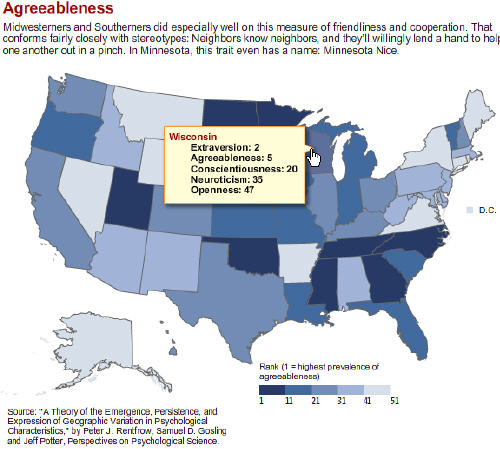
    Many of my clients are from outside the Midwest. I’ve always thought they chose us over other marketing technology firms because the home of Laverne and Shirley is thought of as hard-working. Turns out, they just like that Wisconsinites are push-overs. According to research reported in the Wall Street Journal, Wisconsin rates high for both Extraversion and Agreeableness. Surprisingly, we’ve only in the middle, in terms of Conscientiousness. Here’s the map, with results for Wisconsin showing higher ratings closer to zero:

    Wisconsin's Personality Scores

    I wish I could say Wisconsinites, in most cases, are open-minded. Not so, says the numbers. But I’d like to think that our offices being in Milwaukee and Madison means we buck the state-wide trend.


    Don’t forget MOCTOctoberfest!

    Speaking of Wisconsin, if you’re in the Milwaukee area, don’t forget that tomorrow night we’re having a Milwaukee Interactive Marketing social event, at MOCT. Read all about it and plan on attending!

  • Get to know Milwaukee interactive marketers at MOCTOctoberfest

    If you’re in Milwaukee and part of this crazing industry, come mingle with others similarly afflicted. This Thursday night is MOCToberfest! It’s going to be a fun evening of socializing and shop-talk, at Moct Bar, on 240 E. Pittsburgh Avenue here in Milwaukee.

    Registration is cheap and the venue is cool. Here’s one review of Moct from CityVoter.com:

    Moct is simply the best nightclub in Milwaukee … it is the closest you’re going to get to an LA night club … Great atmosphere, lots of intelligent space.


    The event starts at 5:30 PM on Thursday. For members, it’s just ten bucks — fifteen for non-members. The price includes appetizers. It’s a cash bar.

    “Mix, Mingle, Make it Work!”

  • WOM marketing, TwappyHour and Web414 meeting all help to explode myth of online social networks replacing “meatspace”

    Mingling at a Business Marketing Association luncheon yesterday, outside the conference room with my fellow “Hello, my name is” attendees, I said something quite naive. I was chatting with a couple of our interns. Referring to the topic of the presentation, word-of-mouth (WOM) marketing, I said, “What we’re going to hear today will be far more relevant for you both than for people of my generation.”

    My assumption was that the speaker would talk almost exclusively about using online social networks to generate WOM buzz. I couldn’t have been more wrong. The key case discussed by Spike Jones‘s excellent presentation was how his agency, promoting Fiscar scissors, identified those passionate about scrapbooking and fascilitated meet-ups.

    True, there was a large social network component, complete with forums and blog posts. But once web-based connections were made, Spike’s agency created opportunities for scrapbooking enthusiasts to meet face-to-face. They met for weekends of shoptalk and bonding.

    Social network tools simply acted as catalysts. They were, in essence, meatspace delivery systems.

    Wikipedia defines meatspace as “referring to real life or the physical world … the opposite of cyberspace or virtual reality.”


    Yes, We’re Digital Eggs — But We’re Also Flesh-and-Blood Chickens

    Richard Dawkins, in his controversial articles, books and speeches, reminds us that all life beyond the simplest single-celled entities is digital. He put it like this: “You contain a trillion copies of a large, textual document written in a highly accurate, digital code, each copy as voluminous as a substantial book. I’m talking, of course, of the DNA in your cells.”

    This genetic information reproduces itself more along the lines of a computer file making a copy of itself, rather than the way a photocopier reproduces off of itself. When you make a photocopy of a photocopy, very quickly things get grey and murky. With computer files, as with DNA, there is theoretically no information lost. Things replicate exactly (hard drive flaws and genetic mutuations notwithstanding).

    In his book River Out of Eden, Dawkins helps to clear up that old chicken-and-egg conundrum. Sort of. He says we’re all fundamentally eggs (DNA), programmed to keep our species alive via reproduction. But here’s the rub: Eggs can’t reproduce unassisted. They need to grow into chickens. In this way, Dawkins contends that chickens are the eggs’ strategy for producing more eggs.

    Thinking of our own flesh and blood as essentially a means to replicating our species’ string of digital information is something peolpe take several ways. They consider the paradigm either humbling, inspiring or alarming, depending on their theological perspective.

    For some, in this networked age, Dawkin’s universe of pure information can be seductive. We can sometimes forget that in this digital banquet of the computer-mediated communication, first and foremost, we’re mammals.

    And we’re particularly pack-oriented mammals at that.

    Online Social Networks Abet Meet-ups

    If Spike’s presentation didn’t remind me of the importance of face-to-face meetings (and it was, after all, held at a physical banquet room), my evening certainly did. I left work for two more meet-ups — both made possible through online social networks.

    First, I met a group of new and long-standing friends facilitated by Twitter. Appropriately, it was called a TwappyHour, a term coined by organizer Augie Ray. It was a great way for me to put faces to Twitter “handles” I’d been communicating with for months. As Sam Dodge put it, “Meeting people this way after knowing them for so long online is pretty cool, but also kind of creepy.”

    True enough. One thing that took away some of the oddness of it all was the atmosphere of our “Tweet-up.” It was The Iron Horse Hotel, a new boutique hotel at the foot of the 6th Street Bridge in Milwaukee, within wheelie distance of the new Harley Davidson Museum. Owner Tim Dixon gave this group of 20 or so Twitter-ers a tour of his amazing hotel.

    The Iron Horse Hotel

    I was particularly fascinated by Tim’s account of the rigorous market research he did as he planned his hotel, which is targeted to the surprisingly intersecting groups of motorcyclists and business people.

    I’m looking forward to more of these TwappyHour sessions. Thank you again, Augie (and his lovely and charming wife Geri, owner of Metropawlis, for the discerning pet!) for making this amazing event possible.

    After that, I headed to my first meeting of Web414, which was another demonstration of how computer-mediated communication still hasn’t replaced sitting together around a bowl of snacks. The topic was how to make the next BarCamp Milwaukee better. It was a fun introduction to both the group, and to the “meatspace”: Bucketworks. I’ll be returning to both often.

    If I sound like a gushing gossip columnist as I recount my night, I can be excused. It’s all because I left both events exhilarated by the new friends I’d made, and with deepened connections to some existing ones. I’m forever grateful for the work I do, not because of the cool computing (although I would lie if I said that didn’t matter somewhat), but for the quality of the friendships and associations I’ve made through them.

    To everyone with whom I shared this memorable night: I’ll see you online — and at future meet-ups.