If you’ve been wondering why I’ve been so silent lately, it’s because I’ve been in the midst of a major career move. Those of you who know me well are used to my willingness to dive into something and master it. I’d like to think there has been a pattern to it all — that there’s a method to my madness.
To explain how my 20-plus year career has led me to find Accenture (and them to find me!) I’ve put together this video. Enjoy!
In the internet before Google, Yahoo was the leading search engine. To be more precise, Yahoo was a web directory. That’s an important distinction, because it meant ranking high in Yahoo (back then) required a single editor’s effort. Yahoo editors approved or overrode recommendations for how sites might be categorized in their directory. This was kludgy, imprecise, and definitely not scalable for a fast-expanding web.
Google changed everything. Their search spiders scour the web and look at how peer sites link back to yours. It’s overly simplified, but for the most part, here is the equation if you want high Google placement for your site:
Number of Peer Site Backlinksmultipied byThe Authority of Those Referring Sitesequals The Magnitude of Your Chances of Ranking High in Search Engine Results
In today’s Google-dominated search environment, backlinks are king.
7 ways to boost backlinks to your site
Most search engines have followed Google’s lead, and to at least some extent take into account the quantity and quality of sites linking back to you. Here are seven types of backlinks for you to pursue:
Vendor Sites — If you use specialized supplies in the course of your business (anything from custom mailing labels to MRI devices), talk to your vendor about linking back to your site. And don’t hesitate to suggest specific keywords to use when pointing back to you (more on that at the bottom of this post).
Organization Sites — Any site from the Chamber of Commerce to the Better Business Bureau can be a referring site for you. Make sure you’re listed there and listed properly. These geographically-specific sites are especially important for businesses that are in some why land-locked in their marketing. These local sites help search engines rank you in regional searches. (Example: Last time I checked, this site ranks #2 in Google for “milwaukee marketing technology analytics”)
Community or Non-profit Sites — Are you involved in any charitable work, or do you support local or national causes? Talk to their sites’ managers about being acknowledged with a link. Also, it’s good marketing to tell the world about the ways your business is helping to make the world a better place! It certainly can’t hurt to provide a page of your own, called something like “XYZ Gives Back,” where you show a little gratitude and link back to them.
Press Release Services — Services such as PRWeb help spread news about your site throughout the web. If these electronic press releases are properly worded (again, think about key words people search on!), they can do much to send you both business and boost your search rankings.
Blogging and Twitter Strategies — Done poorly, backlinks from blogs and micro-blogs (such as Twitter) can come back and bite you. But done sincerely, you can share information about your business to audiences who care. And many of these types of backlinks carry considerable search engine mojo. Check out this famous four-minute video for a primer on how an interconnected web of social links helps make for a better online experience.
Reputable Directory Listings — There are a few reputable directories out there you should consider submitting your site to. Yahoo stills has its directory. The DMOZ Open Directory Project is also worth trying (although its editors are volunteers, and I’m unsure how successful new entrants have been in getting listed). You definitely can get into The Best of the Web, however, and should. Industry-specific directories can also turn out to be a good source for reputable backlinks.
Comments on Social Sites — Join the social network conversation, and be sure to include your web address in your comments (comment forms all have a field you can fill out for this purpuse). Be helpful and courteous. Do not self-promote. Follow this advice and you will find that your site will receive some direct clicks from the comments. A handful of curious readers will inevitably investigate the source behind the contribution. But more importantly, some search engines appear to consider these types of backlinks in their algorithm.
One Last Backlink Tip
I mentioned in #1 above to not hesitate to suggest that backlinks be hyperlinks with the key words you care most about. Instead of having the link mention your business name, consider having it mention the line of products you’re known for — in the language your prospects typically use when they are searching for a source. But be careful about spreading the same phrase to all backlink sources.
The reason is search engines are vigilant about sniffing out marketers trying to game their system. One way is looking for identically-worded backlinks … especially those that spring up nearly at the same time. These can flag your backlinks as potentially coming from a “link farm.”
That said, all of the tips above are “white hat methods” of helping people find what you have to sell. In a way, these backlinks are nothing more than good, electronic word-of-mouth advertising.
A newly-launched iPhone application allows Google searches through voice alone. This brings us closer to when non-computing types can work and play in a Web 2.0 world. Imagine: If this future comes to pass, productivity increases in many industries would be huge.
More significant to us marketers, large swaths of the workforce will no longer consider the computing world to be hostile — or at the very least, impenetrable. As I speculated two years ago many workers simply will not make portable computing a habit until it is easy enough to do through speech alone.
You might consider this Part II of a two-part post. Last week I reported on Powerset, Microsoft’s acquisition in semantic search. Now, here is an exciting stride in the the voice-recognition half of the hands-free computing equation.
Both Yahoo and Microsoft already offer voice services for cellphones. The Microsoft Tellme service returns information in specific categories like directions, maps and movies. Yahoo’s oneSearch with Voice is more flexible but does not appear to be as accurate as Google’s offering. The Google system is far from perfect, and it can return queries that appear as gibberish. Google executives declined to estimate how often the service gets it right, but they said they believed it was easily accurate enough to be useful to people who wanted to avoid tapping out their queries on the iPhone’s touch-screen keyboard.
The service can be used to get restaurant recommendations and driving directions, look up contacts in the iPhone’s address book or just settle arguments in bars. The query “What is the best pizza restaurant in Noe Valley?†returns a list of three restaurants in that San Francisco neighborhood, each with starred reviews from Google users and links to click for phone numbers and directions.
The emphasis above is mine. Here’s a demo of the new Google app for the iPhone:
This is going to get very interesting, very fast.
As Raj Reddy, an artificial intelligence researcher at Carnegie Mellon University, reported in the NY Time’s piece: “Whatever [Google] introduces now, it will greatly increase in accuracy in three or six months.”
The semantic search problem, when solved, will help computers understand what people are saying based on their wording and a phrase’s context. On the other hand, voice recognition requires something at least as daunting: Penetrating regional accents. The most visible flaw in this first full week of the iPhone app’s release is it is baffled by British accents.
The next time you need something out of Wikipedia, see if you can find it more quickly using this impressive application.
“Hearing” and Understanding
When I call the technology a toy I’m joking, of course. Accounts are that Microsoft is incorporating Powerset’s app gradually into Live Search. There is another use that’s hinted at in the way semantic search renders answers. It’s a far more exciting prospect than another web-based search engine.
Consider the implications of this technology once voice recognition via cell phones improves.
As I’ve speculated before, we’ll witness the true power of mobile computing when the voice barrier is broken. This voice barrier is a two-fold problem. As with human cognition, there is the problem of accurately hearing, and even more difficult, the problem of understanding.
Powerset’s semantic search shows progress in tackling that second half of the equation.
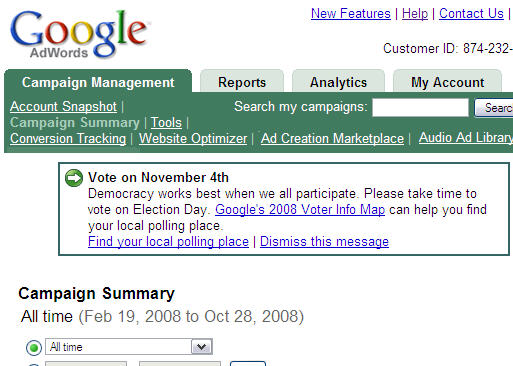
If you didn’t know there was an election tomorrow (yeah, right!), Google wishes to remind you. Amidst typical alerts on its Adwords dashboard to adjust your bids or review your budgets, they’ve posted the following:
This has to be a first for the company — and for that matter any ad network — to provide a civic-minded nudge along with its business notices.
Consider yourself duly alerted. (And yes: Please do vote!)