CareerBuilder’s plans for grabbing and keeping Sunday’s Superbowl viewers

Written by Jeff Larche on January 31, 2008 – 8:02 am -

Like millions of other Americans, I try to catch the Superbowl every year. But I’m a marketer, so my priorities are warped. With DVR remote in hand, I often time-delay the event by 45 minutes at the outset. This is so I can fast-forward through the often painfully one-sided game (and yes, Ron, your Pats will cream the Giants), and focus on the commercials. Laptop at the ready, I hop from one web address advertised to another, seeing the latest trends in corporate integrated marketing. Less strenuous than birding or trainspotting but just as geeky, I chalk the task up to research. But with this research, drinking pale ale is mandatory.

This year CareerBuilder is whetting my thirst for — ahem — knowledge with teaser emails. As usual, they are using the spendy ad space to kick off their annual ad campaign. Something tells me there will be a cool viral microsite to go along with it, to keep the $3 million (which is the reported cost of one of this year’s 30-second Superbowl ad slots) working throughout the year. Here’s their email to me:

CareerBuilder Email From Tuesday

Notice that I turned off the graphics to help you focus on the content. Kudos to CareerBuilder for constructing an email that “looks good naked.”

I’ll see you online, CareerBuilder!


Tags: , ,
Posted in Email Marketing, Web Marketing | 2 Comments »

PRISM, a bricks and mortar store analytics effort, takes its cue from e-stores

Written by Jeff Larche on January 28, 2008 – 7:53 am -

It seems improbable that there was ever a time when skilled marketers didn’t use at least some traffic data to make improvements to their sites. The availability of this data, no matter how flawed, has been a chief impetus for the growth of web marketing as a discipline. The comparison was always with the dearth of similar data from bricks and mortar stores. Here are a few specifics:

Stage of Purchase Web Metric Store Metric
Initiation Unique Visits Foot Traffic Counts
Consideration Page Views None Available
Completion Transactional Data Transactional Data

This list is over-simplified, but it makes a point. In the Consideration Stage — between the time when the door store swings open and the time the purchase is rung up — there is little to help the bricks and mortar marketer understand the motivation of the customer.

By comparison, a web marketer has a full toolkit of metrics. There are page views to show visits to specific product pages and web site sections, exit pages to show when a consumer decides to leave without buying, and shopping cart abandonment metrics to show exactly when a consumer decided to stop his or her purchase.

This stark difference is changing fast.

PRISM (short for “Pioneering Research for an In-Store Metric”), is a Nielsen Media / In-store Marketing Institute co-production. Working with a consortium of retailers and consumer-goods manufacturers, the duo completed a test recently using sensors placed at key points in over 160 stores around the country. These sensors monitored the entrances and exits, as well as some store aisles, composing data sets and even heat maps of customer-traffic patterns.

In a way that is uncannily similar to web analytics, the PRISM system combined these traffic data with transactional information. The end game is to achieve greater insight into consumer behavior.
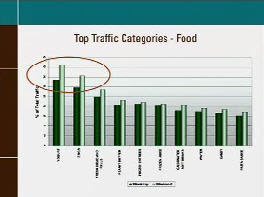
A chart from the videoAs you can imagine, the potential for improving the in-store experience is huge. Just as web marketers have walked away with significant improvements to their sites through web analytics, these marketers are nearly giddy with new-found knowledge. At least, that’s the impression I’ve received by press accounts of PRISM. This piece in In-Store Marketing Institute’s site is characteristic of that excitement, particularly in this accompanying Flash and Quicktime video. (Warning: The video is all talking heads. Sadly, demonstrations of the system at work are being held closely under wraps.)

Here is a typical insight, disclosed in the video by David Calhoun, CEO of the Nielsen Company:

“In some food stores, the heaviest traffic flow is not through the carbonated beverage and snack aisles — which might be the conventional wisdom based on sales rates — but through the yogurt and eggs section of the store.”

The chart above shows this (but not very well — it was captured from the video and only Calhoun’s narrative can identify the categories), with the two circled categories being the Yogurt and the Eggs sections.

Since the advent of web analytics, physical world marketers have looked at us web marketers with envy. It appears their time to play next to us, in the sandbox of database marketing, is just around the corner.


Tags: , , , ,
Posted in Database Marketing, Web Marketing | No Comments »

Yes, you’ll like the music: The Smart Party system can read you like a playlist

Written by Jeff Larche on January 20, 2008 – 8:58 pm -

It’s tough to be a host. Will your guests like the snacks? Is there enough room to mingle, and proper ambiance to encourage conversation? And what about the music?

This is no idle concern. In the days of special events that support your brand, your role as marketing technologist suddenly makes you responsible for enhancing the proceedings with the proper tunes. And musical tastes vary widely!

Luckily, UCLA computer scientists have been on the task, and they’ve developed the Smart Party system. It polls the musical preferences of your guests by reading the playlists in their WiFi-enabled music devices.

As excerpted below, a recent NewScientist item (subscription required), reports that this novel approach to “reading your audience” works by getting inside your guests’ purses and pockets:

The [system] takes a poll of titles to work out the most popular genre and can also copy and play tracks from each device. It can then play music from the most popular overall music genre or tracks supplied by each party-goer in turn.

Pretty cool stuff, although the article goes on to mention the obvious: digital rights management (DRM) may make this system a violation of copyrights.

But I’m not as impressed with this innovation as with the direction that today’s innovators are taking. Before in this blog, I’ve posited that more than anything, portable marketing is about place. You’ll succeed as a marketer by enhancing experiences in a physical location at a particular time.

News of the Smart Party system suggests that a lot of others are focusing their imaginations on making a place-based experience more personal, and ultimately more memorable.


Tags: , , , ,
Posted in Mobile Marketing | 3 Comments »

Your web site’s messages should show a little humanity

Written by Jeff Larche on January 18, 2008 – 10:22 pm -

It’s simple. The reason for Apple’s spectacular success is that, although the human mind is capable of impressive calculation, what makes it uniquely human is its ability to dream.

When they aren’t trying to parrot what Windows-based machines do, most Apple products promise a more fertile ground for right-brained thinking. Mostly these products succeed. And they do because they touch us in the heart at least as much as in the mind.

Now think about your web site. Is it still behaving as if its users are more robot than human? Watch out, because your competitor’s sites might not. They may realize that the most buttoned-down web users haven’t forgotten to smile.

Author and public speaker Daniel Pink made this point, but on a more global scale. His book from two years ago, A Whole New Mind contended that as workers in a new, Conceptual Age, we need to sharpen these six skills: design, storytelling, creative collaboration, empathy, play and rendering meaning — although he labeled them far more colorfully than I just did, which is why he is the famous business author and not me.

Lately he’s been talking about using empathy in public messages. Once again, he was speaking more globally than messaging on web sites. But just review some of these examples and see if you aren’t inspired to breathe some warmth into your site’s content:

Restaurant Sign:
Don’t worry, this line moves really quickly.
Movie Theater Electric Hand Dryers:
We don’t like them either, but they are the most energy efficient and environmentally-friendly choice.
Hong Kong Airport:
Relax. Train comes every two minutes.

These three have one thing in common. They respectfully ask us to take a breath and side with the human being who is delivering the bad news.

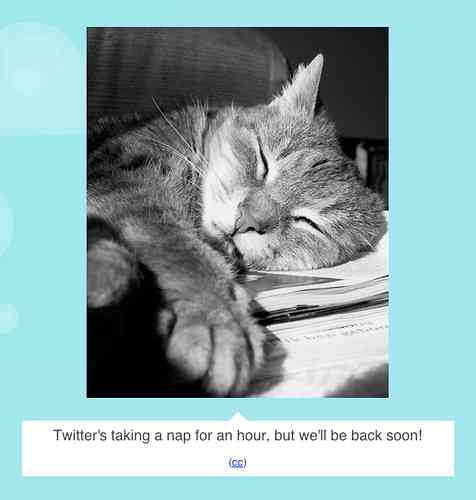
How can this relate to your site? One of the most lighthearted set of web error messages come from the disruption-prone Twitter site. Although the originals were LOLcats, the latest batch — such as this one — take a more conventionally cutesy tack:

A typical (and all too frequent!) Twitter error message

Is this frivolous — therefore below consideration for your site?

That depends. If your current error messages are pushing people over the brink, you’re losing business. There is nothing warm or cute about that business reality.


Tags: , , , , , ,
Posted in Online Copywriting, Web Marketing | No Comments »

“They all laughed when I said I’d use this headline …”

Written by Jeff Larche on January 15, 2008 – 5:29 pm -

“– but then it began to work!” For those of you who have made a study of ad writing, you’ll recognize the name John Caples. His work continues to be extensively studied and copied. Not too shabby for someone whose seminal book, Tested Advertising Methods, was written almost 80 years ago!

Workers or Wackers? CareerBuilder AdHow often is his work mimicked?

Well, how often have you seen an offer for a guide that offers “12 secrets to X,” or “9 tested ways to Y?” Perhaps a million times?

Each writer of those headlines was — knowingly or not — following in Caples’ footsteps. I was reminded of how common these offer headlines are, especially online, where free whitepapers abound, when I saw this recent ad for CareerBuilder (the image to the right). Thank you, by the way, to Adverlicio.us for tipping me off on this one. You can see their Flash animated version here.

And that inspired me to do a Google search for all mentions of the phrase “They all laughed when I.” These happen to be the first five words of Caples’ famous headline for a music correspondence school: “They all laughed when I sat down at the piano — but then I began to play!”

It’s a killer lead that broke all the school’s sales records, paired as it was with gutsy, testimonial-style direct response copy (example: “Someone asked about the maestro’s execution. Someone else called out ‘I’m all for it.’”).

So how many online ad writers are using this technique? The Google results suggested as many as 731 matches. Here are the top five, to give you an idea how this technique is being applied:

  • They All Laughed When I Said I Could Turn Their Relationship Around In Just 10 Minute.
  • They All Laughed When I Spoke of Greedy Doctors
  • They all laughed when I said I was going to tell a joke. Well, they’re not laughing now.
  • They All Laughed When I Sat Down at the Computer: And Other True Tales of One Man’s Struggle With Personal Computing.
  • They All Laughed When I Said I Was Going To Become A Millionaire… But Then I Did It In Only 4 Years!

And then there is this one, which comes the closest to Caples’ original (it even includes quotes, which Caples said was de rigour):

“They All Laughed When I Told Them I Don’t Spend A Penny To Promote My Website — But When I Showed Them My Web Stats!”

In what I suspect will come to be known as the Golden Age of Internet Marketing, it’s fun to see just how much hasn’t changed since advertising was in its infancy.


Tags: , , , ,
Posted in Web Marketing | No Comments »

Today record labels may find digital rights management less easy to defend

Written by Jeff Larche on January 11, 2008 – 5:59 am -

The adage I heard as a kid was, “Why would anyone buy the cow if they can get the milk for free?” True, these sages of my youth weren’t referring to music downloads and DRM (digital rights management). But record labels with much to lose financially have used this argument to defend their aggressive protection of their artists’ intellectual property. They have to be troubled this week by news of Radiohead’s In Rainbows topping album sales charts — in spite of the band’s offering this CD months ago for download, unprotected and at whatever price a listener would like to pay (including nothing at all).

Radiohead wasn’t the first to act on the urge to give fans a voice in setting the monetary worth of their music. One of the first artists was Issa, formerly known as Jane Siberry. As I’ve written before, this is an online business model not unlike street corner busking — in a way returning artists to their performing roots. Radiohead is, however, the most prominent group of recording artists to try this model.

Now, according to a New York Times account released late Wednesday, the band — and their recording label — are reaping an unexpected windfall from this experiment in open source music. Here is an excerpt:

In a twist for the music industry’s digital revolution, “In Rainbows,” the new Radiohead album that attracted wide attention when it was made available three months ago as a digital download for whatever price fans chose to pay, ranked as the top-selling album in the country this week after the CD version hit record shops and other retailers.

The album, the first in four years from the closely watched British rock act, sold 122,000 copies in the United States, according to Nielsen SoundScan.

Part of the reason I find this fascinating is, frankly, personal guilt. This news helps assuage any feelings I might have about copyright violation. Like millions of others, I too occasionally trade digital copies of CDs I like with a friend or two. I tell myself this is ethically acceptable, because it promotes music that my friends might not hear otherwise. In my defense, these friends are hardly a mainstream bunch.

They listen to long tail music.

That means chances are slim they would otherwise sample a given artist’s music. What’s more, these folks are the sort to glom onto an artist they like. They may wind up buying all of that artist’s work (yes, I’m thinking of you, Michael!).

As a business model, I wonder if all long tail artists and labels might benefit from “legal” DRM-free distribution. Perhaps DRM should be removed from any downloadable CD that doesn’t meet a certain sales level. And perhaps the stigma should be removed from ripping and sharing (one-on-one only, not using peer-to-peer online pirating platforms).

Call it a crazy libertarian streak, but I’m the type to wonder about decriminalizing other activities whose overall harm is in serious dispute. This latest news raises the “dispute level” for me of this common little “crime.” It makes me wonder even more about the real financial harm done when a CD by a relatively obscure artist is shared at no charge.

What do you think?


Tags: , , , ,
Posted in Long Tail, Web Marketing | 3 Comments »

ProjectStars CEO describes how this new site blends job board with social networking

Written by Jeff Larche on January 7, 2008 – 3:44 pm -

I’m returning from a holiday hiatus with recharged batteries and major content changes to Digital Solid. Come back often or subscribe to find exclusive interviews with online news-makers, plus more news and tips you’ve told me you appreciate as marketers in an increasingly technological world.

Michael Beddows - CEO - ProjectStarsTo kick things off in 2008, I’m thrilled to bring you an interview with Michael Beddows, CEO of the new projectstars b-to-b online social network. This site is part project board, part social network and part blogging cooperative. It’s a novel mix that has already attracted an impressive critical mass of participants.

Q: projectstars has been around for almost four months. Has the growth you’ve seen in that time surprised you, or was it about what you were expecting?

MB: Considering that our marketing over the past few months has consisted entirely of word-of-mouth, we’re very pleased with both the quantity and quality of our membership growth. This organic growth has also provided us with some great feedback on how we can refine our equity blogging approach.

Q: In a blog entry you mention that there are generally three types of online communities, and they mirror the Malcolm Gladwell The Tipping Point connector types. Of the three, projectstars is a “Maven” network, where you’ve written, “Content is king … For those who are knowledgeable, these [Maven] sites are a great place to showcase expertise and get discovered.” Can you name other communities that follow this “maven model,” where members are encouraged to promote themselves and their expertise?

MB: LinkedIn has an Answers section where members can vie to be nominated as the “Top Expert.” The difference with projectstars is that our members are not restricted to a Q&A format and can participate in more engaging conversations. projectstars is also more amenable to search engine optimization, which means that our member contributions are more discoverable in search engines. It’s one thing to be seen as an expert within the confines of LinkedIn, quite another to be seen as an expert on the Internet at large.

Q: Your site says that you’re “blurring the line” between job sites and business/social communities. This is extraordinary enough, in that I’ve never seen another site that is certifiably both, as yours is. But what has struck me as more novel is that your business model sounds a lot like a cooperative. A week ago you conducted your first share giveaway, where 100 members with the most earned points receive their shares in the business. This sounds unique for a social network site. Is there any other community that you’ve modeled this against?

MB: We believe we are the first social network to offer members shares. We think this is the way any online community should operate as it’s the members who make the community. It’s quite possible that someday, many social networks and blog communities will become equity blogs, where members band together to form a cooperative.

Q: Speaking of blurred lines, I like the Facebook login feature, which allows anyone who is already part of Facebook to register with projectstars from a page within Facebook. I was curious how the tie-in would benefit me, and saw that friends in Facebook who are also on projectstars are immediately identified and added as a projectstars buddy. What a cool way to tie the two communities together. Has this Facebook connection helped spread the word about projectstars?

MB: With so many sites out there, anything which makes registration easier is good in our books, so the Facebook login helps in that respect. We are also developing a Facebook application so that your projectstars blogs will show up on your profile and others can vote on them - once this is completed we do expect that will help spread the word.

Q: Are you optimistic about future tie-ins with other social networks through OpenSocial? How is this work progressing?

MB: We are members of the OpenSocial development lists and are tracking progress closely, however OpenSocial specifications are still in development so we expect it will be later in Q1 2008 before we see anything from projectstars on this front. We are also investigating the possibility of projectstars itself being an OpenSocial container. projectstars members can already set up their own personalized page of projectstars content, RSS feeds, and widgets at my.projectstars.com so this would be an ideal place to host OpenSocial apps.

Q: Blogging is a great way for domain experts to show off their knowledge. On the other hand, many of these same people already have one or more blogs. Are you looking at ways to port “outside” blog content into your site, or do you simply want to encourage bloggers to move their tent within the walls of projectstars?

MB: We did investigate linking members blogs to the system, however there were two problems with this. First, the projectstars community structure means that automating where posts appear is not easily possible, and second we realize that although people do have their own blogs, they don’t always blog about one subject, and sometimes blog about personal/life issues. As we want to keep projectstars content focused on the topics provided by the 300 communities, we decided to enable blogging within the system.

Read more »


Tags: , , , , , , , , ,
Posted in Long Tail, Social Networks, Web Marketing | 5 Comments »
RSS