Twitter’s sudden celebrity will soon become a fight for relevance

Written by Jeff Larche on March 28, 2007 – 8:12 am -

Twitter is a way to broadcast via your cell phone or computer. What do you broadcast? Whatever is immediate and local. You disclose your thoughts, observations and whereabouts — and anything else you can fit within a 140-character limit text message. Here’s an unofficial Twitter wiki. Its Press and Media section has links to some of the latest buzz on this social media app.

Twitter appeared quickly and will, in my opinion, flame out just as fast. Once it has died back down to a glowing ember, I suspect it will reside where it seems most suited: with younger students and others with plenty of time, a big friends list, and a high opinion of their own text-messaged voices.

Because your cell phone can get deluged with “Tweets” (one attendee of the SXSW conference in Austin reported receiving 3,000 of them during her time there), it appears that most people finally turn the mobile feature off. Who of us, after all, has an unlimited text message plan and a high tolerance for deleting messages as fast as they arrive?

But turning off the ability to receive these messages on my cell phone takes away one of Twitter’s major appeals: The ability to “microblog” from anywhere, and read other people’s insights dashed off from whatever house party or night club you weren’t able to get to.

I’m always looking at these phenomena for how they might bubble up into the generations of working stiffs who are hoping technology can aid their productivity — or ease their workday the way a smoke break used to when more people smoked.

This technology has me curious, but unless there is some improved way to filter the spamming effect I don’t see Twitter as surviving the battle for mainstream relevance.


April 17, 2007 — An update:This weekend I succumbed. I needed to experience Twitter for myself, especially since I was reading intriguing comments on other people’s blogs, including this one. Keeping the mobile component turned off, I created this account: http://twitter.com/TheLarch (yes, I dropped my name’s trailing “e” — it’s a silly Monty Python joke).


I’ll do a new entry soon with my thoughts.

Tags: , ,
Posted in Mobile Marketing, Social Networks, Web Marketing | 5 Comments »

How to make a direct mailing break through the clutter

Written by Jeff Larche on March 24, 2007 – 8:51 am -

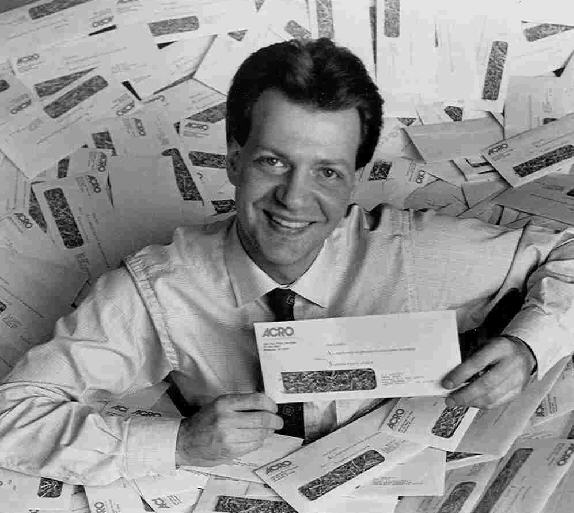
The most successful business-to-business mailing I ever produced was early in my career, for a company called Acro Automation (http://www.acro.com*). It was a lead generation letter, mailed in a standard window envelope. But the envelope was stuffed with a wad of real shredded money. I bought the tangled remains of one-, five-, ten- and twenty-dollar bills direct from the U.S. Treasury, in eleven pound boxes. Each was enough to fill approximately 2,500 envelopes. Showing money fragments through the window of the envelope, along with a printed teaser that explained their relevance, was enough to trigger an 11% response rate from a notoriously non-responsive audience of production engineers.

A publicity shot of me with the Acro envelopes, back when I still got carded in barsShortly after that mailing the government called an abrupt halt to the sale of this byproduct of monetary obsolescence. They apparently didn’t appreciate my use of ex-money to generate more of the real stuff. But the lesson had been duly noted. I had learned how to reach out and grab the reader by the imagination: Be unique and outrageous.

I was reminded of this lesson when I read Seth Godin’s account of marketing one of his books. Read his story and take heed. Reconsider that me-too mailing you were planning for your next promotion. Why settle for average when you can break records — and in the process, accumulate great stories, such as mine about the Treasury, and Seth’s about his similar, bureaucratic battle with International Paper?

*I had nothing to do with their current web site, by the way, but I was involved in the acquisition of their four-letter domain name. At the time I had no idea how rare these would become. I was also responsible for another one of those: www.sofa.com. If I only knew then what I know now, I would have treated these as the valuable client assets that they are!


Posted in Direct Response | 3 Comments »

Imagine a web site without a click

Written by Jeff Larche on March 20, 2007 – 7:44 am -

Thank you to The Thinking Blog for tipping me off to this amazing Flash-driven site where you experience web browsing without using your mouse button. The demonstrations provided can be quite disorienting, but the site reminds us that web navigation is continuing to evolve. Some of the techniques are already used today.

Ilker Yoldas, the blog’s author, suggests that this experience could be the interface used where a mouse button is impractical. He suggests the Wii. I’m also thinking about a giant touchscreen, where tapping is less intuitive than simply dragging one’s finger.

I strongly suggest you check out both www.dontclick.it and Ilker’s blog entry about it. And while you’re at his site, for pity’s sake, don’t shoot the dog!


Posted in Web Marketing | 2 Comments »

You’re it: Tagging, social bookmarking and marketing

Written by Jeff Larche on March 18, 2007 – 7:10 pm -

If the internet is getting smarter, it is only because we are being carefully watched. The video Web 2.0: The Machine is Us/ing Us brilliantly demonstrates what I mean. It shows an internet that has become more valuable by connecting us through observed preferences.

A link to the Web 2.0 videoThose preferences are observed through our past behavior — always the best predictor of future action. The video explains: “100 billion times per day, humans are clicking on a web page … teaching the Machine what we think is important.”

I recommend you follow this video, by Michael Wesch of Kansas State University, through to its completion. The payoff is fascinating and sobering.

Some of this behavior is passive.

Merely clicking on a web page, for example, is something that even my mother does. She needs no special training or instruction. Yet systems such as the recently unveiled Google Personalized Search are improving her browsing experience by customizing content based on her past searches — and even her web browsing history.

Don’t think this has gone unnoticed by those in the search engine optimization business. Google Personalized Search is a major shift in the optimization game, a phenomenon that’s sending us all back to our playbooks.

Other behavior is more active.

Specifically I’m talking about the type of tagging that takes place in online social networks. According to a recent Pew research study, “28% of internet users have tagged or categorized content online such as photos, news stories or blog posts.” On any given day, this report says that 7% of internet users have tagged or categorized online content. To put that in perspective, that’s seven times the number of people who on that day have listened to a podcast.

So who is doing all of this tagging? Not surprisingly, they’re more likely to be under 40, with higher than average incomes and education levels.

Pew has no way to report on whether this tagging behavior is growing in popularity. This was the organization’s first ever research on tagging. But Hitwise reports that sites that enable tagging, such as Del.icio.us and Flickr, are gaining in popularity.

In just three months, according to Hitwise, Flickr grew in popularity by 140%. By that I mean that visits to this photo sharing site accounted for .029% of visits a week in January, up from less than .012% three months earlier.

In the same time span, Del.ic.ious traffic grew by over 600%. Visits to that online recommendation site increased to .0036%, up from .0005% in October, 2006. (Thanks for your help on these stats, Wendy Davis of MediaPost.)

Here’s a Wired rundown of some of the best tagging and social bookmarking sites. Tag, you’re it!


Tags: , , , , , , ,
Posted in Long Tail, Search Engine Marketing, Social Networks, Web Marketing | No Comments »

Vespa gains, then loses, brand traction using social media and the OTHER 1 Percenters

Written by Jeff Larche on March 16, 2007 – 8:17 am -

Hunter S. Thompson quoted a Hell’s Angel as saying ”We’re the 1 percenters, man,” meaning they are on the fringes — perpetually disconnected from the rest of society. Two years ago Vespa unleashed a different gang of cyclers by launching an alternative to a staid corporate blog. Vespaway has since died a sad internet death, but even its demise can teach something about how to harness the word-of-mouth power of your customers.

The gang that Vespa enlisted, also termed The 1 Percenters by authors Ben McConnell and Jackie Huba, is arguably among the most connected citizens instead of the least. In their book Citizen Marketers, McConnell and Huba talk about how:

Amateurs and professionals commingle to assume new forms of ownership in companies, brands, products … disrupting the traditions of the existing cultural filters and promoters. [The book is] also the story of how some organizations have embraced the new reality of participatory engagement, tossing aside the old model of the passive consumer.

In their book, they explain how the owner of the Vespa brand learned from research two key facts:

  • 65% of prospective motor scooter buyers visit the Vespa USA site (that’s good!)
  • 56% visit other sites to see what other people are saying about the scooters (that could be very bad!)

The company’s response was to give a few devoted fans their own blog. They were paid only in swag and passes to corporate events (both very persuasive incentives to bloggers, as you’ll read at the end of this post).

For a while the technique worked well, according to Paolo Timoni, CEO of Piggio USA, the owner of the brand. It’s hard to know for sure, since the blog site has been pulled. But it’s a sound strategy, and one I’ve seen working for other brands large and small.

Which brings up a couple of lessons on social media (the term favored by McConnell and Huba) — lessons not mentioned in the book, as far as I can tell:

  1. You’d better have a lot of recruits to replace those blogging volunteers who burn out
  2. Corporate gifts alone might not be enough to attract these writers

It’s an excellent book nonetheless, one that I am taking my time to absorb.

Which brings me to the full disclosure statement that I need to make. (Mine is inspired by David Weinberger’s — thanks, David). I’ve known Jack Covert, the CEO of 800CEOread for years. He’s a great guy who’s leading an excellent business.

Over the years I’ve spent hundreds of dollars on business books from his company. But Citizen Marketers was a gift, as was the comp I’ve received to attend their upcoming LeaveSmarter event.

This Thursday, March 22, 2007, Ben McConnell and Jackie Huba will be speaking at this latest installment of LeaveSmarter. It’s from 11:30 to 1 PM at the extraordinary Eisner American Museum of Advertising and Design — another Milwaukee, Wisconsin gem. All the details are here: www.800CEOread.com/events.

Incidentally, you may have read my review of the last book profiled in the LeaveSmarter series: Made To Stick. More full disclosure here: I paid full price for that one, from the Oakland Avenue Schwartz Bookstore, and was neither offered – nor did I seize upon — the chance to see those authors live. What was I thinking, man?


Update: Like verbing, another modern trend in the English language is the “schushification” of some words. It seems I just turned away for a minute and swag has become schwag.


Posted in Web Marketing | 2 Comments »

You to your cell phone: I’m feeling lucky

Written by Jeff Larche on March 13, 2007 – 1:13 pm -

If you want to watch your friends hyperventilate, just suggest that someday soon marketers will be monitoring their behavior on their cell phones, both in terms of buttons pressed on the device, and places the device is carried. Be kind, though. Resist the temptation, and don’t add that it may already be happening. Right now.

And so you don’t freak out right along with your friends, let me reassure you of two things:

  1. I am not doing this monitoring. No way. Honest.
  2. Those who are don’t care about you. They use totally anonymous data.

They have no interest in what you’ve been up to — if it doesn’t involve legal commerce. Ultimately, all they want to do is make your cell phone more valuable in your pursuit of the next purchase.

Mediapost recently interviewed GoTo CEO Lee Hancock about the future of behavioral targeting in the mobile phone space.

He talks about a world where your cell phone serves up relevant ads and opportunities the same way that (for example) Gmail, the email account from Google, serves us ads based on keywords embedded in our messages. In both cases, an automated process eavesdrops on you to a certain extent, but only in the service of customizing the user experience. It’s a good thing. And, I’m sure, this cell phone behavioral profiling will be something consumers can opt out of once it is refined and deployed for real.

How would this particular type of monitoring improve a cell phone experience? Here is Mr. Hancock’s example:

One way [that] interest, behavior and location [data] could work seamlessly together is: Say someone has downloaded Madonna song ringtones and goes to the movie menu frequently. An entertainment company promoting a new Madonna movie can target based on that content and behavior, but also focus on the specific movie theater near where that user is. Then a Starbucks nearby having a special Frappuccino offer can target their promotion or a Barnes and Noble nearby the theater can promote a new Madonna coffee-table book. Very powerful stuff, but obviously something that needs to be done responsibly.

My take on this is that it shows promise, but I wonder how these messages will be presented to the user. We know that cell-based ads are not drawing strong responses when they are embedded in a phone’s web browser. And I, for one, would not want an SMS (text message) ad showing up on my cell phone every time I pass a Starbucks or music store. No, I need to initiate the suggestion process and be ready to consider the opportunities it presents.

A Modest Proposal

What if my cell phone had a single, additional button. When pressed, it “rewards” me. The reward it sends my way would be customized, as Hancock describes, based both on my behavior and where I am physically.

Please bear with me a moment. I’m going to make another Google comparison to illustrate my point.

When that search engine was new, it usually delivered more relevant and correct search results than competing search engines, including the goliath Yahoo! directory.

Google was boastful. The search page ballyhooed this advantage by providing two “Search” buttons. These buttons remain to this day. One delivers the top ten results, as most other search engines do. The other button is called, “I’m Feeling Lucky.” It takes you to the top result. Period. If you’re disappointed, you always have the “Back” button. But more often than not — especially back then, when the web was a smaller and simpler place — you got what you wanted.

That Google button is not something I use, but I’m sure for many it is like the food lever in Skinner’s classic box we learned about is Psych 101. That lever delivered a pellet of food each time it was pressed. It trained lab mice to associate a reward with this action.

Now imagine I’m the mouse — er — consumer. I’m in a mall, let’s say, and I’ve got a few minutes to kill before my wife returns from a shopping sortie. And I figure: What the heck. I press the button on my phone … the “I’m Feeling Lucky” button. And I receive via SMS a list of offers that I am likely to welcome. I may even act on one or two of them.

Will this be a game-changing feature on my phone? No.

But like Dr. Skinner and those lab mice, the behavioral targeting geniuses will have caused me to associate the gathering of this type of data with a positive outcome: The delivery of customized goodies that I truly welcome.

The “Lucky” button will connect me in a far richer way with my surroundings. I’ll receive merchants’ offers, yes, but also, possibly, news about nearby friends who have also opted into the system, or even tips on events in the neighborhood that may have passed my notice.

I like it. The button feels right to me.

How about to you?

Would you press such a button? Are you feeling lucky?


Posted in Mobile Marketing, Permission Marketing | 6 Comments »

Should your brand spawn an online community?

Written by Jeff Larche on March 9, 2007 – 7:23 pm -

Some brands are clearly benefiting from their own online communities. Nike’s community is quite active, with over 57,000 members. The largest Blackberry community has nearly twice that number. Marc Andreessen is betting that more niche brands — as well as sports teams, community groups and hobbyists — will want to reap the same benefits.

I’m thinking he’s onto something, due to the new ways that consumers are interacting with brands, as well as the power of search engines to fuel these connections. It wouldn’t be the first time Andreessen has a winning hunch.

You may recall that in mid-’90, the sweetheart of the internet was Netscape. Marc Andreessen was co-developer of this free web browser. During Netscape’s zenith, he was on the cover of every magazine from Business 2.0 to Time. That’s before Microsoft moved into the browser business, and its Internet Explorer did to Netscape what its Word did to WordPerfect and Excel to SuperCalc. Microsoft has rained on a lot of parades. Andreessen got drenched. But also quite rich.

As reports these past few weeks have declared, he has invested his money in Ning, a way to “launch a social network with a few mouse clicks.”

Ning would take much of the pain out of testing an online community surrounding your brand. But is it a wise decision? Let’s put aside for a moment the legal considerations (liability for bad advice shared on your forum, for instance), as well as the logistics of moderating the thing.

Does this marketing tactic support your brand? I say yes, for the following three reasons:

  1. Your customers experience your brand but could not care less for your company. As David Raab eloquently put it, “Brands are movie stars. Companies own the theater.” An online community becomes a place in that theater to congregate.
  2. People will trash talk your brand regardless of whether you host a community sounding board. Sam Decker of Bazaar Voice contends, and I agree, that it’s better to have them do it on your forum than someone else’s. I’ve quoted him speaking about negative user-generated content (UGC) in an earlier post.
  3. Search engines can’t get enough of the UGC that these forum sites generate. They just love ‘em. Isn’t it better for people searching on generic brand features to find content about your brand as opposed to a competitor’s?

Does the prospect of an online forum about your brand scare you? It should. But you need to know more about online communities, and what better way than to launch a simple test? If not for your brand, how about for your church group? Marc Andreessen is preparing a well-stocked marketing laboratory just for you.

Want to check out a sample Ning-driven community? Here’s one on the evolution of broadcast and personal media.


Posted in Long Tail, Search Engine Marketing, Web Marketing | 4 Comments »

Mobile phones just want to be free

Written by Jeff Larche on March 7, 2007 – 7:55 am -

Your cell phone is capable of doing far more than you realize. Okay, not your phone specifically, but your model of phone could have been manufactured to perform some pretty useful tricks. These include preserving your contacts list on your computer, allowing you to more easily share photos and other media, and even tell you what talking on the device is costing you that month, in real time. What’s stopping this progress is not in dispute: Phone companies are scrambling to find ways to charge for these services.

It’s a story that sounds familiar. Two weeks ago I was fascinated to read all of the takes from readers on my music industry post. Its premise was that CD sales are falling because of a changing business model, and this changed way of doing business might be better served by removing digital rights management (DRM) protections. It’s an appealing idea if you’re Apple CEO Steve Jobs, who recently posted an essay, called Thoughts on Music, proposing this change. And it’s a terrifying idea if you’re a typical music label executive.

Similarly, if you’re Columbia law professor Tim Wu, you call the removal of cool features from a cell phone “feature crippling.” He presented a paper to the Federal Trade Commission last month, where he makes a compelling argument for using legislation to free the phone manufacturers to innovate. Currently, the features they build into cell phones sold domestically are dictated (he would say stymied) by the big wireless carriers: Verizon, AT&T / Cingular, Sprint Nextel and T-Mobil.

Mr. Wu makes his case on his blog, and in an interview on this week’s On The Media podcast. He calls the atmosphere “restrictive” of any significant application innovation, and quotes one mobile application developer who characterizes the atmosphere these restrictions have created as, “a tarpit of misery, pain and destruction.” Working every day with bright, imaginative application developers and designers, I can understand this developer’s frustration. Your cell phone really does want to be free.

The crux is how are these innovations to be paid for? Each new feature requires additional support, and that support has to be offset by increased revenue. And although new features offer an opportunity for greater profits, how do you get consumers to pay for them as a service? This argument was made in the On The Media piece by Chris Guttman McCabe, the VP of regulatory affairs for CTIA, The Wireless Association. He ultimately says regulation should not be imposed because competition and the free market is working in this industry, albeit slowly. Even Mr. Wu admits that although each of the big wireless carriers are restrictive, the degree to which they restrict this innovation varies greatly from one to the other.

It’s a tough quandary. I got extremely excited about the Microsoft Zune when I thought it could allow for the free exchange of music files and podcasts. Then I learned that DRM deals restricted sharing to “three plays or three days,” whichever comes first. After that the file you’ve exchanged goes away, even if it’s an MP3 produced by a struggling garage band that posts the very same MP3, for all the world to trade, online. Similarly, the new Apple cell phone, due for release this summer, is designed to work for only one carrier, AT&T / Cingular. That’s a big limitation.

Meanwhile, as the free market sorts this out, I’m using hacks to play music on my cell phone, and I’m using shareware and an expensive connection cord to sync my contacts list with my computer — even though both use Bluetooth. And if you want to see the photos I took last night? I only hope you use Verizon. Otherwise I can’t text them to your phone. Not at any cost.


Posted in Mobile Marketing | No Comments »

MarchFirst, Second Monday, and the scarcity of good domain names

Written by Jeff Larche on March 1, 2007 – 8:14 pm -

Today is an auspicious day, and not just because it’s the first ever One Positive Day. This is the eighth anniversary of US Web officially changing its name to MarchFirst.com. I recall realizing for the first time that the business world was running out of good dot-com brand names, and fast.

Back then, US Web was the fastest growing web development franchise in the country. They were hot stuff — super-heated, in fact, by the plentiful VC of the Dot Com Boom. When they chose the new name MarchFirst, they gave marketers such as myself a clear look inside their rebranding process.

To me the new name suggested a frustration – and ultimate resignation — over a growing domain name scarcity. Eight years hence, this scarcity has has only gotten worse.

I can understand why they had opted not to choose a non sequitur, like Amazon.com, or something flippant and undignified, like Yahoo!

They chose instead what I like to call the cocktail party story variety of brand name. It’s an opportunity for employees to tell something about their company, because saying who they work for at a cocktail party forces the question, “What does that name mean?”

Sadly, the answer in this case is hardly memorably, or instructive of the brand: “That’s the day we were renamed MarchFirst.”

When I started my first business in a new market, I chose a similar cocktail party story name. I chose Second Monday Direct Marketing. People would ask, and I would explain that in a direct mailing, the second Monday after the first day of response was often the best day of response.

It wasn’t a scintillating story, but it was novel. It also associated my business with direct mail and results. What’s more, it helped me say the brand name a few times during the course of the story, which was all that it took for people to remember it. The name was easy to say over the telephone, and spell. It made a good domain name.

If I had to name a direct marketing company today, however, I’d be out of luck, and not just because the factoid this name was based on is no longer true. SecondMonday.com went into circulation long ago, and has been scooped up by someone else. Just like nearly every other good domain name you can imagine.

More recently, I had luck with another cocktail party domain name, DigitalSolid.com. (If you want to hear the story you’ll have to invite me to your party.)

Second Monday is not availableThis week my team is embarking upon yet another “namestorming” exercise, for yet another client whose brand name will be inextricably tied to their domain name. Once again, the process won’t be pretty. It will require lists of hundreds of word combinations. There will be disappointing WHOIS searches –brief high hopes dashed by a message like the one on the right. When I try my luck with domain name ideas, I feel like the poor schmo in the convenience store, scratching off another lottery ticket that yields — zilch.

If there is any good news in this, it’s that the soul of good art (and branding is an art!) is constraint.

The boundaries of the rectangular picture frame actually free the painter, and the limitation of the 88 piano keys inspires the songwriter. Struggling as we have been with the ever-shrinking canvas of available domain names, I was inspired this morning to hear on NPR a story about Theodor Geisel, better known as Dr. Seuss.

He took the challenge of writing a book to replace the unbelievably boring Dick and Jane series of reading material. Seuss was on a noble crusade to teach six- and seven-year-olds how to read without prematurely sapping their will to live.

Accepting the challenge, Seuss faced a huge limitation. He was handed a list of only 200 words that children this age were likely to be able to understand. According Philip Nel, the author of The Annotated Cat, and quoted in the NPR story:

“[Seuss'] favorite story about the creation of The Cat in the Hat is that it was born out of his frustration with the word list.

“He said he would come up with an idea, but then he would have no way to express that idea. So he said…: ‘I read the list three times and almost went out of my head. I said I’ll read it once more and if I can find two words that rhyme, that will be my book. I found cat and hat and I said the title will be The Cat in the Hat.’”

In the end, Nel says, Seuss used exactly 236 words to write The Cat in the Hat, words that young readers can understand.

The assignment took nearly two years to complete, but the result is a book that is still read and loved – which is inspiring until you realize that his pace works out to less than three words a week. Yikes!

Our domain namestorming must produce a half dozen viable name options in as many business days. It’s an especially tall order because, I swear, there simply aren’t 200 good domain names remaining in all of Whooville.


Posted in One Positive Day, Web Marketing | No Comments »
RSS