
If AI has made you question your value as a marketer, you’re not imagining things. The tools are getting better fast, and some tasks are disappearing. But here is the good news: marketers who combine AI fluency with human judgment are becoming more valuable, not less.
I call this Darwinian Hyperscaling: adapting your skills faster than the pace of changes in our marketing environment.
In practice, that means three moves. Build decisions on strong mental models. Strengthen the social skills that machines cannot replace. Train your attention so you can think clearly when everyone else is reacting.
Do those three things, and AI becomes your multiplier, not your replacement.
Gradually, and then suddenly
Mike Campbell, a character in Earnest Hemingway’s novel The Sun Also Rises, said he went bankrupt two ways: “Gradually, and then suddenly.” That quote aptly describes how we got to our current scary employment climate.
Enter: Darwinian Hyperscaling. Just as the forces of environmental changes can accelerate evolutionary adaptation, the forces changing how we deliver business value will only reward those who are ready.
The unifying strategy I recommend is to aggressively morph into a Centaur — pictured above from Greek mythology. In this book from Cory Doctorow, he describes the Centaur and Reverse Centaur, as follows:
“In automation theory, a “centaur” is a person who is assisted by a machine. Driving a car makes you a centaur, and so does using autocomplete.
“A reverse centaur is a machine head on a human body, a person who is serving as a squishy meat appendage for an uncaring machine.”
When creating and executing marketing strategies, show your employer’s AI models who’s the boss.
Apply these three lessons to firmly graft your torso onto this powerful business intelligence, instead waking up and finding yourself resembling the rear end of a two-person horse costume!
Lesson 1: AI models are terrible at knitting mental model lattices. Exploit this and prosper
Before his death in 2023, Charlie Munger wrote and spoke often about collecting mental models. He freely shared how he used them with his business partner Warren Buffett.
Mental models are logical frameworks for solving tough problems.
Without models from multiple disciplines, you will fail in business and in life.
— Charlie Munger
Munger famously said, “The first rule is that you can’t really know anything if you just remember isolated facts and try and bang ’em back. If the facts don’t hang together on a latticework of theory, you don’t have them in a usable form … You’ve got to hang experience on a latticework of models in your head.”
Case Study: The “Follow The Incentives” Mental Model
One of Munger’s most repeated quotes also happens to be a powerful mental model. It’s one that I applied to solve a tough problem last year with the help of AI — to great success. He said, “Show me the incentive and I will show you the outcome.”
This case study and the lesson it teaches follows a standard Problem – Complication – Solution format:
Problem: I was asked to identify what challenges were keeping marketers — those in a specific business category — up at night. But I knew nothing about that sector, especially since it contained more than a dozen sub-sectors, each with their own unique marketing pain points. Additionally, my assignment was to match my agency’s offerings to whichever pain points were relevant for that sub-sector. This would take months of research … Before AI!
Complication: A simple prompt, such as an expansion of “List sub-sector X’s marketing challenges and how we could solve them,” is practically an invitation to hallucinate. How do you trust the results?
Solution: Crowdsource, in an anonymous way, the people with the most to lose if they do not intimately understand their audience’s marketing challenges. In other words, follow the incentives and learn from their findings.
As I was thinking about who has skin in the game in identifying pain points, I realized the following:
- Every sub-sector has at least two professional conferences catering to its unique marketing needs. Many sub-sectors have four or more conferences. That’s a competitive environment — especially when budgets for attending conferences are shrinking.
- If one of them programmed their conference break-out sessions in a way that attendees found unhelpful, they would go out of business. (Again, Darwinism at work!) Now that’s an incentive to get your programming right!
I created an AI Agent that would poll each conference’s website, and capture its break-out session titles and descriptions. The Agent could then easily match the relevant ones to my employer’s offerings.
The carefully researched break-out sessions were proxies for the marketing pain points I was seeking!
It worked beautifully.
I was even able to confirm, talking to colleagues who knew sample industries intimately, that the pain points indeed rang true.
… All this research and matching, accomplished within an hour or less, for each major business category.
The takeaway: Only automate where an AI model cannot fail you. The workflow behind the Agent should be based on one or more mental models you employ to the task. Be the Centaur.
(By the way, don’t ask me to share the actual output. That is the property of my employer at the time. But the methodology? That’s as open source as Munger’s freely-shared wisdom.)
Action: Make a study of mental models
You cannot go wrong by starting with The Great Mental Models.
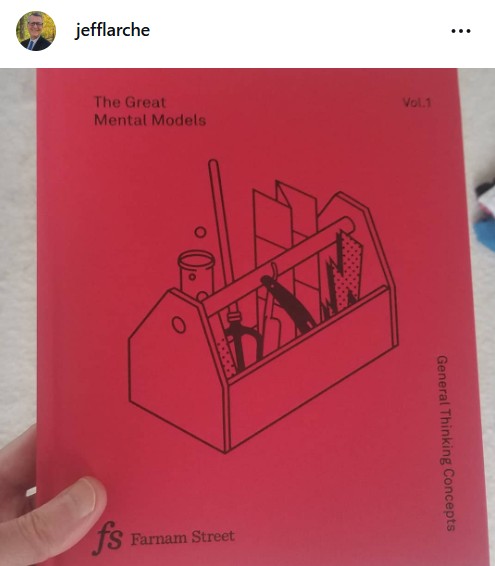
Six years ago when Farnam Street Publishing announced it was producing this volume, I eagerly pre-ordered it. It did not disappoint.
Lesson 2: Improve your social skills
In 2017, a working paper called The Growing Importance of Social Skills In The Labor Market, concluded that those workplace skills are far more important in this century than in the 1980s and ‘90s. That finding may seem counter-intuitive to you, especially if you are old enough to have worked in teams at that time, as I have. Its findings, controlling for education, demographics, and region, include the following:
- Workers with higher social skills enable their teams to specialize more efficiently, generating larger productivity gains
- Social and cognitive skills (being productive across many workplace tasks) are complements: The wage premium for social skills is higher for workers who are also cognitively skilled
If you wonder how the growth of AI since the paper’s publication has changed the dynamics, I have news for you. Yes, AI has made your ability to do more workplace tasks (what the paper calls cognitive skills), but these new cognitive skills must be paired with the cohesion you encourage within your teams by demonstrating excellent social skills.
Last year in my personal blog I posted about how AI has reshuffled the recipe for career success, citing Professor Scott Galloway. He listed his 3 human skills that make you irreplaceable in an AI world. The third of those skills?
Connection.
I’ll quote heavily from Professor Galloway below, since he provides plenty of specifics [all emphasis is his]:
“AI can summarize, analyze, and even write with fluency. What it can’t do is care. It doesn’t build trust, show emotional investment, or make someone say “I want that person in the room.”
“That’s why, in an age optimized for competence, connection is the real premium.
“Connectivity means showing up with warmth, curiosity, and follow-through. It’s being the person who brings the group together, who makes others feel smarter when they work with you, or more confident because you’re on the project. When others see that your heart’s in it, they trust you’ll go the extra mile, pay attention to the crucial details, and take personal responsibility. That trust is hard to earn and impossible to automate.”
Action: Consider finding a coach
If the person described above does not align with what people think of you, find out how you can move closer to that professional leadership style.
For inspiration, I strongly recommend Brené Brown’s latest book, Strong Ground: The Lessons of Daring Leadership, the Tenacity of Paradox, and the Wisdom of the Human Spirit. This was my introduction to Ms. Brown and I’m now a superfan!
Lesson #3: Practice mindfulness meditation
I’ll bet you weren’t expecting that one!
I may be biased, because I started meditating in my 20s, and when I lived in Milwaukee I was an active member (and OG webmaster!) of the Mindfulness Center of Milwaukee. But it turns out mindfulness is the only reliable antidote to AI-induced cognitive decline, a malady described by two Wharton scholars: Thinking—Fast, Slow, and Artificial: How AI is Reshaping Human Reasoning and the Rise of Cognitive Surrender.
To be clear, their paper described the problem, not the solution. It was cognitive neuroscientist Dr. Sahar Yousef who posits mindfulness as the remedy. At last month’s SXSW conference, she and Section CEO Greg Shove shared research on AI’s cognitive effects on university students.
I was surprised / not surprised to learn from them that “Mindfulness is the only cognitive protector. Of all the traits measured, only one showed a protective effect against both cognitive dependence and AI companionship reliance: the ability to be fully engaged in the present.”
Other academics would agree. In Yuval Noah Harari’s 21 Lessons for the 21st Century, each of the first twenty chapters describes a different challenge facing us.
I won’t lie. Reading it was a rough ride. I recognized each of the many challenges he described in detail, either facing us today or swiftly approaching.
Reading each progressive chapter, I felt like Hemingway’s Mike Campbell, realizing during a meeting with his accountant that he would soon be very, very insolvent. I wondered: What solace could Harari leave me with? How was he going to help me handle the onslaught, including that of machines thinking for us, making us gradually unfit to reason for ourselves?
The title of his final, twenty-first, chapter:
Meditation.
Action: Learn more about mindfulness
I started my own pursuit of meditation with Jon Kabat-Zinn’s Full Catastrophe Living. It still holds up!
He is professor emeritus of medicine at the University of Massachusetts Medical School, where he was founding executive director of the Center for Mindfulness in Medicine, Health Care, and Society.
I read the book shortly after it came out, to cope with chronic pain and the depression it caused. He taught me that meditation, removed from Eastern dogma, could do truly miraculous things to our minds.
That includes thinking clearly and strategically in stressful business situations.
The introduction of the book explains the meaning behind its title (hint: it’s from a classic musical). I think you’ll agree, we need all the skills we can find to face and overcome today’s occupational and societal “catastrophes.”