Opinions are all my own

  • Financial services marketers lean heavily on direct response and email tactics

    A new report by the Direct Marketing Association reveals that marketers in the financial services sector are relying heavily on direct marketing and email, and showing an impressive ROI for these tactics. Here are two particularly impressive findings from this research of U.S. banks and credit institutions:

    • They invested $13.4 billion in direct marketing advertising, which produced $178.8 billion in sales, or $13.34 returned for every dollar spent
    • Growth in email marketing within financial services companies is expected to be the greatest of all media types used in the next four years, for a compound annual growth of 22.5%

    The report also showed a very small reduction in print advertising over the next four years.

    What can account for this? Aside from the arguably better overall effectiveness of these media, they are also tactics more suitable to centralized control. As financial institutions continue to consolidate, these tactics become even more appealing.

  • Online personas are an impossible vacation

    Maybe it’s because I’ve just returned from some time away from the office — and the blog. For whatever reason, a post from earlier this year by Jared Spool reminded me of Spalding Gray’s comedic novel/memoir Impossible Vacation. Spool insists that an online persona is not a document. He contends that it is far more alive — a corpus of research and hands-on interaction. His key point: “Personas are to persona descriptions as vacations are to souvenir picture albums.”
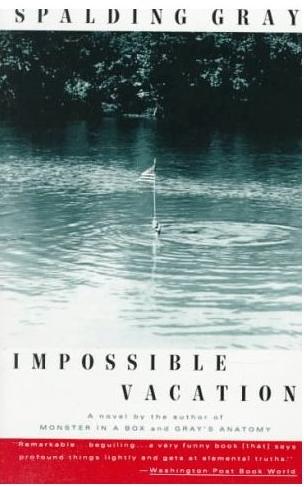
    Impossible Vacation

    Of course he is right. Stating as much is akin to other applause-getters, such as “Hitler was a bad man.” But he goes on to deliver the goods. Spool, of User Interface Engineering, provides excellent examples and resources that can help marketing technologists in the pursuit of that “vacation” experience. For instance, Spool sites this slideshow presentation by Todd Zaki Warfel of Messagefirst. Todd’s list of common persona mistakes includes not using them throughout the design process — something I feel is key to making personas come alive.

    The late Spalding Gray was a monologist best known for acutely personal one-man shows. His novel, Impossible Vacation, was similarly self-referential. The protagonist struggles through a sequence of sometimes perverse journeys, never able to — well, you can guess. Building personas is equally unending. Every new dataset and customer encounter should enhance a deepening understanding of user needs and motivations.

    The personas you build should be revisited and revised frequently. How else do you share any new-found user understanding? The objective is to “grok” your various user types, to use Robert Heinlein’s coinage. Heinlein defined grokking this way:

    Grok means to understand so thoroughly that the observer becomes a part of the observed—to merge, blend, intermarry, lose identity in group experience.

    Impossible? Yes. But by every degree of striving, user interface design becomes more useful to the people who matter most.
  • Mindfulness the Google way by Jon Kabat-Zinn

    Merlin Mann is one of my favorite productivity bloggers. And similar to how you feel when you learn that two old friends have met and hit it off, I was pleased yesterday to read his post on an influential teacher in my life: Jon Kabat-Zinn, founder of the Center for Mindfulness in Medicine, Health Care, and Society.

    At about the same time that I was gaining my stride in my professional life, a chronic pain situation nearly ended it. Then I learned about what this fellow was doing, deep in the bowels of the University of Mass. Medical Center. I learned about Kabat-Zinn and his “de-dogma-ized” meditation program in a segment of a PBS special, Bill Moyers’ Healing and the Mind. What followed is a journey I’m still on.

    Read Merlin’s post, and check out the YouTube video it describes, which was shot on the Google campus.

    April 1 Update: Here’s an account of the health benefits of this type of meditation, from yesterday’s BBC News site.

  • B-to-B Viral Marketing Case: Powerboat sales as a window to our current economic squall

    Let’s say you’re a company that mines data in a quiet niche — one not known for analytic vigor. You’ve been doing it for years and do it wonderfully. For clients who appreciate your chops, you’re a godsend. But these clients are exceptional in the traditional retail business sector you serve.

    How, how do you spread the word about your super-segmented lists and dead-on business intelligence services? Intuition says you find something to “go viral” around. But that requires some degree of topical relevance, if not outright sensationalism. How do you enliven something as dry as, say, boat purchase behavior (pun intended), to give it the life necessary to grab headlines?

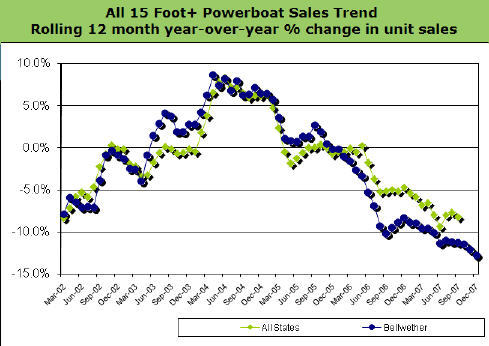
    The answer is what Info-Link does. They periodically publish one of the more pedestrian metrics they track: Quarterly sales in bellwether states. Below is their latest Bellwether Report, available on their site and distributed via a simple but effective opt-in email:

    Info-Link Bellwether Report

    You can explore various sales statistics by quarter (use the pull-down). Yes, the news is depressing. But it’s undeniably informative. And share-able. What information can your business repackage in such a way that people will want to share it?

  • Boost your office productivity with a bigger screen

    Over the years, many of my co-workers have used two monitors to get work done. Others have swapped “standard issue” monitors for larger ones. Their explanation is always the same. Information work is all about work space real estate, and these set-ups make them more productive. Evidence has suggested to me that they’re right. Now from the Wall Street Journal comes further validation.

    This piece reports on a study that was financed by NEC, but vetted by a more objective body (the university’s research board):

    Researchers at the University of Utah tested how quickly people performed tasks like editing a document and copying numbers between spreadsheets while using different computer configurations: one with an 18-inch monitor, one with a 24-inch monitor and with two 20-inch monitors. Their finding: People using the 24-inch screen completed the tasks 52% faster than people who used the 18-inch monitor; people who used the two 20-inch monitors were 44% faster than those with the 18-inch ones.

    The conclusion is a worker could save upwards of 2.5 hours a day by using a bigger monitor. This is far more than I would have expected.

    Do you use a monitor that’s around 24-inch? Or two? If so, I assume you have the free time to comment. As for me? I’m writing this on my lunch break, with little time to spare. I need a bigger monitor baaaddd!