Opinions are all my own

  • Can video be the future of “print” journalism, and the salvation of newspapers?

    It’s an interesting thought. As anyone watching the industry knows, Craigslist.org and other web-based classified ad services have eroded the financial underpinnings of the newspaper. Last month Mike Cassidy, in MediaPost (registration required), postulated that a new media phenomenon may actually come to the newspaper’s rescue.

    … Newspapers are in a position to leverage their unique assets and benefit from the video trend. By having journalists and reporters not only file their stories in a video format, but by also providing B-roll or ancillary footage, newspapers can create more and higher-valued ad placements.

    I see a similar opportunity when it comes to video and classifieds — with the real question being, who will leverage it?

    The answer is that several publications are certainly trying. One of the first is IC Places Orlando. Here is an example of how the journalistic infrastructure of the newspaper could be leveraged to provide an ad product that other web properties would have to struggle mightily to match.

    Newspapers have gotten into their current pickle by being too slow to realize how serious a threat the internet is to their business model. They now have to do something — or actually, many things — differently in order to remain socially relevant and financially viable.

    As the 1980’s hit announced, Video killed the radio star. Will it help save the morning paper?

  • Is “click here” the web equivilent of an ugly red sticker?

    A background in direct response can warp a person for life. Just ask a typical ad agency creative director. In a past agency, where I started out as the lone voice in all things direct marketing, I seriously think the creatives wanted to have me committed. I was reminded of that time in my career when I read this post in Copyblogger:

    Many years ago, an advertising agency in my neighborhood hired me to consult on a direct mail project for one of the biggest nonprofit organizations in the country. One glance at the client’s test results revealed that the successful mail pieces featured big red stickers, the kind you often see on magazine subscription offers.

    So one of my recommendations was to use a sticker in the new direct mail piece. From the expression on the designer’s face, you would have thought I had just relieved myself on the conference room carpet. He crinkled his nose in disgust and informed me that the agency “didn’t do stickers. They’re tacky.”

    Needless to say the red sticker mailing, running as a control, continued to out-perform more attractive test packages. The ugly and unsophisticated won out, in terms of effectiveness, over the attractive and more contemporary.
    Click here graphicI was thinking of this while participating in a discussion recently on the pros and cons of using “Click here” as an inducement.

    Our team’s stance is simple and non-negotiable: The practice is bad form. They’re in good company. Jacob Nielsen, the Moses of usability best practices, carved his own Ten Commandments of web design on a virtual stone tablet, and #2 included “Don’t use ‘click here’ or other non-descriptive link text.”

    Built into this commandment is the crux of his reasoning. If you employ link text that is not descriptive, you’ve wasting valuable words. But is this waste always sinful?

    Effective Versus Efficient

    “Wasteful” can be considered the antonym of “efficient.” And who doesn’t want to be efficient? Well, the answer is me — sometimes. That is, sometimes there are strategic reasons for a little “waste.” Stephen Covey is quick to point out in his book that it’s not called Seven Habits of Highly Efficient People. No, Covey chose the word “effective” for the title for a good reason.

    If your web users are not particularly web-savvy, you may have to go back to “Web 1.0” in your copy and presentation. And that may mean slapping some “red stickers,” in the form of hackneyed hyperlink instructions over your web design. Only testing can tell you for sure.

    The exception is if you are asking your user to make a commitment. In the case of “buy it now,” etc., you should still never use “click here.” To do otherwise would simply be too inefficient to be optimally effective.

  • Of social media, exploding churches and imploding airlines

    In Hawaii, Aloha can mean both hello and good bye, but for Aloha Airlines recently, it meant only bankruptcy. Likewise for ATA, Skybus, Skyway, and most recently Frontier. For those holding useless tickets, the news spelled delays, hassles and lost money. Naturally, the public outcry was covered by television news and various bloggers. But for my news, I didn’t have to go farther than Twitter. Using keyword search, I could tune into the griping and gnashing of teeth in real time. Twitter gave me “News I can use,” and I didn’t even have to look at a newscaster haircut.

    Twitter also reported something that local news simply cannot: Are any of my friends directly affected? The answer was No, to the airline implosions, but two Twittering friends were delayed by the American Airlines wiring harness problems.

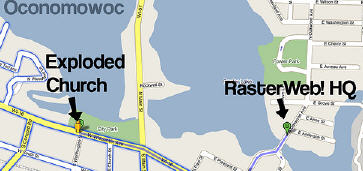
    Map showing church

    Another colleague inadvertently acted as Breaking News reporter, when he reassured his Twitter audience that his office is a safe distance from the “exploded church.” Here is what raster reported on the day that a hundred-year-old church in his city blew up due to a leaking gas line:

    don’t worry about us, we are not that close to the church that exploded: map

    As you can see from the map he supplied, raster did a great job of showing why he was unharmed, but also, what had just happened. That night, when I watched the local news, I was already well aware of what happened.

    What Twitter will evolve into is anyone’s guess. But where it is right now is a place I could never have imagined: Squarely between me and local journalism.

  • Making things up as you go, and why I love my job

    When I speak to groups of college students, I can’t help sounding a little frenetic. Concepts and cases spill out of my mouth, and I never fail to leave the classroom elated. Just as surely, a few audience members appear — as they file out — to be feeling the same way. (It could simply be because I stopped yammering!)

    I try to wrap up each presentation, whether it’s on database marketing, or web marketing, or new media, with a story from my childhood. A topic that fascinated me was the advent of television. I would read the memoirs of TV pioneers. (My favorite was Dick Cavett’s. He continues to spin great yarns in his blog. A notable recent blog was on his encounters with William F Buckley, Jr., on the screen and off.)

    Back when Cavett was a struggling comedy writer, he suddenly found himself replacing Jack Parr on the fledgling Tonight Show, which topped the ratings in its time slot as the first nationally-broadcast talk show. The rest is history. It is also history steeped in the possibilities of a humming, glowing box that was new to households everywhere.

    I tell the students how fortunate they are to be born in a time when other revolutionary technologies are emerging (which, together, become a sort of digital connectedness). They, and I, are part of a exciting adventure. This came to mind as I read this, by MediaPost’s Search Insider columnist Gord Hotchkiss (registration required):

    We’re building a new world up as we go. More correctly, a new world is emerging organically from the efforts and thoughts of millions of people. It’s a world defined in an ethereal middle space, a world of mind-spawned musings and accomplishments, shared and propelled one packet at a time. We’re not discovering anything, we’re building something entirely new. At any given moment, hundreds of millions of us are making it up as we go along. It’s a Darwinian experiment on a grand, grand scale.

    Can you describe to me a better job than being a part of that?

  • New Zoombak mini-GPS puts special events on the map

    Marketing technology has focused on the potential of mobile marketing for years. But it has always just been potential. Like most bloggers in my industry, I’ve written with yearning about a day when you can conduct breakthrough events or execute innovative sales strategies using cell phone GPS capabilities, and about making a mobile-oriented device such as an SMS-enabled chandelier (below) a centerpiece of your special event.

    Text-message enabled chandelierThese posts were written two years ago.

    So what’s the hold-up?

    The chief problem is carrier barriers. Our four cellular phone carriers refuse to agree on protocols. These shared platforms would make phone bells and whistles — features that users in many other countries enjoy today — possible in this country as well.

    If you’re expecting these barriers to fall soon, think again.

    But in the meantime, other technology has slowly come into the reach of event marketers, and to those others like myself who grasp that the next marketing technology wave has to do with place, not a faster internet or better web agent.

    Or even the unlocking of domestic cell phones!
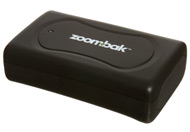
    The ZoombakMeet the Zoombak

    I’m thinking specifically now of Zoombak, a GPS device that is tiny, and cheap enough to buy in bulk and rent. It can become a way to create an unforgettable special event.

    Don’t let this application as a high-tech dog tracker fool you. Here’s what Zoombak’s web copy says about this $200 device:

    Our small, lightweight, water-resistant locator attaches comfortably to your dog’s collar with a durable and secure pouch. You can pinpoint your dog’s location on-demand via Zoombak.com, mobile phone (coming soon) or live customer care. You can also determine your dog’s location in real time using our continuous tracking option. Simply log on to Zoombak.com to view a map of her current location, as well as her path taken since leaving home. Once you create and activate your own customized safety zones, you can be promptly notified by text message and/or email (your choice) when your dog leaves the zone.

    Imagine you’re a college recruiter, and that instead of tracking your dog, you invited a dozen participants in an exploration of your college campus. They could be on a high-tech scavenger hunt. The rest of your potential students could watch the competition on web-enabled monitors. They’d speculate on which person or team returns first with all of the requested items. (Because it’s against the law, there would of course be no wagering.)

    Another example of the possibilities: Consider the popular fund-raising event of releasing dozens of rubber ducks in a river and seeing whose duck crosses the finish line first. How much more interesting would it be if, instead of a river, it was a sprawling shopping mall — or topiary maze — and instead of ducks, these where local celebrities willing to (temporarily) get themselves extremely lost for a good cause?

    These are just two applications that come to mind when GPS suddenly moves within spitting distance of medium-to-large event budget.

    Can you think of other applications for this?

    (Thank you, David Joachim of the New York Times for getting my brain racing with an article on the Zoombak.)