Opinions are all my own

  • The Domestication of Artificial Intelligence

    The Domestication of Artificial Intelligence

    A version of this post originally appeared in my personal blog.


    I’ve thought and read a lot about artificial intelligence (AI). Particularly, its potential threat to us, its human creators. I’m not much for doomsday theories, but I admit I was inclined to fear the worst. To put things at their most melodramatic, I worried we might be unwittingly creating our own eventual slave masters. But after further reading and thinking, I’ve reconsidered. Yes. A.I. will be everywhere in our future. But not as sinister job-killers and overlords. No, they will be extensions of us in a way I can only compare with that most beloved of domesticated creatures: The dog. For you to follow my logic, you’ll need to remember two facts:

    1. Our advancement as a species from hunter-gatherers to complex civilizations would not be possible without domesticated plants and animals
    2. Our collective fear of technology is often wildly unfounded

    Bear with me, but you’ll also probably need to recall these definitions:

    • Domestication: Taking existing plants or animals and breeding them to serve us. Two examples are the selection of the most helpful plants and turning them into crops. Michael Pollan’s early book, The Botany of Desire: A Plant’s-Eye View of the World, will bring you a long way to seeing this process in action. As for animals, you may think of dogs as being mere pets, but early in our evolution as humans we bred the wolf to help us hunt for meat, and to protect us from predators. Before domestication, we pre-humans hunted in packs, and so did the wolves … never the twain shall meet. After this domestication, we ensured the more docile canines a better life, under the protection of our species and its burgeoning technologies (see definition below), and they delivered the goods for us by helping us thrive in hostile conditions. It was a symbiosis that turned our two packs into a single unit. No wonder the domesticated dog adores us so, and that we consider them man(kind)’s best friend.
    • Technology: Did you know the pencil was once considered technology? So was the alphabet. You may think of them merely as tools, but technology is any tool that is new. And our attitudes toward anything new always starts with fear. Douglas Adams put it this way: “I’ve come up with a set of rules that describe our reactions to technologies: 1.) Anything that is in the world when you’re born is normal and ordinary and is just a natural part of the way the world works. 2.) Anything that’s invented between when you’re fifteen and thirty-five is new and exciting and revolutionary and you can probably get a career in it. 3.) Anything invented after you’re thirty-five is against the natural order of things.” Fear of technology not surprisingly spawned the first science fiction: Mary Shelley’s Frankenstein; or, The Modern Prometheus, a literal fever dream about a scientist’s hubris and the destruction it wrought upon himself and the world. This fear has a name: Moral panic. And it has created some pretty far-fetched urban myths.

    In a Wall Street Journal piece, Women And Children First: Technology And Moral Panic, Genevieve Bell listed a few of these vintage myths. The first is about the advent of the electric light: “If you electrify homes you will make women and children … vulnerable. Predators will be able to tell if they are home because the light will be on, and you will be able to see them. So electricity is going to make women vulnerable … and children will be visible too and it will be predators, who seem to be lurking everywhere, who will attack.” And consider this even bigger hoot: “There was some wonderful stuff about [railway trains] too in the U.S., that women’s bodies were not designed to go at 50 miles an hour. Our uteruses would fly out of our bodies as they were accelerated to that speed.”

    Sounds messy.

    I don’t have to tell you about our modern moral panic surrounding A.I. Except there is a bit of reverse sexism going on, because this time it is male workers who are more the victims. Their work — whether purely intellectual or journeyman labor — will be eliminated. We’ll all be out on the street, presumably to be mowed down by self-driving cars and trucks.

    The Chicken Littles had me for a while

    So what changed? In the same week I read two thought-provoking articles. One was in The New Yorker, The Mind-Expanding Ideas of Andy Clark. Its subtitle says it all: The tools we use to help us think — from language to smartphones — may be part of thought itself. This long piece describes Clark’s attempt to better understand what consciousness is, and what are its boundaries. In other words, where do we as thinking humans end and the world we perceive begin? He comes to recognize that there is a reason we perceive the world based on our five senses. Our brains are built to keep us alive and able to reproduce. Nothing more. All the bonus tracks in our brain’s Greatest Hits playlist … Making art, considering the cosmos, perceiving a future and a past … these are all artifacts of a consciousness that moves our limbs through space.

    To some people, perception — the transmitting of all the sensory noise from the world — seemed the natural boundary between world and mind. Clark had already questioned this boundary with his theory of the extended mind. Then, in the early aughts, he heard about a theory of perception that seemed to him to describe how the mind, even as conventionally understood, did not stay passively distant from the world but reached out into it. It was called predictive processing.

    Predictive processing starts with our bodies. For instance, we don’t move our arm when it’s at rest. We imagine it moving — predict its movement — and when our arm gets the memo it responds. Or not. If we are paralyzed, or that arm is currently in the jaws of a bear, it sends the bad news back to our brains. And so it goes. In a similar way we project this feedback loop out into the world. But we are limited by our own sense of it. Domestication of canines was such a game-changer because we suddenly had assistants with different senses and perceptions. Together humans and dogs became a Dynamic Duo … A prehistoric Batman and Robin. But Robin always knew who was the alpha in this relationship. Right now there is another domestication taking place. It’s not of a plant or an animal, but of a complicated digital application. If that seems a stretch … If grouping these three together — plants, animals and applications — keep in mind that domesticating all of them means altering digital information.

    All Life Is Digital

    Plants and animals have DNA, or deoxyribonucleic acid. They are alive because they have genetic material. And guess what? It’s all digital. DNA encoding uses 4 bases: G,C,T, and A. These are four concrete values that are expressed in the complex combinations that make us both living, and able to pass along our “usness” to new generations. We’re definitely more complicated than the “currently” binary underpinnings of A.I. But as we’ve seen, A.I. is really showing us humans up in some important ways. They’re killing us humans at chess. And Jeopardy. So: Will A.I. become conscious and take us over? Clark would say consciousness is beyond A.I.’s reach, because as impressive as its abilities to move through the world and perceive it are, even dogs have more of an advantage in the consciousness department. He would be backed up by none less than Nobel Prize in Economics winner Daniel Kohneman, of Thinking, Fast and Slow fame. I got to hear him speak on this subject live, at a New Yorker TechFest, and I was impressed and relieved by how sanguine he was about the future of A.I. Here’s where I need to bring in the other article, a much briefer one, from The Economist. Robots Can Assemble IKEA Furniture sounds pretty ominous. It’s a modern trope that assembling IKEA furniture is an unmanning intellectual test. But the article spoke more about A.I.’s limitations than its looming existential threats. First, it took the robots comparatively long time to achieve the task at hand. In the companion piece to that article we read that …

    Machines excel at the sorts of abstract, cognitive tasks that, to people, signify intelligence—complex board games, say, or differential calculus. But they struggle with physical jobs, such as navigating a cluttered room, which are so simple that they hardly seem to count as intelligence at all. The IKEAbots are a case in point. It took a pair of them, pre-programmed by humans, more than 20 minutes to assemble a chair that a person could knock together in a fraction of the time.

    Their struggles brought me back to how our consciousness gradually materialized to our prehistoric ancestors. It arrived not in spite of our sensory experience of the world, but specifically because of it. If you doubt that just consider my natural and clear way just now of describing the arrival of consciousness: I said it materialized. You understood this as a metaphor associated with our perception of the material world. This word and others to describe concepts play on our ability to feel things. Need another example: This is called a goddamn web page. What’s a page? What’s a web? They’re both things we can touch and experience with our carefully evolved senses. And without these metaphors these paragraphs would not make sense. Yes, our ancestors needed the necessary but not sufficient help of things like cooking, which enabled us to take in enough calories to grow and maintain our complex neural network, and the domestication of animals and plants that led us to agriculture and an escape from the limitations of nomadic hunter-gatherer tribes (I strongly recommend Guns, Germs and Steel: The Fates of Human Societies for more on this), but … To gain consciousness, we also needed to feel things. And what do we call people who don’t feel feelings? Robots. “Soulless machines.” Without evolving to feel, should A.I. nonetheless take over the world, it’s unlikely they will be assembling their own IKEA chairs with alacrity. They’ll make us do it for them. Because our predictive processing makes this type of task annoying but manageable. We can even do it faster over time.

    It’s All About The Feels

    But worry not. Our enslavement won’t happen because — and I’m feeling pretty hubristic myself as I write this — we’re the feelers, the dreamers, the artists. Not A.I. Before we domesticated dogs, we were limited in where in the world we could roam, and the game we could hunt. After dogs, we progressed. We prospered. Dogs didn’t put us out of jobs, if you will, they took the jobs they were better at in our service. Inevitably, we found other ways to use our time, including becoming creatures who are closer to the humans we would recognize on the street today, or staring back in the mirror. We are domesticating A.I. Never forget that. And repeat after me: We have nothing to fear but moral panic itself.

  • How to lie with data visualizations, Part 1

    How to lie with data visualizations, Part 1

    The last time our world experienced a virus of Covid-19 lethality, our public discourse was not that different than today’s. Of course I’m talking about the 1918 Spanish Flu. Even its name is a lie. It was called that in U.S. newspapers not because Spain was the origin of the virus but because Spain was a neutral party in World War I, which was blazing at the time.

    How’s that, you say? While other countries embroiled in the conflict didn’t want to spook their citizens back home by honestly assessing the toll the deadly flu was taking on their troops, Spain was more forthright. More than most countries, Spain even took precautions such as strict quarantining and social distancing.

    Following the dictum that no good deed goes unpunished, Spain got to “own” the flu appellation in the U.S. press because of those actions, in a xenophobic slight not unlike the way French fries — as beloved during the time of our multi-country occupation of Iraq as they are today — became known for a time as “freedom fries.” Why? France did not choose to join our little alliance. And we all know how successful that nation-building adventure was.

    It makes you wonder when we will start paying attention to what our European neighbors are thinking. They occasionally may be onto something.

    Hey, we’ve got this!

    So what has this got to do with data visualizations? Just that powerful systems often try to deceive as a way to hold onto power. This can involve the systems disclosing data they possess to their constituents in a way that assures the inattentive Hey, we’ve got this! I’m going to show you an example from my recent work, but first, let me show you the data visualization pants-on-fire deception that got me typing in my basement instead of enjoying this sunny Saturday afternoon ..

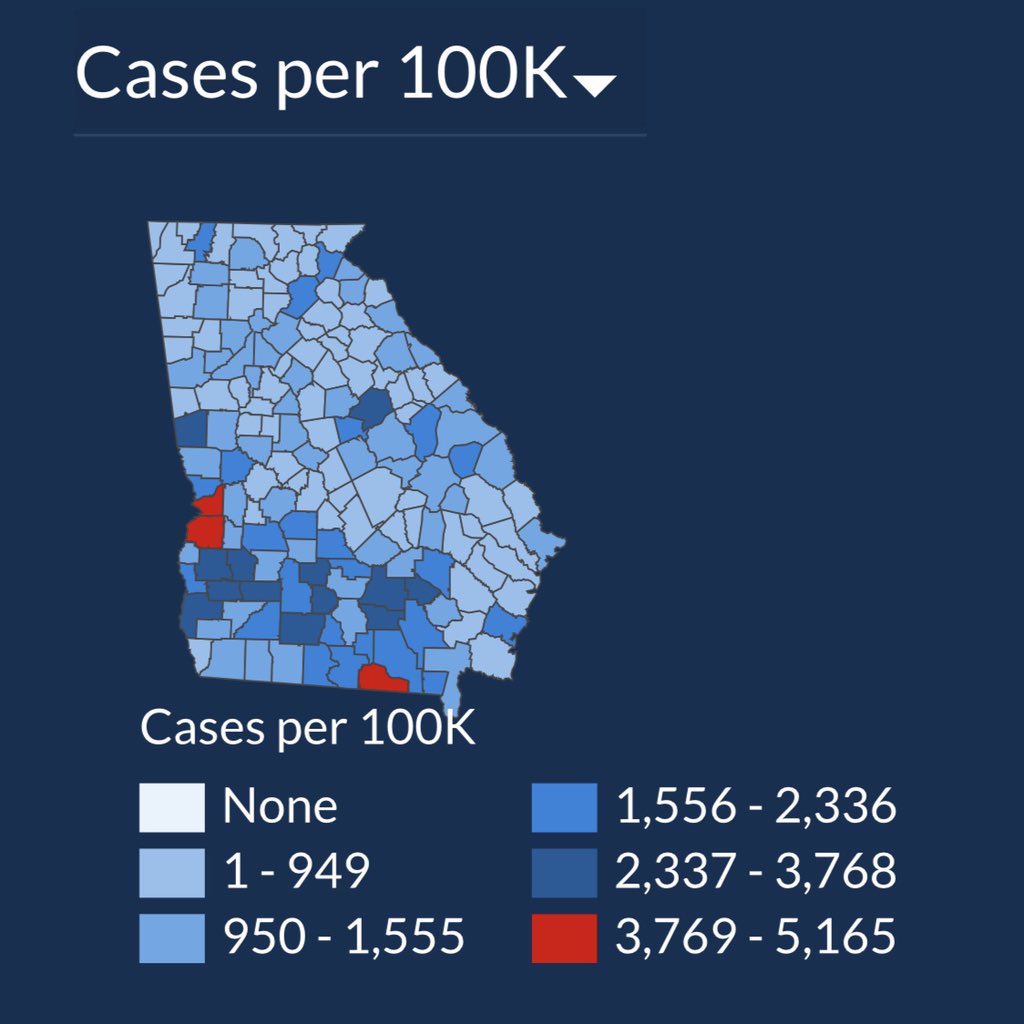
    This is a set of charts — one from July 2, and the other from today, July 18. In those two weeks, can you spot the 50% increase in cases per thousand? (I verified today’s number on the Georgia Department of Health website just now, and confirmed the July 2 screencap is legit as well).

    Made more infuriating when you realize human lives are at stake, the graphic is right below this statement: “The charts below presents [sic] the number of newly confirmed COVID-19 cases over time. This chart is meant to aid understanding whether the outbreak is growing, leveling off, or declining and can help to guide the COVID-19 response.”

    Okay, quiz time: Can you spot the increase in this before-and-after map?
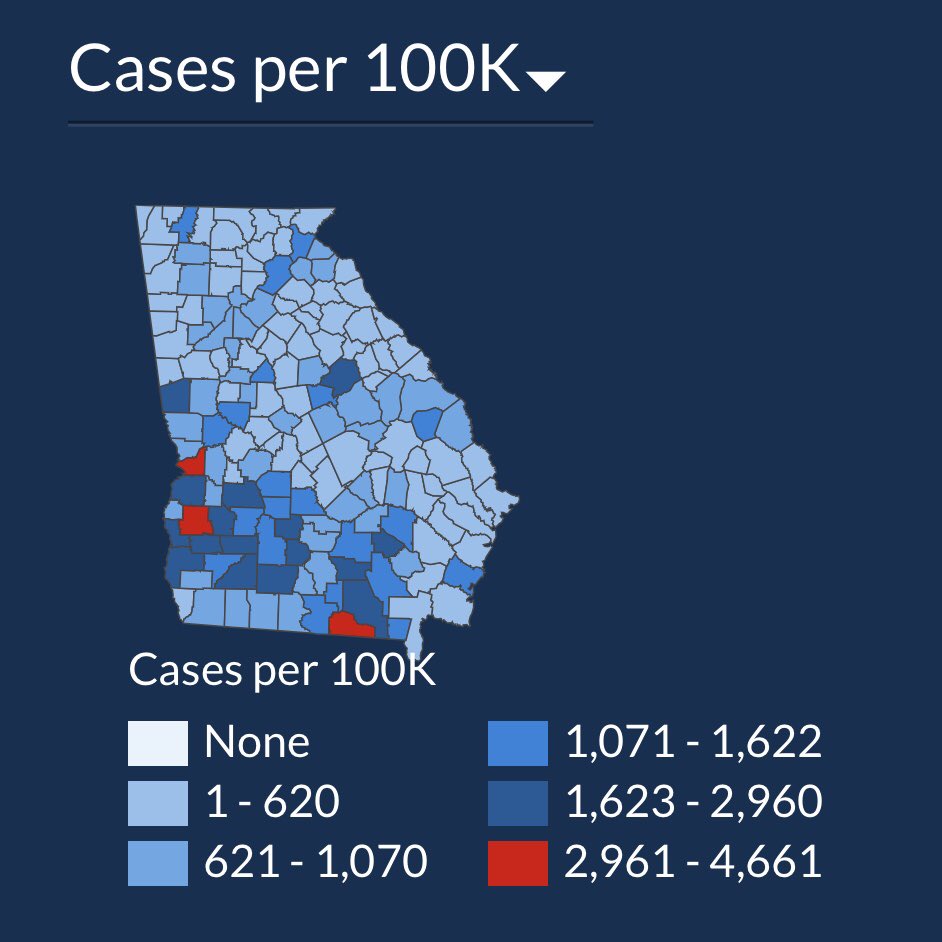
    Map before

    If you haven’t caught it yet, I’ll give you the explanation that @andishehnouraee provided: “[Georgia Governor Brian] Kemp’s health department keeps changing the numbers on the map’s color legend to keep counties from getting darker blue or red. 2,961 cases was Red on July 2. Now a county needs 3,769 cases to show red. The result: an infographic that hides data instead of showing it.”

    I find this indefensible. I will say other graphics on the same page definitely show a spike. But if I’m a Georgian and I look for my county on the only map on the page, how am I to know that my community has half again more confirmed cases than it did two weeks ago? This data visualization “shell game” may persuade inattentive citizens of a given county to not social distance, or wear a mask in public, and thereby cause further infection in an actual, honest-to-goodness public health crisis.

    [Some Redditors have said these maps were designed to show county-to-county differences, but I’m not buying it. When you choose a color scale, either keep the numbers the same for the colors or don’t use numbers at all, and show percentages. The typical citizen isn’t going to spend more than a few seconds looking at the map, and will get the wrong story from this one.]

    How to deceive using shifting scales, with Excel as your accomplice!

    The above is an example of: If you don’t like the data, change the base numbers. Another, more common way is to not clearly show your bar charts or line charts starting from zero where the axes meet. Let’s say I am trying to improve my abysmal running pace, and share my progress with the world (These are real numbers, but give me a break … I’m an old nerd, not an elite runner!):
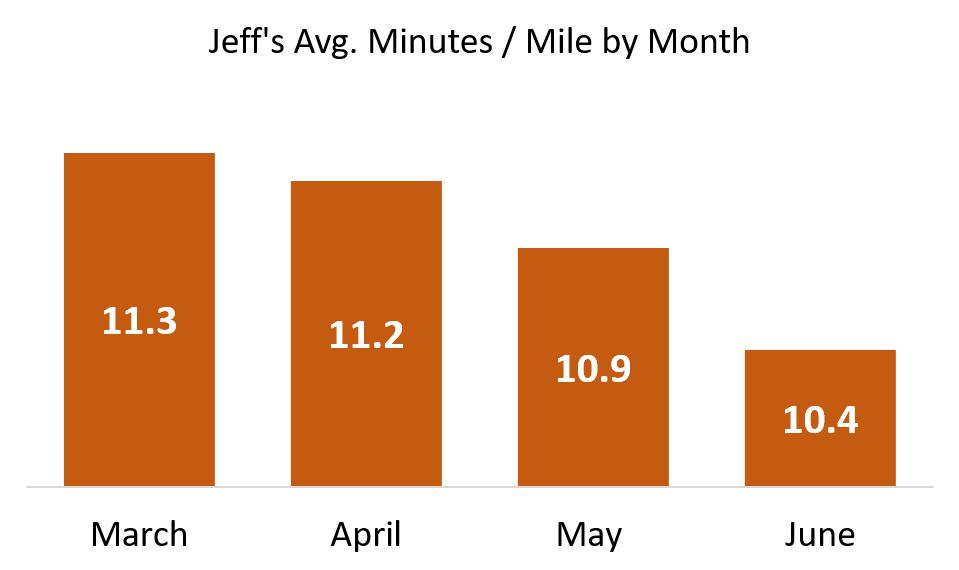
    Look at this glorious chart! I can hear you exclaiming: What progress you’ve made, Jeff! But is it really that impressive? Of course not! When I popped these numbers into Excel and hit Insert Bar Chart, Excel did some editorializing. It started my Y-axis at 9.8 minutes per mile. And in doing so, it made me look like to the inattentive as though I’ve halved my time since March!

    Let me repeat: Excel did this handicapping of my pathetic times automatically.

    To get a real world view of my running — a world which includes rare athletes who have completed  marathons at far less than half my personal best — here is the same graphic when the bars start at zero minutes per mile:
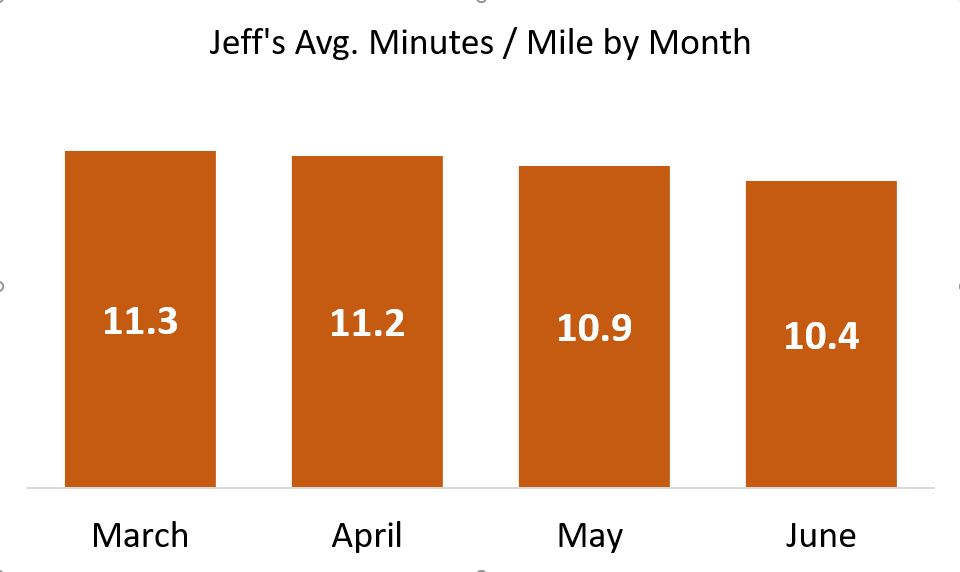
    Not nearly the ego-boost, but it’s honest!

    Scale breaks to the rescue

    What if you just don’t have the room for all of that athletic plodding? In other words, what if my sad pace just wouldn’t fit on the slide, the bars being too tall? Yes, that’s a real thing, as I’ve pointed out in data visualization lectures:

    Sometimes you want to take your audience all the way to the treetops, where the trunks are invisible but you can see which are the tallest of the majestic redwoods.

    There’s this thing called a scale break  (shown below with a made-up data set):
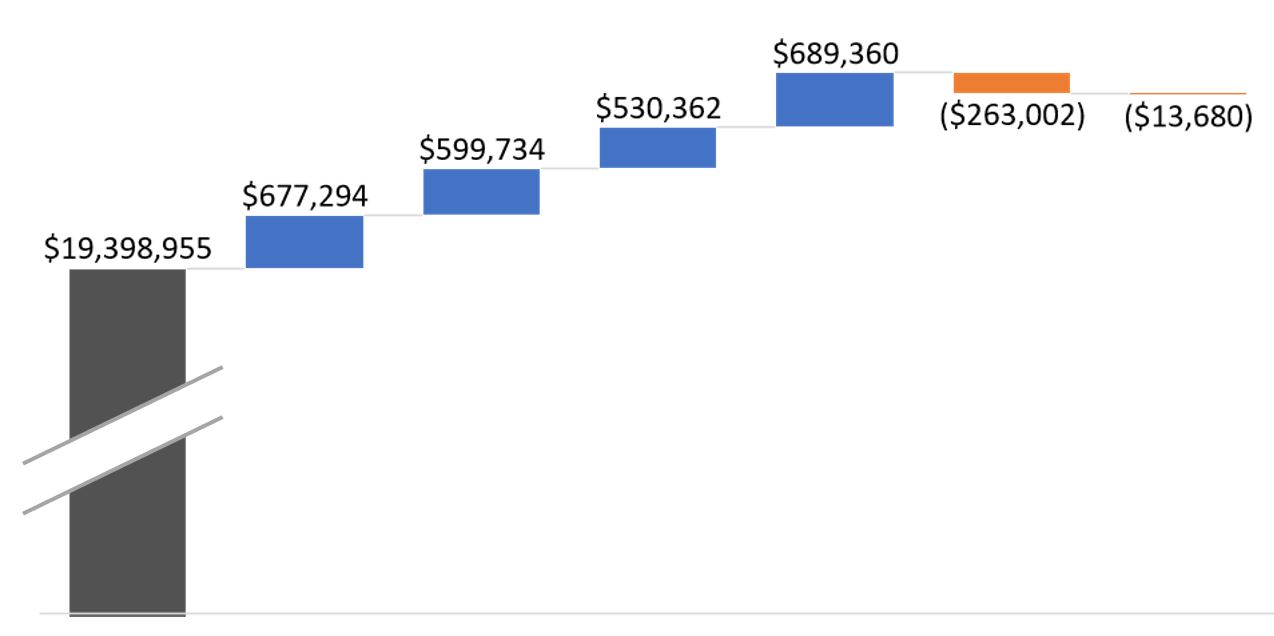
    Now you can see a chart that tells an honest story without messing up the scale of your slide. And you can focus your audience’s attention on the data that matters.

    Watch this blog for a follow-up, with more tips on how to lie with data visualizations!

  • Build a Google Analytics campaign spreadsheet that also crafts the links!

    Dorcas Alexander wrote on the Luna Metrics blog recently about an important and often-overlooked topic: Organizing the campaign information you can gather in Google Analytics. I’m following up here with a way to document your campaigns. This method also solves the problem of constructing the special URLs used to create those campaigns in the first place.

    If that seems a little opaque to you, read on. I suggest you start with this excerpt of Dorcas’ post:

    It’s so easy to tag your campaigns for Google Analytics that you can quickly fill your reports with a mishmash of labels and end up with campaign tag soup! But what’s the best way to get organized? Even if you know what medium and source mean, it’s not always obvious how you should fit campaign info into those slots. And what about the extra slots we get for campaign tags like campaign and content and term?

    It goes on to list four simple steps to preventing confusion. The fourth discusses documenting your work. It recommends how — by setting up a Google Docs spreadsheet, which can be shared among all content or analytics team members. He goes on to say, “Another good thing about using a spreadsheet is that a formula can pull all your labels together into a campaign-tagged URL.”

    That’s a great idea, but how exactly can this be done?

    Here’s my how-to, an addendum to that Luna Metrics post.

    Above is the Google Spreadsheet I created for a former client (I needed to stop working with them when I joined Accenture). I’ve replaced the live information they were using with some of my own, to protect confidentiality. I’ll assume you already know how to set up a free Google Docs account, which includes the use of their cloud-based Excel competitor, named Spreadsheet.

    1. Create five columns: Output URL, Target URL, Formula, Campaign, Source and Medium. But wait!, you say. Where is that third column? It’s the Formula column, and is hidden here. I hid it because, a.) It looks identical to Output URL when you have live data in there, so it was redundant, and b.) I prefer to keep it hidden because each cell of that column contains the same formula — one that you definitely don’t want to accidentally change or delete. If I were setting up the system in Excel, I’d make those cells protected.
    2. Before “hiding” column C, place this formula in it: =((((((((B2&IF(ISERROR(FIND(CHAR(63),B2,1)),"?","&"))&"utm_campaign=")&D7)&"&utm_source=")&E2)&"&utm_medium=")&F2)) This formula confirms that the target URL (in cell B2) does not already contain a question mark in it. If it finds one already, none will be added. If it finds no question mark, it added one. After that it builds a trailing URL string that will be familiar to those who roll their own URLs, or use Google’s URL Builder. Once you’re done you’re safe to highlight the column and hide it.
    3. In the Output URL column, place a far smaller formula: =C2 Yes, that’s all. Just display the contents of the hidden cell C2 in the visible cell B2.
    4. Populate the Target URL cell in that row with the web address of the landing page you want to tag with campaign information.
    5. Finally, fill in the Campaign field, along with the Source and Medium fields. These are the unique names of the campaign you wish to credit that visit to, along with the web site or social app it was came from (e.g., Twitter, or Jason Falls’ Social Medial Explorer blog), and the general medium (e.g. social, or web).

    That’s it! In the Output URL you’ll find the line. Copy it, and paste it wherever you are setting up a hyperlink on another site or digital channel. For example, that top line shows the URL I used when I was Tweeting about my recent blog post extolling the new release of an Excellent Analytics upgrade.

    In the rows to the right of those I’ve shown, you can make notes about when it was used, why, and how you promoted the link. All of this can be helpful when you pull the campaign, source and media statistics for analysis.

    I hope this helps. Let me know what improvements you might have experienced in how to catalog your campaign information.

  • Excellent Analytics 1.1.5 Update Announced

    If you’ve been following my web analytics work, you know that I’m a major fan of Excellent Analytics. I have news. There has been a major (and much-needed, considering the changes by Google Analytics API), of their terrific Excel Add-on. Here are a few of the improvements and additions, as listed in the announcement of the Excellent Analytics update:

    • All dimensions and metrics are up to date. I.e. everything made available to the API should be included in EA.
    • A new tab in the menu bar, “Settings” has been added. You can access proxy settings at any time if you’re using a proxy and need to enter your settings. Before it only popped up when it seemed to be needed. In the settings dialog you can also find “Request timeout”, increase this figure if you have problems logging in. “Update metrics” and “Update dimensions” will make it easier for us to make sure you always will be able to access new metrics and dimensions as Google add them to the API. Before we needed to make a new release of EA for every update.
    • You can choose to save your password locally on your computer if you do not want to enter it every time you open Excel. It won’t be stored in clear text. We do not store your password anywhere for you. It’s only stored on your computer. If you don’t want your password stored at all, just don’t check “Remember password.”
    • EA checks for updates every time you use it. If there is a newer version of EA you’ll be prompted to download it. You can also ask to be reminded again later.
    • Improved user interface. Some things like sorting and profile selection have been moved.
    • Make a query and run it for multiple profiles at once! Before you could only create a query for one profile at a time. Note that you, however, when you want to update data per profile, have to do one update per profile. It’s for that initial creation that you can run one query for multiple profiles. This makes creating your report templates easier.
    • Multiple level sorting of data. I.e., you are able to sort by descending x and then by ascending y, etc.

    This application is, for the moment, free and open-source. It’s a valuable web analytics resource!

  • 3-D Printing: Because Atoms Are A Drag

    Twenty years ago the consumer tech magazine to read was PC/Computing. This, in spite of its stupid name. (Spell it out: “Personal Computing Computing.”) I recall an ad from its back pages for some long-forgotten software. Buy the software and you’d get a bonus bumper sticker, reading: In the future everything will work. Those were the days of crappy dial-up modems and the crash-prone Windows 3.1, so this was high sarcasm.

    In honor of the upcoming Rock the Green music festival, to be held on Milwaukee’s lakefront September 18, I submit this similarly absurd proclamation: Technology will fix our planet. What’s more, I assert that your guffaws (yes, I can hear them now) is in fact further evidence of its certitude. Here’s how:

    Yes, a chain mail glove, produced by Within Technologies. It represents an amazing technology; one that uses one-tenth the metal of conventional manufacturing and arguably just as little fossil fuel. What’s more, there isn’t a single seam or joint in the whole works. It was manufactured by a printer.

    Alexander Bell’s Telephonic Folly

    In the future we’ll be printing things, not just pictures or descriptions of things. Things made of metal, fiber, just about any material. This printing will take place well beyond the factory floor. It will happen in the back of auto repair shops, clothing stores, hobby shops. Out of the nozzles of printers will issue the very supplies and inventory of future commerce. Someday we may even be printing our own “stuff,” right in our home.

    This will save huge amounts of fuel. Needless to say, that will spare our planet from megatons of pollutants annually. And yes, I know I’m sounding all PC Computing. But contrary to the bumper sticker, I know these printers won’t work perfectly. Nothing ever does. There will be problems. But it won’t matter. The technology will arrive, whether we invite it into our lives or not. And if his particular revolution won’t take place, I’m confident another will . It will be just as extraordinary. I blogged about that one other tech revolution: Not printing things in three dimensions but the very food we eat, using living cattle, pig or chicken cells instead of metals and plastics. Yes, printing T-bone steaks.

    I base my confidence — my optimism — on history. The world is full of smart people. Always has been. But we have a massive blind spot for the reality of our lives in the future because we’re limited by our imaginations.

    Take the telephone. The phone has been a tool of almost universal good, aiding both business and society. It has saved lives (think: Dial 9-1-1) and saved massive transportation costs (as when you phoned ahead before driving to the store and discovering they’re sold out anyway).

    I’ve written before about the phone, and how no one thought that technology would be much beyond a less precise telegram. Here’s an excerpt from that 2007 Business Journal post:

    Executives in the telegraph industry couldn’t imagine that a device with no written record of the communication could be a threat to their business. In fact, legend has it that William Orton, the president of [the once mighty telegram company] Western Union … was offered a chance to buy Alexander Bell’s phone patent for $100,000. The story goes that he replied, “What use could this company make of an electric toy?”

    The emphasis is mine, but you get the point.

    I do suggest you click on this link to a post on my personal blog, about, of all things, growing meat in the lab. It’s another new technology that I think will be as revolutionary as the telephone.

    To be fair, it’s not so much the technology that makes it revolutionary — this one uses in vitro lab culturing, which isn’t new — but the good it can do . It promises to feed the world, and in doing so conserve a staggering amount of natural resources and carbon-emitting fuels. I’m not kidding.

    When they hear about culturing meat in a lab most people laugh or wince. I frankly don’t blame them. I may be a bit of a whack job to think this level of aversion can be overcome, but I do believe the writer of the New Yorker piece, who I cite in that post, when he says he expects to see it arrive, in at least a limited way, within ten years.

    Read it, and I dare you to disagree. It’s that much of a game-changer.

    Printing Chain Mail and Grandfather Clocks

    Which brings me back to 3-D printers. They’ve actually been around for about 20 years. I saw my first one at my brother’s company, ten years ago. Originally used to print manufacturing prototypes, now they’re frequently being upgraded to manufacture the things themselves. Here’s an excerpt from a recent Economist story about them:

    Far-fetched as this may seem, … people are using three-dimensional printing technology to create … medical implants, jewellery [sic], football boots designed for individual feet, lampshades, racing-car parts, solid-state batteries and customised [sic again — hey, they’re British] mobile phones. Some are even making mechanical devices.

    At the Massachusetts Institute of Technology (MIT), Peter Schmitt, a PhD student, has been printing something that resembles the workings of a grandfather clock. It took him a few attempts to get right, but eventually he removed the plastic clock from a 3D printer, hung it on the wall and pulled down the counterweight. It started ticking.

    Although the article focuses on the savings in raw materials (it takes only ten percent of the metal to make something complicated in this way, compared to the wasteful machining and whittling away of metal blocks), there are other clear implications for a greener planet.

    It will happen when these 3-D printers become more affordable. Think about it: There was a time when only well-financed businesses could afford a fax machine. Time improved the technology and drove costs down. Now you can buy a fax machine for about fifty bucks.

    What if these printers were to follow the same trajectory? At first only the largest businesses could afford to produce their own machine parts. Then smaller businesses could afford it. But they wouldn’t be faxing each other digitized pictures of documents. They’d be transmitting the digitized plans to actually make stuff.

    Atoms Are A Drag

    Jeff Jarvis famously said that the reason businesses like Amazon.com and Apple’s iTunes have prevailed over stores that sell real books and CDs is that moving atoms from place to place is costly. Digital transportation, by comparison, is frictionless. Atoms are a drag.

    Imagine a world where the friction is taken out of moving real things around. Instead of the rotor to your car’s disk brakes arriving by truck at the repair shop, the part would arrive digitally, and perfectly configured to your vehicle. Or at least the plans for it would. Then a tiny pile of metal and composite powder, a small fraction of the size of what’s needed using today’s technology, would be fed into a 3-D printer. You’d be on the road more quickly, at a lower cost, and at a lower cost to the planet.

    What do you think about a future where atoms are no longer a drag? Do we dare to dream of our grandkids inhabiting a world with more fresh water, less pollution and fewer pollution-borne illnesses?

    I say we must.