Opinions are all my own

  • June is Online Community Month

    The headline says it all. On my blog, June is Online Community Month. It is so decreed. And mind you, by community, I don’t mean a particular type of web site, such as the myriad online “communities” described by forums, chat rooms and other real community metaphors. I mean real communities — that raise kids and pay taxes and send loved ones off to war — that are strengthened and propagated by online activity (maybe). In a phrase, I’m talking about computer mediated Community, with a capital C.

    Friends vs. “Friends”

    This may seem like splitting hairs, this online Communities versus communities business. But it is huge. It is as different a distinction as a friend is to a “friend” — one forged on Facebook (or some other social network) with the click of a mouse and the exchange of some level of web access.

    My decision to devote a series of blog entries to the topic started in the Fall of last year. Ever the optimist, I had assumed that technology was the friend of community — as scary as it sometimes appears to parents of the young and keepers of the status quo. I was planning to research the topic to succinctly lay out of the facts to this view. Then I did some digging, and a lot of reading and discussing, and now I’m not so sure. Sometimes Chicken Little is right, and the sky really is falling.

    I will be looking, in this U.S. election year, at political involvement online. And also the involvement of grassroots organizations. And even professional associations. I’ll be getting the help of experts where I can, and readers who are willing to provide their two cents.

    Bowling Alone

    I’ll also be helped by an extraordinary book that predates Web 2.0, but still has great value, from the perspective of recent history. It will also be used to fairly distribute blame, where blame is due, to technology other than modern, web-enabled networking. I’m talking about the book Bowling Alone, by Robert D. Putnam. The title comes from the phenomenon of an era that seems distant now, when we as a society bowled in leagues together, usually after work. The disintegration of this community-building ritual, along with others great and small, is exhaustively examined.

    I’ll be sharing observations and statistics from the book throughout the month, as I look at this question: Has technology eroded our social fabric, or simply provided a new way to weave it?

    I’ll start today with this factoid from the book — one that examines the communication technology that scared our parents the way the web does this generation’s. I’m talking about the technology that Newton Minow is 1961 called the “vast wasteland.” His famous speech used that term to describe the specific social decay that comes from a day of television:

    When television is bad, nothing is worse. I invite you to sit down in front of your television set when your station goes on the air and stay there for a day without a book, magazine, newspaper, profit-and-loss sheet or rating book to distract you — and keep your eyes glued to that set until the station signs off. I can assure you that you will observe a vast wasteland.

    The One-fingered Salute

    Bowling Alone talks about the technology of television a lot, asking if there is evidence that a society glued behind a set is more prone to ignoring the niceties that keep a community civil. Below is one interesting finding that the author used to show that it does.

    It compares two self-reported activities: Participating in altruistic community events and flipping the bird to passing motorists. Here is his chart, showing the reverse correlation between contributing to what he calls “social capital” and contributing to road rage. It shows a similar direct correlation between this anti-social activity and highly valuing television. Click for a larger view, fully-legible view. (Ignore the reference to “churchgoing” in the titleby the way. It refers to additional data not shown here. It was included to help those who wish to find the entire dataset in the book’s index.)
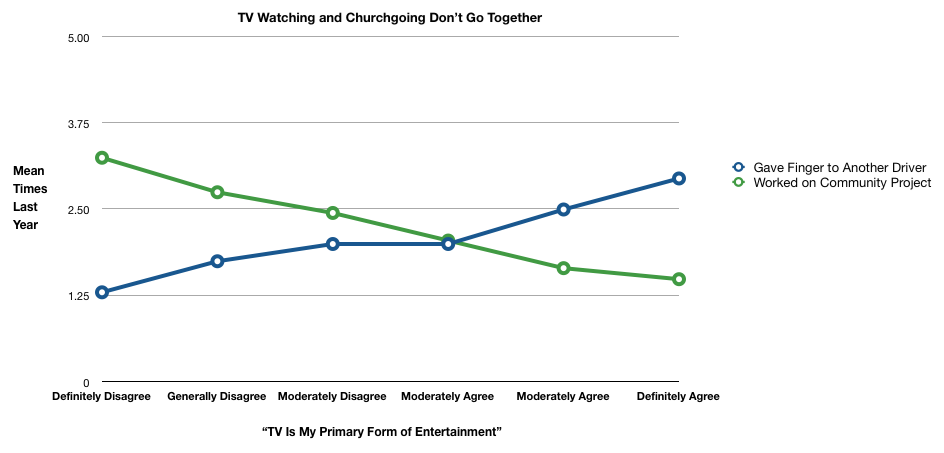
    Do people who are socially involved and people who highly value television have the same impolite driving habits?

    Optimists would say that these trend lines may be coincidental. Every generation has complained about the gradual coarsening of its citizens. Web-savvy optimists, such as myself, would also argue that television can degrade “connectedness” while more modern technology aids it. Keep reading this month for more perspectives on this question, to see if I am one such optimist.

  • Associate with Milwaukee interactive marketers at SWIG

    Join me and other members of the Milwaukee Interactive Marketing Association (MIMA) at our May Mixer. It will be held at SWIG, in the Third Ward of Milwaukee. It happens this Thursday, May 22.

    This event is a terrific chance to catch up with colleagues, learn a thing or two about our fast-changing field of interest, and celebrate the late arrival of summery weather — all at SWIG, a newly re-opened hot spot. Here is a map.

    Registration is just $15 for members, $20 for non-members. Register online from the MIMA site. And while you have your Paypal account or credit card in hand, why not join this wonderful grassroots organization.

    The festivities start at 5 PM tonight. I hope to see you there!

  • Add your own Twitter tactics and resources to this valuable list

    Marketing Sherpa ran an interesting piece on Friday on all things Twitter (thanks for the head’s up, Kevin). Its headline, Get Famous Using Twitter to Market Your Company & Yourself, is a tad grandiose, but the content is some of the densest I’ve read in terms of valuable ideas per word. Especially for marketers new to the medium, it’s an excellent overview and how-to.

    What the post left unsaid is the bad news: It’s still difficult-to-impossible to measure real ROI for a Twitter effort. That said, from an SEO and customer service perspective, Twitter is a great tool.

    Primarily, Twitter is a terrific way to measure the pulse of consumer sentiment — both cheaply and in real time.

    One tool mentioned that was news to me was this one: Twitter Volume, a way to “compare how often different brands/companies/words/phrases are mentioned on Twitter.”

    Conversely, a tool I love that wasn’t mentioned is this high-quality search of Tweets: Summize.com. The volume of Tweets returned is among the highest I’ve seen and the recency of the Tweets is also excellent.

    Any favorite Twitter-related tactics or tools that weren’t mentioned here, or in the Sherpa piece? Let me know.

  • Your web site should be like the world itself: Inviting and “flat”

    When Thomas L. Friedman asserted that The World Is Flat, he was referring to the interconnectedness of this newly networked world. He could have also been referring to the structure of an ideal web site. Why should it be flat? The site needs to offer a way for nearly everyone to efficiently find everything with the fewest possible barriers.

    Ryan Singer of 37Signals reminded me of this when he wrote that web architects should think about paths instead of hierarchies. He writes:

    My friend did some work for a shoe company who wished to hide six different kinds of shoes behind a gate called “Performance”. When my friend asked 40 uninvolved people in his office what the category “performance” meant to them, only 10 had even a vague idea. So hierarchies have their problems.

    My team’s web architects have often run into the same thing when beginning a redesign of a client’s web site. The language used in the architecture often hides what users are striving to find. Ryan’s solution is to, “Collect all the paths you can think of in a pile, pull out the 8 paths that 80% of your visitors come looking for, and that’s your home page. When paths overlap or the same customer needs them, weave them together.”

    I’d council to do the following, as a supplement to this excellent advice:

    1. Build your path list, to use Ryan’s term, by scrutinizing many a visitors’ navigation of last resort. Namely, look at behavior in your site’s search function. As I’ve mentioned earlier, mining your internal search data can reveal much about what your web site is hiding from user!
    2. Consider approaching the challenge in terms of audience, and not exclusively in terms of most popular pages (such as the eight paths accounting for “80% of visitors”). The reason? Your visitors may be leaving before they find some of your most popular content.

    Finally, I’d add this word of caution — three times, in fact: Test, test test! Your key audience may be of a generation where an indiosynchatic navigation system my more useful, but too initially initimidating. Baby boomers and their elders came from a time when hierarchy was not a dirty word. They may instead have a much shorter word for an elegant but unexpected site navigation: chaos!

    Have I missed any other tips in making a site as flat as the digital world where it resides?

  • Hey, Milwaukee, it’s pecha kucha! Let’s all go watch a slideshow!

    The media have called pecha kucha — that unpronounceable presentation format created by two Tokyo architects — a poetry slam for designers. Except it’s not just for design folks.

    Writers, photographers, and just about every other member of the creative class have devised and shown these six-minute wonders. Shown where, you ask? Over 100 cities around the world have conducted public pecha kucha nights. And this summer Milwaukee will be added to the list.

    I created my first pecha kucha in October and became immediately hooked. I dare you to attend its official Milwaukee debut and not be bowled over by its power.

    An audience at a recent pecha kucha event

    You’ll find more details at the official site, but here are the basics:

    WHEN 

    Tuesday, June 17th, 2008
    8pm; $10 register online or buy at door 

    WHERE 

    Hi Hat Garage
    1701 N. Arlington Place
    Milwaukee, Wisconsin 

    PRESENTERS 

    • Corey Canfield | Milwaukee Recycles (Kind Of)
    • Erica Conway | How a Woman Runs a Business
    • Tom Crawford | Kaszube Ornithological Concern International
    • Peter Exley | Growing Up in a Black and White World
    • Daniel Goldin | Dead Department Stores
    • Nicolas Lampert | Meatscapes: A Travel Log
    • Faythe Levine | Craftivism & Community
    • Aaron Schleicher | The Making of a True American Record
    • Jolynn Woehrer | Unwrapping Chocolate for its (Dis) Contents:
      A Feminist Analysis of its Fetishisms and its Fair Trade
    CREDITS 

    Hosted by 800ceoread at The Hi Hat Garage
    Promoted by 91.7 WMSE and Schwartz Bookshops
    Founded by Klein Dytham architecture

    Thank you Jon Mueller of 800CEOread for helping to bring this form to Milwaukee!