At least one other person had a video camera, so there will likely be other videos circulating. Want to try spotting them? Check out the buzz surrounding the event on Twitter, where they will undoubtedly be posted. Just search for the MKElikemind hash-tag (#MKElikemind).
Mark Your Calendar For the April 17th likemind
I received at least a dozen emails and direct messages from colleagues who couldn’t attend, and hoped to attend the next one. I’ll bet my co-organizer, Chris Moander, did as well.
That means the April 17 likemind will be just as varied and interesting as this first meet-up. So mark your calendar!
Kudos To Bucketworks
I need to give a special thank-you to the providers of the absolutely perfect setting for this type of event. Bucketworks, you’re the best!
Every year the TED conference introduces new and provocative ideas, many of which soon become commonplace. Two years ago, Jeff Han’s demonstration of multi-touch screens presaged the Microsoft Surface, and the first mass-produced multi-touch cell phone: the iPhone. These multi-touch screens are many things, but unencumbered is not an adjective that comes to mind.
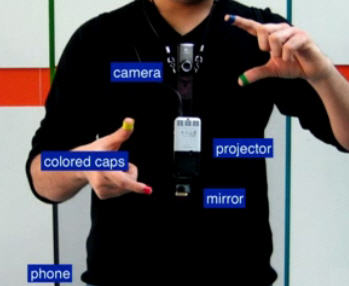
Even the iPhone requires you to hold a cell phone, which is a barrier for a lot of real-world applications. MIT Media Lab’s Pattie Maes explained the challenge at the latest TED conference. She said that, for instance, “If you are in the toilet tissue aisle of your supermarket, you don’t take out your cell phone, open a browser and go to a web site when you want to know which is the most ecologically sound toilet tissue to buy.” She and Pranav Mistry, also of MIT’s lab, have devised a potential solution to accessing this type of rich information in the real world. They call call this sort of computer interface their Sixth Sense. Here is the video of the computer demo.
The demonstration had the audience on their feet, cheering.
The components add up to only $350
Here you check your plane ticket to see if the flight is on time
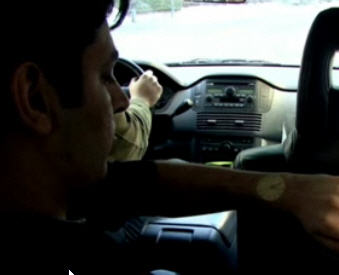
Checking the world’s most lightweight watch (assuming you’re in the shade!)
Here are three things I love about this concept, as crude as it currently is:
It’s cheap, light and small
It can very quickly become cheaper, lighter and smaller
With video recognition, the need for colored finger-markers will be unnecessary (so will logging in, since it will recognize its owner’s unique fingertips from anyone else’s)
Wearable computers have been talked about for decades, but this is the first user interface that is starting to make sense to me.
When Jeff Han’s concept of multi-touch computer interfaces was presented two years ago, my blog post was effusive about the possibilites. Someday we might be able to work standing up — more prone to both creativity and collaboration (please excuse the obscure pun). The biggest barrier to this future was that darned wall-sized screen. With the Sixth Sense device, any white wall becomes a screen — and an inviting whiteboard for one or more knowledge workers to play in.
Do you agree that this crazy contraption has a lot of possibilities?
Okay, so Austin isn’t really the “birthplace” of Twitter, but it was at the South-by-Southwest (SXSW) tech conference two years ago that Twitter was introduced to the technorati in a big way.
I recall reading blogger and anthropologist danah boyd’s posts about her frustration with the system (she had set her cell phone to receive every tweet from her hundreds-strong network — in real time). She later that year mused about its uses in a public conversation that first persuaded me to tinker with Twitter.
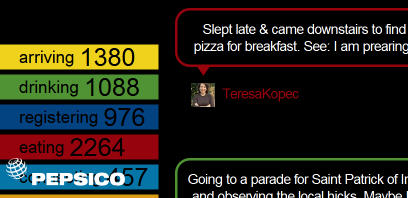
Now it’s two years later, and time again for SXSW to light up Austin. But this year Twitter, and social media in general, are far more mainstream. Pepsico is cashing in. Check out this tool for reporting on tech tweets from Texas!
Business-to-business (B2B) marketing executives may comfort themselves that they don’t have to think about social media because, “That’s for consumer products.” That excuse has just been exploded by Forrester Research. Although no one should storm into an uncharted jungle unprepared, Forrester advises that B2B marketers had better start donning their pith helmets and sharpening their machetes.
If you’re a B2B marketer and you’re not using social technologies in your marketing, it means you’re late. … [Although there are some strong b2b companies doing well in the social media space], a lot of the blogs, communities, and other social outreach from business to business companies is less than mature, to say the least.
This is your chance to stand out. Take this report and show it to your boss to convince her that it’s time to get started.
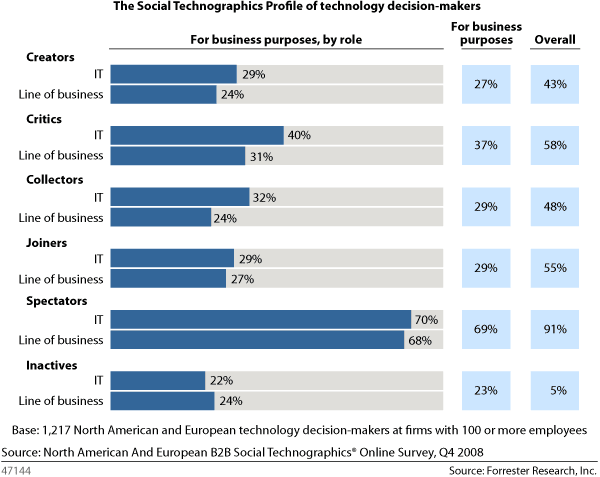
This chart shows the Technographics of the B2B buyers they investigated. Although they are an admittedly “plugged-in” audience (they are technology buyers for the most part), Forrester discovered that 91% of the group were Spectators, the highest percentage they’ve ever witnessed in a Social Technographics Profile.
Even the overall Creators (i.e., bloggers, forum posters, etc.) and Critics (those who use social media to rate products and post reviews) are quite high, at 43% and 58%.
The Takeaway
The way businesses buy is changing fast, and in the direction of ignoring the marketer altogether. Instead, they’re talking amongst themselves, in conversations that B2B marketers should ignore at their peril.
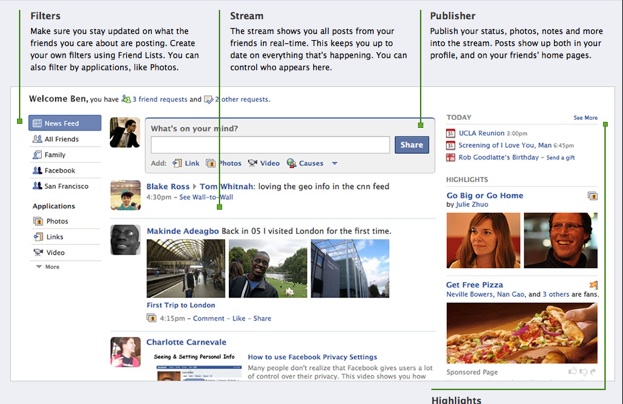
This morning I was part of a panel discussion, talking to the Greater Milwaukee Committee’s Insider Breakfast, held at The University Club. The topic was social media. One of the questions from the audience was (to paraphrase), “I know of MySpace, Facebook, LinkedIn, Twitter, etc., but the only one I am a member of is LinkedIn — and I barely know how to use that. How do I prioritize as I get my feet wet in them?” Panelists had varying opinions, but I opted for a one-word answer: Facebook.
Start with Facebook, I advised.
Others, notably GMC president Julia Taylor (whose Twitter presence is @JHTaylor) and Cd Vann (@ThatWoman_SOHO), “participating visionary” of SOHO|biztube.com, disagreed. They leaned more toward Twitter as a place to start. As much as I enjoy Twitter, and find it invaluable in my consulting business, I rarely suggest a client start there as a way to understand the experience. Here are my reasons:
4 Reasons Why Facebook Is A Better Set of Training Wheels
Twitter is too scary — Three weeks ago NY Times tech columnist David Pogue finally dipped his own toe into the waters of Twitter. Pogue began the column by saying, “I’m supposed to be on top of what’s new in tech, but there’s just too much, too fast; it’s like drinking from a fire hose. I can only imagine how hopeless a task it must be for everyone else.” This was his apology for being a “geek” and not being willing to face the ugly, 140-character beast that is Twitter. I feel for him. But more importantly, I feel for the clients who have to learn the arcane nomenclature of “re-tweets,” hash-tags and Twitter agents. When the panel discussion was over, I confided to Mary McCormick of the Rotary Club of Milwaukee that mere mention of Twitter causes most of my clients to go into spasms. I wouldn’t knowlingly wish that on anyone!
Twitter is too amorphous — The same quality that makes Twitter so popular also makes it a little too much like a multi-faceted, super-charged desktop application (think Excel) that is daunting specifically because it is so versatile. I find myself using Twitter for a lot of things, and this versatility can lead to early abandonment and disappointment (read the book The Paradox of Choice: Why More Is Less for how this veritable banquet we face can be psychologically overwhelming).
Facebook lowers the chance of a “crappy first experience” — Robert Scoble wrote that there is a barrier we’re facing today. It’s a “new digital divide.” The divide is between the folks who can swim easily in the social network pool and the “normal” people who refuse to or are afraid to dive in. Scoble writes that when these normal people get into a social network, “they enter a pretty lame environment since there are no friends … The first experience is a real crappy experience, since there’s no input. And it’s all about input from other users.” Facebook is more helpful than Twitter, and it’s easier to find a group of folks you can immediately “friend.” They can help you, and reduce the crap risk significantly.
Facebook is becoming more like Twitter by the week — Just this week Facebook announced new changes to their interface. They make this social networking site, which already has a version of “tweets” in their mini-feed feature, even more like its competitor for user attention and participation.
I think all of us on the panel would agree that if you are a business leader, you need to start personally leaping the chasm — the digital divide — to get a feel for the new communication medium. You need to give social media a try. If you choose Facebook, I’m here. If it’s Twitter, I’ll see you there too, at @TheLarch!