Opinions are all my own

  • Multi-touch table magic, courtesy of MS Surface

    Robert Scoble just posted this YouTube video of a demonstration of Microsoft’s Surface multi-touch tabletop monitor. Shot at last week’s Gnomedex, this video serves as a sneak preview of what this technology can do in a social setting.

    Last month I posted about the new Bokode barcode. One application I described to friends was its use on trade show floors. The barcodes would be worn on presenter name tags, and reveal much about the wearers to any conference attendee wielding a smart-phone camera (the link to the Bokode post is below).

    The MS Surface offers a different solution to the same challenge. It’s one of making the most of a networking opportunity. The tabletop displays the conference’s social graph, which can be manipulated and organized by anyone who steps forward and plops down their name tag.

    Making the most of conferences

    National conferences demand efficiency from its attendees. The cost in time and money is considerable, so many of us look at them as a competition to beat our personal best: How many relevant contacts can we make? How many friendships and business ties can we deepen? It’s all an effort to be efficient, and not fly home feeling we’ve overspent on a rare chance to make valuable face-to-face contacts.

    This strong networking benefit is what’s convinced me that Microsoft is on to something. I suspect the main challenge with their tables will be the over-crowding that takes place around them. Conferences providing this technology will be hard-pressed to have enough tables to go around.

    Related links:
  • Employers of marketing and PR pros are undervaluing a key skill

    Online newsroom specialists iPressroom recently surveyed businesses to see what sorts of skills they are looking for in their marketing and PR pros. The survey had a small sample size, as many of these do, and this report’s many charts read far more into the results than can be reliably concluded. But I credit its authors for noting something that jumped out at me as well:

    Rather than focus on attracting or pulling visitors to their website by publishing high quality content and researching popular language, organizations appear to be more interested with pushing out messages to “friends” through social media, even though, in many cases, those messages include hyperlinks back to their own websites. Until these organizations learn to develop a more sophisticated approach to building and managing landing pages and web content management on their websites, they will have difficulty evaluating their return on investment for these emerging channels.

    (Emphasis mine.)

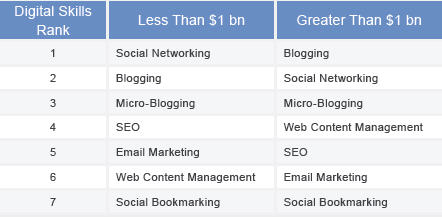
    I found this report by reading a trendy headline somewhere. It proclaimed that marketing and especially PR executives are expected to possess skills that most are still scrambling to master. Here is a sample chart showing the data behind this assertion:

    The digital skills expected of marketing and PR executives

    The employers surveyed should be commended for understanding the pressing demands of social media. However, they’re overlooking an equally important skill in their communications hiring checklist. They must hire people who understand the importance of good site content and how to measure its value. This is essential to making long-term gains from social media and search engine efforts.

    It’s not enough to know how to attract eyeballs. The owners of those eyeballs had better find something on a site that’s worth experiencing and sharing.

  • What b-to-b customer retention changes would YOU recommend?

    A friend with a successful b-to-b eCommerce business posed a simple question to me: “If you could only do one or two things for an ecommerce business (that sells actual products rather than a service or software or something) to increase customer retention, what would you recommend?” Here are my recommendations, in priority order. What are yours?

    1. Place your web address, with a compelling call-to-action, directly on the products being shipped. Make this call-to-action as time-sensitive as possible. Don’t be lame and do include a deadline. NO: “Fill out our warranty card online.” YES: “Set up an email reminder on our site so you’ll never forget to replenish. Do it by [date] and we’ll give you an automatic 10% off your next purchase, and free shipping!” Enclose a card reiterating the offer. This may be your last best shot at creating a repeat customer.
    2. Follow up your shipment with a “We’d like to know if your products are fitting your needs” email or letter. Include a customer satisfaction survey that rewards them with something they can use with an immediate order. If you’re using snail mail, naturally you should enclose a printed catalog. Draw their attention to related items that can be found within it (or if it’s an email, found on the eCommerce site). If possible make the effort self-financing by generating an immediate re-purchase. Use the Net Promoter Score (NPS)* methodology in the satisfaction survey, to track current loyalty for this customer and as a way to track overall likelihood to repurchase as a trend over time.

    Those are my recommendations. What are yours? Comments are especially welcome, for me and my friend.

    *I’m including this because, although NPS has fallen out of favor as a predictor of company growth, and in other ways is definitely not perfect, I agree with Dale Wolf in that I like its simplicity. You need to use something as a predictive baseline that can (hopefully) be compared with real loyalty measurements. The NPS methodology, associated with Satmetrix Systems, Inc. and Fred Reichheld, is good enough to do the job.

  • PPC landing pages start talking at the 200th click

    There’s a trick to conducting pay-per-click (PPC) campaigns on a shoestring. Larger campaigns buy popular keyword phrases. They consequently generate a torrent of clicks. Smaller campaigns, on the other hand, must make similar decisions success using a comparative trickle of data. So how do small-time marketers know when they have enough information to make reliable decisions?

    A good rule of thumb is to start trusting the results of a PPC landing page at about 200 clicks. That’s according to Tony Brewin, of SuperEvent in the U.K. His advice was part of a Wordtracker post on optimizing Google Adwords campaigns.

    This is coincidentally similar to the rule of thumb I’ve used in direct mail campaigns. For smaller mailings, direct mail veterans have known that you could start to be confident about results once you’ve received roughly 20 of them.

    A statistician friend once described these critical mass numbers as the thresholds where there is enough information to get simple yes / no answers about whether a campaign is succeeding. He compared them to when you watch a dot of light coming at you from a distance during an evening drive. This threshold is the point where you can first tell whether you’re seeing a single headline, from an approaching motorcycle, or from a car’s pair of headlights.

    It’s still a limited amount of information, but knowing what’s coming at you quickly and definitively can be useful both in driving and in direct response.

  • Take this test to see if you’re a Marketing Tactic Addict

    The world’s recent arms race has lessons to teach about modern marketing. The U.S. and Russia (then the U.S.S.R.) spent a fortune on new weapons during the Cold War, each afraid it would get trumped by the other in battle. Tactics — what weaponry to use — took priority over strategy — when and how to use them. Jonathan Schell’s book of that time chillingly described what was at stake: The Fate of the Earth.

    In spite of lessons from both ancient and recent history, folks who wage wars typically get hung up on gizmos. So do those who “wage commerce.” Are you addicted to tactics over strategy? Take this test:

    1. Can you list three narrowly-focused strategies for doing an end-run around your competitors? Give yourself one point for each, and add a point for each that uses “out-of-vogue” technologies or tactics, such as direct mail or email.
    2. Have you recently watched a competitor use a tactic and asked, “What’s their plan for using that?” Give yourself two points for looking deeply into the tactic. If instead of asking yourself that question, yours was “Cool! How can we get us one of those?,” dock yourself two points.
    3. Was your last strategy something you first imagined being executed using older or lower-tech methods, but they turned out too slow or costly? Give yourself one point.
    4. Do you find yourself, “Spending eight hours on tactics and five minutes refining your strategy?” (A tip of the hat to Seth Godin’s blog today for this one.) Take away three points.
    5. Finally, have you rejected a proposal lately because the authors didn’t do a clear job of linking their most gee-whiz tactics to the strategy you outlined in your RFP (request for proposal)? Give yourself three points. Conversely, if your RFP did not explicitly describe your strategy, subtract four points.

    Tally things up and pencils down. If your final score is less than three, you may be a Marketing Tactic Addict. If it’s a negative number, seek professional help. Addiction to the latest tactics — whether they’re social media ploys, video podcasts or whatever — are empty calories at best and brand poison at worst.

    Remember that the attack that brought our country temporarily to its knees didn’t come from a thermonuclear strike made by a hostile country. It came from a networked, amorphous group — one that sneaked into our infrastructure and turned it against us with explosive results.

    The enemy used nothing more than box cutters and a willingness to be martyred. It’s a chilling example of simple tactics aligned behind a killer strategy.