Opinions are all my own

  • Online eye contact triggers altruism

    This week I presented my C2 training course, Web Design & Content that Delivers ROI, at Proven Direct. One technique I discussed was the uncanny ability of a type of online graphic to attract attention (as measured by eye scan heatmaps) and move people to action. A lot of ads have used this technique, either intentionally or accidentally.

    The technique: Have a person in your ad look directly at the user.

    One example I gave was about a coffee station at a university with an “honors system” money collection jar. When the pricing sheet on the wall included the eyes of a person looking back out at the coffee drinkers, the money collected in the jar more than doubled, compared to weeks when the photo used was of a field of flowers. The photo could include any human, as long as the gaze was straight out.

    What’s more, apparently the gaze does not necessarily have to be convincingly human — instead, just human-like. The graphic you see to the right depicts an application of this is fascinating technique described in New Scientist magazine. Here’s the account, as I described it to my class:

    The researchers split the group into two. Half made their choices undisturbed at a computer screen, while the others were faced with a photo of Kismet — ostensibly not part of the experiment.

    The players who gazed at the cute robot gave 30 per cent more to the pot than the others. (Investigators Terry) Burnham and (Brian) Hare believe that at some subconscious level they were aware of being watched. Being seen to be generous might mean an increased chance of receiving gifts in future or less chance of punishment …

    Burnham believes that even though the parts of our brain that carry out decision-making know that the robot image is just that, Kismet’s eyes trigger something more deep-seated. We can manipulate altruistic behaviour with a pair of fake eyeballs because ancient parts of our brain fail to recognise them as fake, he says.

    Keep this in mind where you are seeking to design an ad or interface that you don’t want overlooked.

    If you’re in the Milwaukee or Madison areas, please be sure to attend my second course, presented by C2: Web Analytics That Clients Love. It will be held in Madison on April 27, and Milwaukee on May 11. Either of these presentations is just $69, but the Milwaukee course continues its $59 Early-Bird Pricing for another 12 days.

    I hope to see you there!
  • Search conversion lift seen from social media

    On Friday I gave a presentation in Chicago, at Loyola University, on social media and compliance. We covered many topics dear to the hearts of those who participate in social media and would prefer not to go to jail due to SEC or HIIPA violations. Left to other presenters was the topic of social media’s importance in today’s marketplace.

    It’s just as well that I left the topic out. Since most of the attendees were bloggers themselves (yes, more than half of them — I counted hands!), covering the importance of social media would have been preaching to the converted. But recent research, by GroupM and comScore, helps remind us all that some of the strongest reasons to engage in social media aren’t readily apparent.

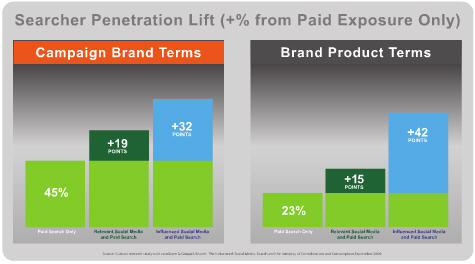
    The study showed that people using search engines who also use social media are “more engaged consumers” and “more likely to be looking for places to buy and brands to consider.”

    The research found that consumers using social media are “1.7 times more likely to search with the intention of making a list of brands or products to consider purchasing compared to the average internet user.”
    Here are more findings from the study:

    • Consumers exposed to influenced social and paid search exhibit 223% heavier search behavior than consumers exposed to paid alone
    • Fifty percent of social media-exposed searchers search daily for product terms, compared to 33% of non-exposed searchers

    And finally, this is the finding that I thought was most revealing: “In organic search, consumers searching on brand product terms who have been exposed to a brand’s social marketing campaign are 24 times more likely to click on organic links leading to the advertiser’s site than the average user seeing a brand’s paid search ad alone.”

    How much do you spend on paid search ads? This finding suggests to me that whatever you invest in pay-per-click advertising, you can reduce that cost or improve its reach by combining it with a well-planned social media engagement.

    Great post-presentation feedback

    After the presentation I met a ton of the audience members through Twitter. This is a group who really understands how social media can extend the value of a presentation! One participant, David Kamerer, had a great suggestion for a way to improve my compliance presentation. He suggested I add some content on the CANN-SPAM email marketing law. Thanks, @DavidKamerer, and the other folks attending the talk. I had a blast!

  • How to get non-Twitter users to tweet

    You’d think it would be impossible to get those who haven’t signed up for Twitter to get hooked on the immediacy and community of “tweeting.” You’d be wrong.

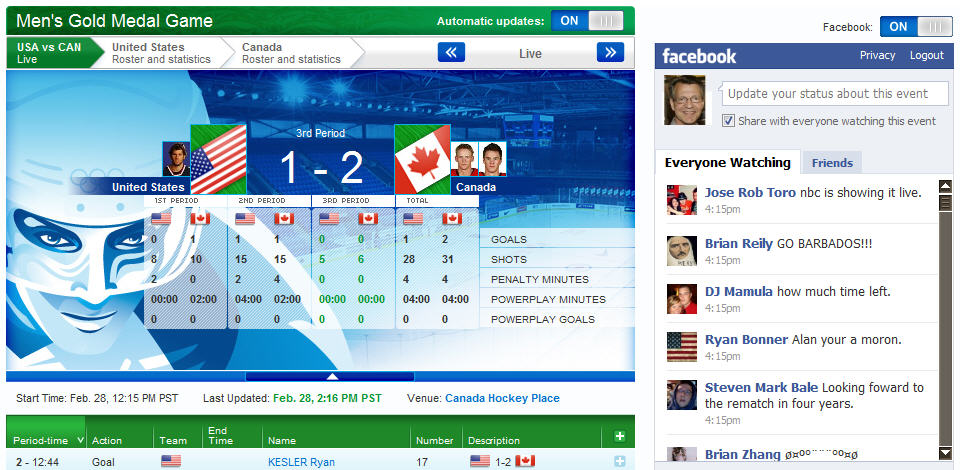
    Just now I wanted to watch the statistics while I had the USA – Canada Olympic Gold Hockey Game on the television. I logged into the official Winter Olympics site. I found paydirt — and a surprising real-time Facebook status feed. You can click the image for one that’s easier to read:

    What struck me about the Facebook feed is I didn’t have to log in. Since I already had Facebook loaded in another browser window, it immediately gave me the opportunity to add my own two cents to the cheering / jeering session. I didn’t, but I did find the flow of other people’s comments to be a fun addition to my solo enjoyment of the game.

    I’ve written before about how Facebook is a perfect set of social media training wheels for the newbie. This is more evidence.

  • Tuesday’s Milwaukee Pecha Kucha Night will blow you away

    Twenty slides, twenty seconds, 120 minutes of anarchy.

    That’s the promise behind the upcoming Pecha Kucha event, to be held at the Sugar Maple, on the corner of Lincoln and Kinnickinnic in Milwaukee. Judging from the names I recognized among the list of presenters, this PK Night should be the best yet.

    No Cover

    Yep. It’s free to get in this time. And because it’s held at the Sugar Maple, there will be a huge assortment of microbrew and imported beers.

    Pow? Free? Wow

    That’s right. The first 20 people through the door receives a copy of Andy Nulman’s Pow!

    Milwaukeans Watching a Pecha Kucha Presentation

    As Always, Diverse Topics

    Watch presentations that last no longer than seven minutes, on the following:

    • Green Homes
    • Coffee’s Global Impact
    • “I Don’t Dance, Don’t Ask Me”
    • Brewing Beer
    • “Novembeards”
    • The Three Brains of Humans

    … And much, much more!

    Presenters include James Carlson, Jim Chambers, Fred Gillich, Steve Hawthorne, Ryan Matteson, David Ravel, Winston Smith, Mike Brenner, Betty Blexrud-Strigens, and Jim Warchol.

    It all starts at 8 PM this Tuesday, February 23, 2010. I’ll be there. Will you?

    Pecha Kucha Milwaukee
    at The Sugar Maple
    441 E. Lincoln Ave.
    Milwaukee, WI

    As always, check in at the official Pecha Kucha Milwaukee site for updates!

    Related posts:

  • Why I joined HarQen

    Today was my first day as a HarQen team member. Although my title is Director of Client Services, I’ll be wearing many hats. What, you haven’t heard of HarQen yet? You can be excused. During its young life, the members of this lean start-up have built from scratch a set of web-based services in an entirely new category: Voice Asset Management (VAM). It is ambitious in the extreme — and leaves little time for a focused PR effort.

    That’s one place where I come in. I’ll be wearing many hats here, but two are social media “ambassador” and PR leader. I’ll be helping HarQen clients share their stories about these astounding services. Chief among those offerings is VoiceScreener, a way to vastly improve the quality and speed of hiring.

    I know from personal experience the value of the VoiceScreener VAM system. (Yes, VAM. There’s that acronym again. Here’s another for you: VaaA, which stands for Voice as an Asset.)

    In a previous life I was the defacto recruiter for the digital marketing team I led. One of the most grueling searches was when I was looking to hire a truly stellar project manager. VoiceScreener would have helped me, by inviting the dozens of applicants to answer a few guided questions over the phone — all at their convenience, talking to an automated “interviewer.” Answers are turned into the voice assets that can be quickly reviewed, sorted and forwarded — all as easily as processing emails.

    One VoiceScreener client brags that the application dramatically accelerates the preliminary phone interview process. He contends it literally doubles the odds that any given applicant is going to be hired. He’s with a large recruiting firm, where twice as many high-quality applicants means, over time, twice as much revenue for him and his company.

    Follow me and you’ll likely hear him tell you about it. All I’ll be doing is providing the megaphone.

    I’ll be posting fewer entries here, at DigitalSolid, as I focus on the blog at VoiceScreener. I hope you follow me over there. The category of VAM is about to heat up and I’d love to share my experiences in this exciting new adventure.