Category: Web Marketing

New ways to create and measure sites so they improve their ability to bring your best customers closer and attact other individuals just like them

  • Twiducate concept is too good to stay in the classroom

    Yesterday Naomi Harm give a keynote address at the Lake Geneva Schools Technology Academy, an educational event for elementary, middle school and high school teachers. Although I wasn’t at the event, word reached me about a social media-inspired educational platform called Twiducate. Similar to Yammer (“Twitter for intra-business communication”), Twiducate does not use the already overtaxed Twitter platform, but instead uses many of the principles that make Twitter so useful.

    I took a test-drive of Twiducate last night, and two things struck me. The first revelation I had became the title for this post; The developers of Twiducate will be hard-pressed to stop work groups other than classrooms from using the tool. The other revelation is about education reform. Yes, reform won’t happen on its own. But certain facets of it will happen naturally, “seeping in” from the emerging social media zeitgeist. Avoiding new teaching environments like Twiducate will be like holding back a rising tide.

    Here’s a video:

    So: Will the subversion of this tool be harmful?

    I think asking the question is moot. This type of thing will happen regardless. I’m thinking of at least two other examples of where a social network is forced to morph because of the unintended uses those pesky members decide to put it to.

    1. Fotolog.com started as a primarily photo-sharing site, similar to Flickr.com. But its meteoric growth in the last decade — especially in Chile, Argentina and Brazil — was due to users hopping on to connect and generally socialize. Sharing favorite pics became secondary.
    2. If the above sounds like dumb luck — like simply being in the right place with the right product (read: social toolset) — you’re right. And you’re also probably thinking of my second example. Although Mark Zuckerburg might posit that Facebook’s growth was all part of some master plan, we shouldn’t forget that he built it in his dorm, six years ago, as merely a “Harvard-thing” — primarily an easy way for him and others to organize study groups.

    Check out Twitucate. Do you agree that it’s more than education’s new “Moodle-killer?” Does it have “legs” beyond academia, and is that a good thing?


  • Jim Raffel to talk about business blogging strategy at Milwaukee Likemind

    As co-host of Milwaukee Likemind (search for #MKElikemind on Twitter), I never fail to enjoy the presentations. True, I help to choose the content … but take my word for it. I’m also constantly surprised by the fascinating twists and unexpected tangents these conversational events take.

    Haven’t you waited long enough to check one out? Here’s the information on next Friday’s event, from the MKE Likemind Posterous blog:

    Jim Raffel, CEO of ColorMetrix Technologies and blogger at JimRaffel.com, has some big ideas on how to improve your blog. At least, he has formulated and put into practice many ways to improve his own blog, and he has offered to share with you some of the best. Jim will be speaking at the July 16, 2010 Milwaukee Likemind, starting at 7:00 AM. …

    Even if you do not currently have a blog, or manage a blog for your business, Jim’s message is one you should hear. That includes:

    • If you don’t have a blog now, considering getting one
    • Consider your blog a way to advance your personal brand
    • The blog as an “ongoing job interview”

    “Twitter is great, but it’s microblogging. It gives you a chance to say what you’re thinking. But it doesn’t represent rich  ideas or insights” Jim said. “Your blog is where you can drive people to find out more about you.”

    The event will be held at Bucketworks, 706 5th St., Milwaukee, just north of National Avenue. Here’s a map.

    If you’ve heard Jim Raffel speak, you know what an engaged and exciting speaker he is. His blog is a new one that I’m following, and I’m finding the content valuable and well presented.

    I hope to see you in a week!

  • Dashboard liberation: Excellent Analytics moves Google application to Excel

    Although it’s easy to bash Microsoft, over the years a handful to tricks have made me an avid fan of Excel. Pivot tables and relational look-ups (all hail VLOOKUP!) are two arrows in my web analytics quiver. I’ve just added another. If you work in Google Analytics a lot, you should too.

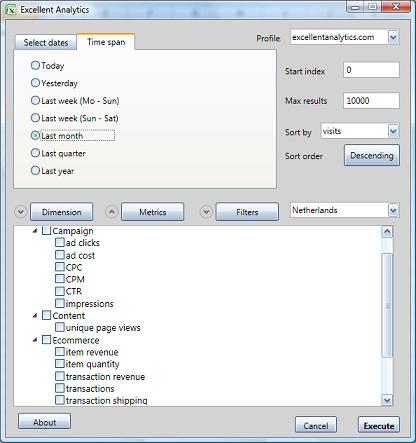
    Excellent Analytics is a free Excel add-in that truly lives up to its name. It allows you to run queries to Google Analytics’ API right from Excel, and publish its results there.

    Say goodbye to many of the “Save to Excel” hassles that used to come with wishing to share and chart Google Analytics results beyond its powerful-yet-limited dashboard.

    Go to Excellent Analytics now and give it a try. You’ll need Windows Vista or greater, Microsoft Office 7, and Windows .NET Framework 4. Give yourself a couple of hours to install and learn the system. Then start publishing, charting and sharing. You’ll fall in love the way I did!

  • Thoughts on Likemind: Guerrilla Marketing was easier back when it was harder

    Guerrilla marketing, a concept coined by Jay Conrad Levinson and made popular during a simpler pre-Internet age, was never as easy as it sounded. The Internet’s arrival as a marketing tool didn’t make guerrilla marketing less relevant. It did heap on potentially detrimental distractions.

    I was reminded of this when Jon Mueller announced the topic of his presentation, set for this Friday morning at Milwaukee’s June Likemind meet-up. The title is DIY: The Fine Line Between Building and Killing an Idea. Jon acknowledges that modern technology grants us unprecedented power to launch an idea or market a business. In some ways it’s a Utopia to the Jay Conrad Levinson of that long series of guerrilla marketing books. Each explored a different facet using guerrilla warfare tactics to out-compete bigger and better financed competitors.

    Jon’s talk will describe how technology has not made do-it-yourself (DIY) marketing necessarily more surefire. He’ll explore how digital marketing provides “distraction, an assumption of promise (if I use this, the result will be this), and a diminished true interaction between people.” In other words, the very technology that can be a DIY heaven can also be a marketer’s undoing.

    Since Jon is general manager of the business book giant 800ceoread.com, I’m expecting him to be citing business books like the Guerrilla Marketing series — but also more recent books on the perils of the Internet age.

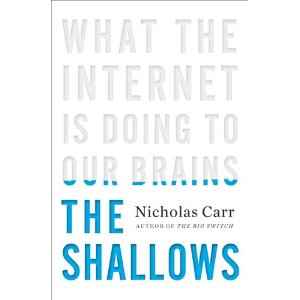
    Most notably, I’m expecting him to touch upon the new book by Nicolas Carr, The Shallows: What the Internet Is Doing To Our Brains, which just came out, and

    It contends that the web is changing how we think and make decisions — and not for the better. I hope you join Jon at the event. Here are the details. It’s free of charge, at 7 AM on Friday. It also may be outdoors, weather permitting!

    Finally, I’d like to brag about a one-degree-of-separation moment I had a few days ago. I met a co-author of two of the Guerrilla Marketing books. Al Lautenslager (a.k.a., @GMarketingGuy) is based in Appleton, Wisconsin. It was interesting to chat with someone who is keeping Levinson’s ideas current, as is evidenced by a smartly done and decidedly DIY marketing website. I hope we keep in touch, Al!

  • Online surveys as brand awareness Trojan horses

    Another offline marketing tactic goes online. For years, some face-to-face or phone surveys during election seasons have been used to start or intensify voter opinion. Most of us have heard of these tactics, but if you haven’t, here’s an example:

    “Hello, I’m doing research on the local senatorial race. Here’s our survey question for you: If you learned that Senator Jones, who is up for reelection, regularly terrified kittens, how would that influence your vote? And here’s our follow up question: What if you learned he was even meaner to cute little puppies?”

    Click to view the ad in contextOther surveys of this ilk are less nefarious, but they do have this in common: They claim to do one thing while accomplishing another. Think of them as Trojan horses, carrying awareness instead of seeking to measure it.

    I thought of this technique when I saw this online ad — er — I mean, survey.

    I have to say, it’s kind of brilliant.